Zerodha co-founder Nikhil Kamath’s new initiative for founders is raising eyebrows among India’s startup community.
Called The Foundery, the accelerator is a 90-day residency based in Alibaug. The first cohort consists of 26 founders who’ve been selected through a intensive selection process. The founders will be able to refine their ideas, and be mentored by some of the top names in their industry during their stay. But what’s drawn the attention of X are the details around the funding — the residency will take as much as 75% equity in exchange for an initial investment of Rs. 4 crore.
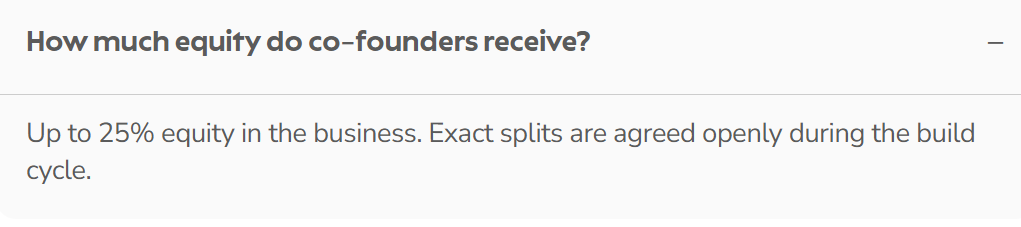
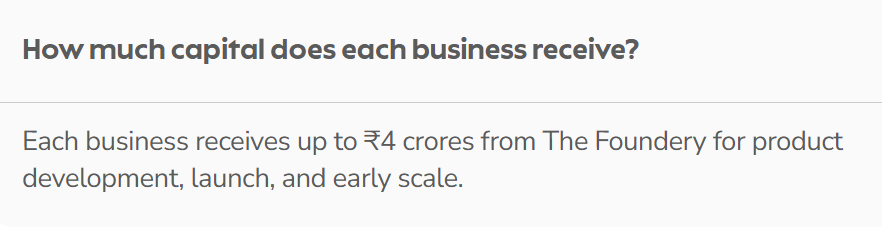
As per the FAQs on The Foundery’s website, co-founders will receive “up to 25% equity in the business”, with exact splits being agreed “openly during the build cycle”. “Each business receives up to Rs. 4 crore from The Foundery for product development, launch, and early scale,” the website adds.
This is unusual as far as startup accelerators go. Y Combinator, perhaps the best-known accelerator in the world, takes only 7% equity in exchange for a $500,000 investment. Techstars invests $220,000 in exchange for 5% equity, while 500 Global invests $150,000 for 6%. Peak XV’s Surge meanwhile discusses individual equity allocations on a case-by-case basis. For an accelerator to take 75% percent equity is almost unheard of in the startup world.
The onerous equity terms drew strong reactions on X. “Wait, they take 75% equity for $420k?” wrote a user.
Some commentated on how how much more equity The Foundery was taking compared to Y Combinator. “i never understood this. how can you give away (upto) 75% of your startup, that too at a nascent stage,” wrote a user.
Some called it a terrible deal for founders.
Others said that The Foundery’s offer was not really one of entrepreneurship, but that of a job.
And some others cheekily hinted that it was almost a scam.
It is indeed unusual for an accelerator to take such a large fraction of equity in businesses they fund. Under this structure, the founders are immediately minority shareholders, and will likely have lesser say in the running of their own business than the investors. Also, follow-on rounds will likely dilute their equity even further, making them smaller and smaller shareholders of their business.This will make it hard for founders to stay motivated in running their business, and will also make it tricky to hire good talent with so little equity left to give out. It remains to be seen how The Foundery’s cohort fares, but with Kamath taking 75% of equity on day 1, the companies really belong to investors than to the founders before they’ve even started out.