There’s an unusual line-up of investors on the cap table of SatSure, a Bengaluru-based space-tech startup. It isn’t Sequoia or SoftBank leading the round — it’s HDFC Bank, ICICI Bank, Kotak Mahindra Bank and TransUnion CIBIL, some of the largest financial institutions in the country, all writing cheques into a company that builds and launches satellites. That alone tells you something about what SatSure has managed to pull off: convincing conservative, risk-averse lenders that pixels from space can be as valuable to them as balance sheets.
SatSure is a full-stack Earth Observation (EO) company — it builds satellite payloads, analyses the imagery those satellites and other sensors capture, and turns it into decision-making tools for banks, insurers, agri-businesses, infrastructure players and governments. Founded in 2017, the company has spent the better part of a decade proving that data from orbit can answer very grounded, very Indian questions: has a farmer actually sown the crop they took a loan for, is a mortgaged property really there, has an irrigation canal silted up, is a construction project on schedule.
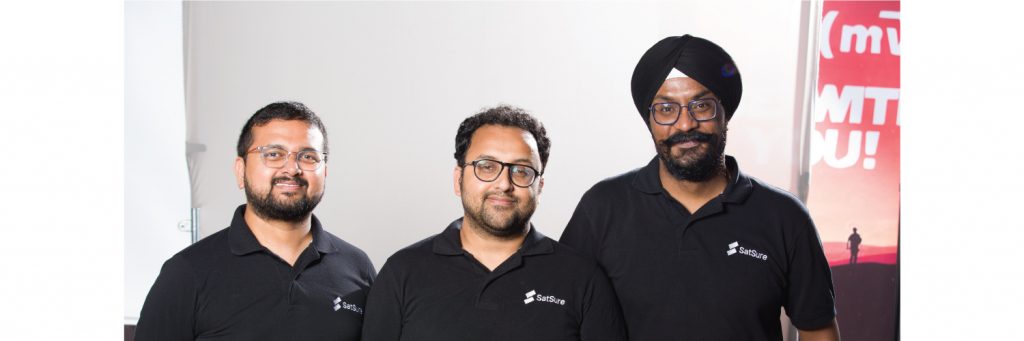
The Founders
SatSure was started by three IIST (Indian Institute of Space Science and Technology, Trivandrum) alumni — Prateep Basu, Rashmit Singh Sukhmani and Abhishek Raju — who bonded over a shared conviction that India’s still-nascent private space sector had a much bigger opportunity downstream, in analytics, than in building rockets.
Prateep Basu, Co-founder and CEO, is an aerospace engineer from IIST with a postgraduate degree in Space Studies from the International Space University in Strasbourg. He began his career as a liquid propulsion systems engineer at ISRO’s Satish Dhawan Space Centre, before moving into industry as a geospatial industry analyst at Boston-based Northern Sky Research (NSR), a firm known for its satellite industry market research.
Rashmit Singh Sukhmani, Co-founder and CTO, also trained at IIST before starting his career as a Scientist/Engineer at the Indian Institute of Remote Sensing (IIRS), an ISRO institute, between 2011 and 2013. He later picked up an MBA, giving him — in his own words — a mix of business and engineering training that let him bridge the technical and commercial sides of the company. At SatSure, he’s moved through nearly every product function — from leading satellite image analysis, to heading product management, to Chief Data Officer — before taking over as CTO in 2023.
Abhishek Raju was the third co-founder, and went on to lead the company’s international expansion as Head of EMEA before moving on from day-to-day operations; he remains an angel investor and continues to sit on SatSure’s cap table.
How It Started
The founders set up SatSure in 2017 with a simple but ambitious thesis: satellite imagery, once the preserve of defence and government agencies, was about to become cheap and abundant, and someone needed to build the analytics layer that would make it useful for mainstream industry. Agriculture — where India has hundreds of millions of smallholder farmers and a chronic shortage of reliable, real-time, ground-level data — was the obvious first wedge.
The company’s first real proof point came from a large private bank. Working with ICICI Bank on remote risk assessment gave SatSure its “foot in the door,” which eventually led to deeper work with ICICI and then HDFC. But breaking into the highly conservative world of agricultural lending and crop insurance wasn’t easy — insurers wanted proof that governments trusted satellite-based crop assessments, and governments wanted proof that insurers trusted them, a chicken-and-egg problem that kept SatSure stuck for years before a government order finally broke the deadlock. That opened the doors to insurers, banks, and eventually marquee private lenders.
What started as remote risk assessment has since grown into a much richer product: an agricultural stack built around “crop-stage digital twins” that monitor land parcels down to the individual acreage and yield level.
Products and Customers
SatSure’s flagship offering for banks and lenders is SatSure Sage, a suite that uses satellite data, location intelligence and machine learning to help lending institutions verify crop cultivation, assess credit risk for farmers who have no formal credit history, and monitor loans after disbursement. In 2022, it partnered with TransUnion CIBIL to launch the CIBIL Credit & Farm Report (CCFR), which combines a borrower’s credit history with satellite-derived crop and land insights into a single report for lenders.
Its customer and investor base overlaps in a way that’s rare for a startup — HDFC Bank, ICICI Bank and Kotak Mahindra Bank are simultaneously clients and strategic investors, having concluded that owning a piece of the company made sense given how central its data had become to their agri-lending operations. Internationally, SatSure has partnered with Netherlands-based Rabo Partnerships (a Rabobank subsidiary) to bring cash-flow-based lending tools to smallholder farmers globally, and has worked with Kenya’s agricultural research body KALRO on agri-transformation projects. The company counts customers in more than ten countries today. Beyond banking, its analytics are also used across insurance, infrastructure monitoring, utilities, forestry and aviation.
Building Its Own Satellites
Rather than remain purely a downstream analytics company dependent on third-party imagery, SatSure decided to go upstream and build its own satellites — a fairly unusual move for a startup that started life as a data-and-software company. It set up KaleidEO as a subsidiary to develop the payloads, staffed by a team of young ex-ISRO scientists.
KaleidEO is building a constellation of four microsatellites designed to operate in Very Low Earth Orbit (around 380 km altitude), carrying optical and multispectral imaging payloads (OPT-120 and OPT-70) that can deliver 1-metre resolution imagery across a 65 km swath in six spectral bands. The pitch is to cover the globe with just four satellites instead of the 12-14 typically required by commercial constellations, by innovating on swath width. The launch timeline has slipped — originally targeted for Q4 2025, it was pushed to 2026 as the team decided it needed more time on technology development and integration rather than rush the launch.
KaleidEO has also tied up with Helsinki-based ReOrbit and Bengaluru’s Dhruva Space, with SatSure and KaleidEO contributing payload technology and downstream analytics to a broader partnership aimed at building full-stack EO capabilities. In a significant vote of confidence in India’s private space sector, SatSure was named part of a consortium led by Pixxel Space (alongside PierSight and Dhruva Space) that won a roughly ₹1,200 crore contract from IN-SPACe under the Earth Observation Public-Private Partnership (EO-PPP) programme, to help build India’s first fully indigenous, privately-built 12-satellite EO constellation over the next several years — with SatSure contributing two satellites built around its KaleidEO imaging technology.
Funding
SatSure has raised close to $29 million across multiple rounds since its early angel funding, from a mix of institutional and strategic investors. Its Series A round, closed in August 2023, brought in $15 million in equity and venture debt, led by Baring Private Equity Partners (BPEP) India and Chicago-based deep-tech investor Promus Ventures, with participation from Omidyar Network India and xto10X. The funding was earmarked to keep SatSure’s plan to launch its fleet of four high-resolution satellites on track, and to expand operations across the Americas and Asia-Pacific.
What stands out is the investor register itself: alongside typical venture funds, SatSure counts its own banking customers — HDFC, ICICI Bank, Kotak Mahindra Bank and TransUnion CIBIL — as strategic shareholders, along with ADB Ventures and others. It’s a structure that’s unusual for an early-stage deep-tech company, but one that reflects how tightly SatSure’s product has been built around the needs of Indian financial institutions.
Where It Stands Today
SatSure now employs somewhere in the range of 130-160 people and operates out of Bengaluru, with a growing international footprint. Revenue estimates from third-party trackers put the company in the low double-digit millions of dollars annually, driven largely by its banking and agri-finance products, alongside government and infrastructure contracts.
For a sector that in India has mostly been associated with ISRO’s headline-grabbing missions — Chandrayaan, Mangalyaan, Gaganyaan — SatSure represents the quieter, commercial side of the story: the idea that the real money in space isn’t necessarily in the rocket, but in what you do with the picture it beams back. With its own satellites now on the runway for a 2026 launch and a growing roster of bank and government partnerships, SatSure is betting that Earth Observation can be as fundamental to Indian finance and infrastructure as credit bureaus and land records have been.