Stock market futures and options trading continues to be a high-risk option for Indian retail users.
A new report by the Securities and Exchange Board of India (SEBI), titled “Profitability of Individual Traders in the Equity Derivatives Segment (FY25–FY26)”, shows that 87.7% of individual traders in India’s equity derivatives segment (EDS) ended FY26 in the red, incurring an average loss of Rs. 1.17 lakh. While this loss-making percentage is an improvement from the 90.9% recorded in FY25, the average loss per person has actually gone up, from Rs. 1.13 lakh to Rs. 1.17 lakh, a rise of 2%.
Individual traders, as defined in the report, include retail and HNI traders — resident individuals, Hindu Undivided Families (HUFs), Non-Resident Indians (NRIs), sole proprietorships, and individual investors under Portfolio Management Services (PMS).
Fewer Traders, But Bigger Losses For Those Who Stayed
The report paints a picture of a market that’s shrinking in participation but not necessarily getting safer for the individuals who remain. Active individual traders in the EDS fell 18% year-on-year, from 106.2 lakh in FY25 to 87.5 lakh in FY26 — the first such decline since FY16.
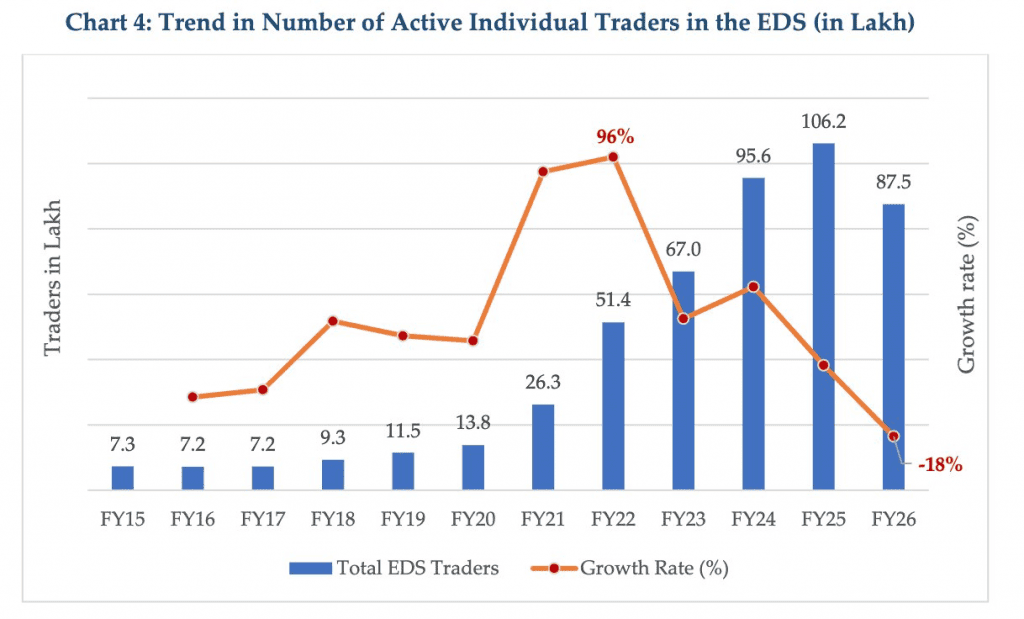
New trader entries also dropped sharply, down ~40% to 20.8 lakh in FY26 from 34.3 lakh in FY25, and well below the FY24 peak of 43.1 lakh. At the same time, exits accelerated: nearly 46 lakh traders who were active in FY25 didn’t trade at all in FY26, a 76% jump from the 26 lakh who exited the year before.
SEBI notes that the pullback was sharpest among smaller traders, particularly those with annual turnover below Rs. 10,000, suggesting that casual, low-stakes participants are the ones most likely to have walked away.
Aggregate Losses Fell, But Options Still Dominate The Damage
In absolute terms, the news is less grim than in previous years. Aggregate net losses across individual traders declined 18% to Rs. 91,685 crore in FY26, down from a revised Rs. 1.12 lakh crore in FY25. However, that improvement is almost entirely a function of fewer people trading, not fewer people losing money on a per-person basis.
Options trading alone accounted for 92% of all aggregate individual losses in FY26. The share of loss-makers in options stood at 87.7%, notably higher than the 66.0% loss-maker rate in futures. Losses also remain heavily concentrated: about 23% of traders accounted for nearly 90% of total losses.
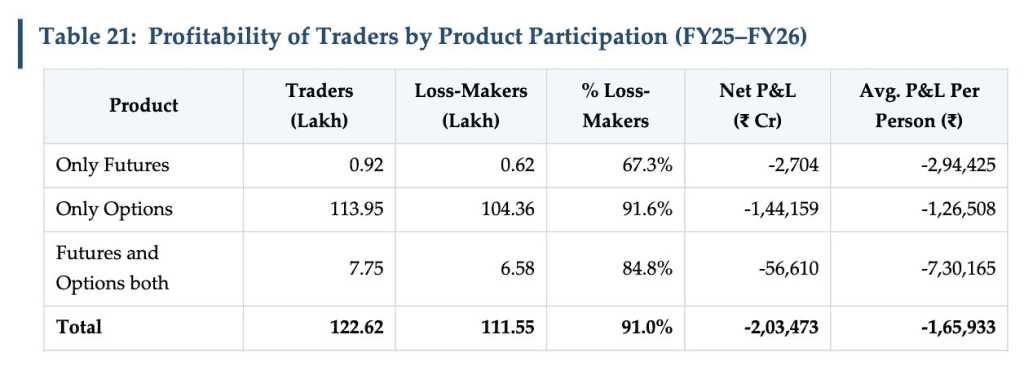
The asymmetry between winners and losers is stark. The average loss among loss-makers was Rs. 1.47 lakh, compared to an average profit of just Rs. 1.22 lakh among profit-makers — meaning the typical loss was 21% higher than the typical gain.
Turnover Growth Has Slowed Sharply
Beyond individual profitability, the report also flags a broader slowdown in the equity derivatives segment itself. Notional turnover grew just 4.2% in FY26, compared to 20.4% growth in FY25. Futures activity actually contracted by 15%, while Options premium turnover grew a modest 7%.
The deceleration in Options growth has been building for a few years now — from 73% in FY23, to 31% in FY24, 14% in FY25, and now just 7% in FY26. Within this, Index Options was the only bright spot, growing 9%, while Index Futures (-16%), Stock Futures (-15%), and Stock Options (-10%) all declined.
A Familiar Pattern, With Regulatory Fingerprints On It
This is far from the first time SEBI has flagged the risks of retail participation in F&O trading. The regulator’s earlier studies found that over 90% of individual traders lost money in FY22 and FY24 as well, and India’s derivatives boom coincided with a surge in retail participation through low-cost trading apps — a trend that helped platforms like Groww overtake Zerodha as India’s largest broker by active client count, even as most users on these platforms hold relatively small amounts of capital.
SEBI has introduced a series of measures since October 2024 aimed at curbing speculative activity in F&O — including limiting weekly expiries, increasing lot sizes, and tightening position limits — and this latest data suggests those measures are having some effect on participation and aggregate losses. But the fact that average losses per trader actually rose in FY26, even as the market shrank, indicates that for the individuals who continue to trade derivatives, the risk profile hasn’t meaningfully improved.