India’s real-estate transactions continue to break records.
Bengaluru-based Embassy Developments has signed an MoU to sell an entire residential tower at its ultra-luxury Juhu project to Dinesh Thakkar, founder, chairman and managing director of stockbroking giant Angel One, in what the company is calling the largest single residential unit transaction in the country.
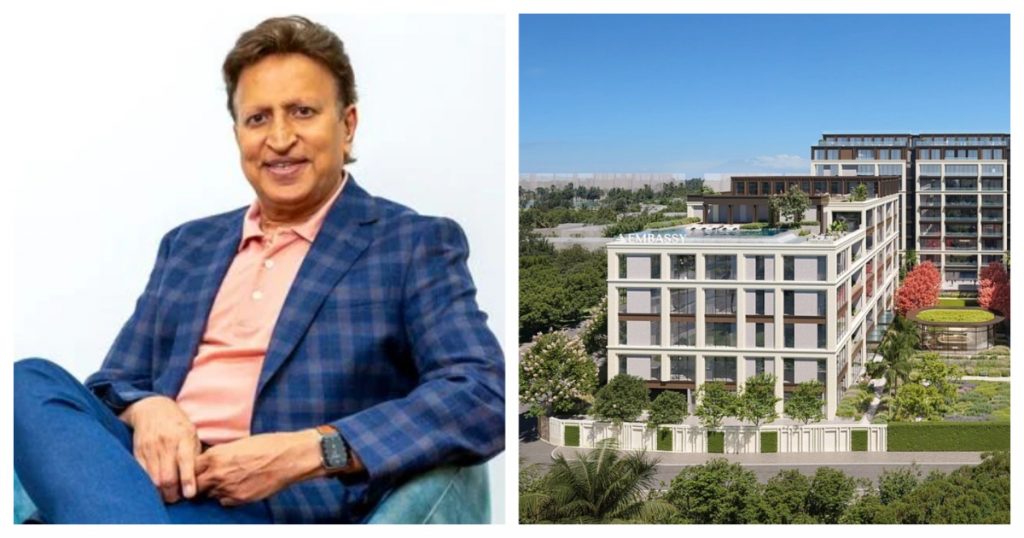
The residence is a G+7-storey tower at Embassy Terazza on Juhu Tara Road, with a RERA carpet area of 63,000 square feet, at a transaction value of approximately Rs 711 crore. That works out to roughly Rs 1.13 lakh per sq ft on carpet area — not India’s steepest per-square-foot rate (several Worli and Malabar Hill deals have crossed Rs 2 lakh+ per sq ft this year), but the sheer size of the unit is what pushes the total value to a national record.
Embassy Terazza is an ultra-luxury, low-density development spread over more than two acres, with about 50 residences and an estimated Gross Development Value of over Rs 3,000 crore. Thakkar’s single tower alone accounts for roughly 24% of that entire GDV — effectively, he’s bought a quarter of a marquee project in one shot.
Thakkar has named his new home “Angelus.” Explaining the purchase, he said his focus was on privacy, space, sea views, and creating a luxurious, iconic sanctuary that would become our family home. Embassy Group chairman Jitendra Virwani framed the deal as proof of the developer’s three-decade-long read on what today’s ultra-wealthy homebuyers actually want.
This isn’t even the priciest home story of the year — that title still arguably belongs to entrepreneur Manav Sardana, who bought India’s costliest single apartment for Rs 271 crore just last month. But Thakkar’s purchase is different in kind: it isn’t one apartment, it’s an entire building, making it the largest transaction by total value that India’s residential market has ever recorded.
Who Is Dinesh Thakkar?
Long before he was buying towers, Dinesh Thakkar was building one brick-by-brick — the metaphorical kind. In 1996, Thakkar started a stock broking company, Angel Broking, from a small office in Mumbai, at a time when investing in India was largely inaccessible to ordinary people and trades were routed through physical terminals and paperwork-heavy broking offices. What set the firm apart in Thakkar’s own telling was a reaction to the industry itself: the lack of ethics and transparency in stockbroking pushed him to build something that was transparent, technology-led, and customer-friendly.
That bet on technology is really the spine of the Angel One story. The company went public in 2020 as Angel Broking and was renamed Angel One in 2021, as it repositioned itself as a full-stack fintech platform rather than a traditional broking house. It hasn’t been an entirely smooth ride — the company was briefly restrained by SEBI in 2013 — but the pivot to digital-first broking paid off enormously. Angel One’s profit jumped from Rs 82 crore in FY20 to Rs 625 crore in FY22, and for a brief stretch in April 2022, Thakkar’s stock holding pushed him to the edge of billionaire status — the richest anyone in India has gotten purely off stockbroking.
The scale today is substantial: Angel One’s client base crossed 38 million in May 2026, up nearly 20% year-on-year, and the company posted revenue of over Rs 4,272 crore and net income of over Rs 1,126 crore in FY24, with revenues climbing further since. It’s now counted among India’s top listed retail brokers by active client count, in the same conversation as Zerodha and Groww. Angel One has also leaned hard into AI — Thakkar has spoken of using technology, data and AI to bridge the gap for underserved investors as the company pushes into Tier 2 and Tier 3 markets.
Thakkar holds roughly an 18% stake in Angel One, and his net worth has been pegged at around $586 million as of mid-2026 — a fortune built entirely on the business of helping other Indians invest theirs. The Rs 711 crore Juhu tower is, in that sense, less a departure from the story than its logical punctuation mark: three decades of digitising Indian stockbroking, capped off with the single largest home purchase the country has ever seen.