It appears that spending time trading doesn’t really help one’s chances in the Indian stock market.
A new report by the Securities and Exchange Board of India (SEBI), titled “Profitability of Individual Traders in the Equity Derivatives Segment (FY25–FY26)”, shows that prior trading experience does little to improve a trader’s odds in the equity derivatives segment (EDS). In fact, the data suggests the opposite — the longer someone trades, the more likely they are to keep losing money, and the bigger those losses tend to get.
New Traders vs Regular Traders: Nearly Identical Loss Rates
SEBI’s report splits traders into two categories: “new traders”, who are trading in the derivatives segment for the first time since FY22, and “regular traders”, who have traded in at least one previous year since FY22 and continued trading in the year being studied.
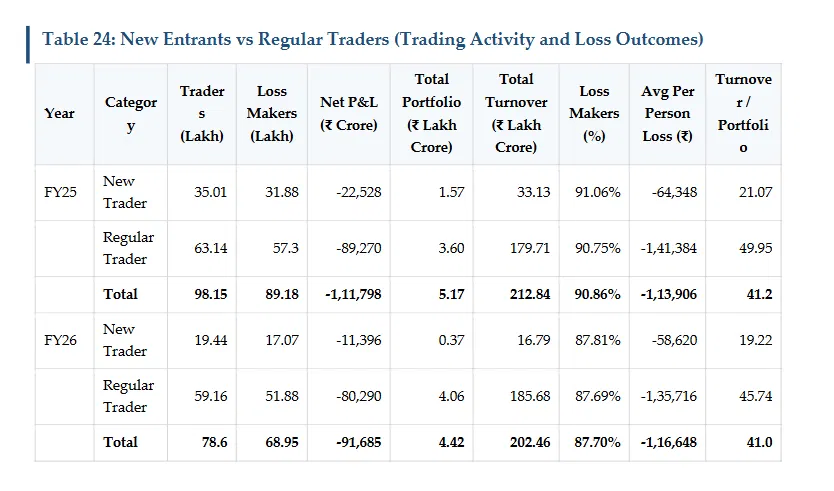
In FY26, 87.81% of new traders ended up with net losses, compared to 87.69% of regular traders — a statistically negligible difference. The pattern held in FY25 too, when around 91% of traders in both categories lost money. In other words, whether someone was trading in the derivatives market for the first time or had been at it for years, their chances of losing money were more or less the same.
Where the two groups diverge sharply is in how much they lost. In FY26, the average net loss per regular trader stood at Rs. 1,35,716, more than double the Rs. 58,620 average loss for a new trader. The same gap showed up in FY25, with regular traders losing an average of Rs. 1,41,384 against Rs. 64,348 for new traders.
Regular traders also did the bulk of the damage in aggregate terms. They made up 75% of all traders in FY26 but accounted for 92% of total turnover and 88% of total net losses. In FY25, regular traders were 64% of the trader base and contributed 84% of turnover and 80% of net losses.
More Experience, More Exposure
Part of the reason regular traders lost more comes down to how aggressively they traded relative to what they actually owned. In FY26, regular traders’ average turnover was about 45.7 times their portfolio value, compared to 19.2 times for new traders. In FY25, that ratio stood at roughly 50 times for regular traders versus 21 times for new traders.
New trader participation itself collapsed in FY26, falling from 35.01 lakh in FY25 to just 19.44 lakh. Their share of the overall trader base dropped from 36% to 25%, their share of total turnover fell from 16% to 8%, and their share of total net losses shrank from 20% to 12% — a sign that fewer first-timers are entering the derivatives market, and those who do are trading more cautiously than in previous years.
The Longer You Trade, The Worse The Odds Get
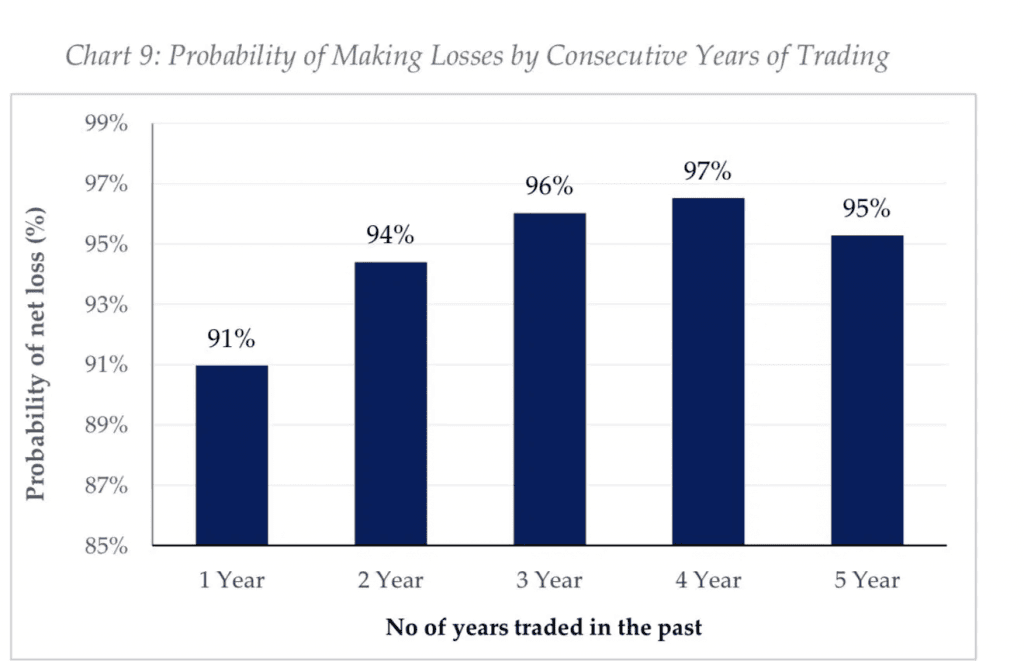
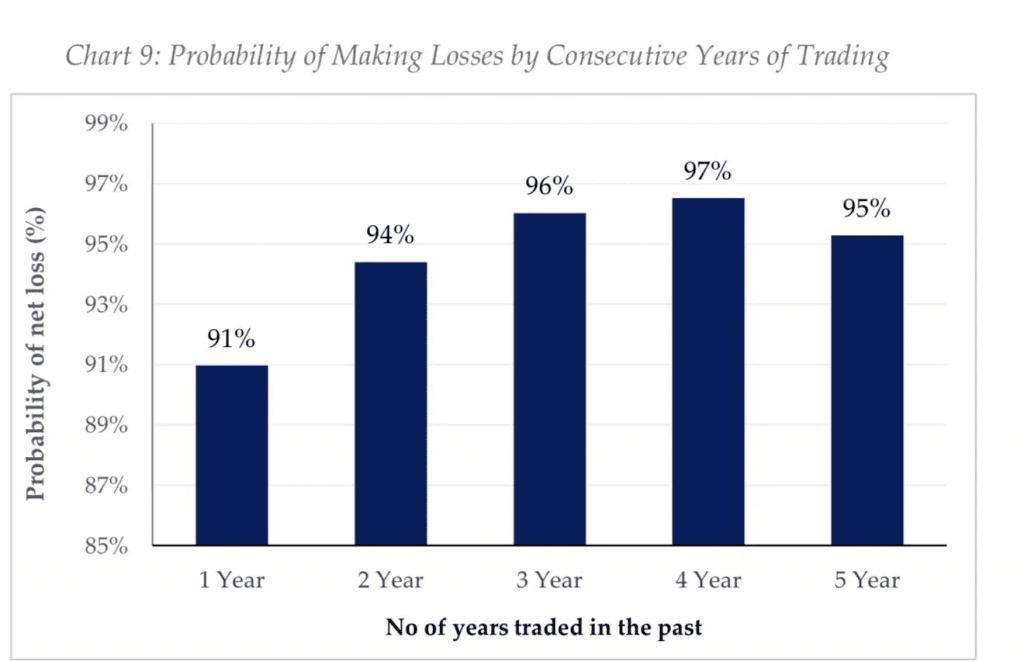
A separate breakdown in the report, tracking traders by how many consecutive years they’ve been active, reinforces this pattern. The probability of a trader making a net loss actually rises with experience: it’s 91% for someone trading for just one year, climbing to 94% after two years, 96% after three years, and peaking at 97% after four consecutive years of trading, before dipping slightly to 95% at the five-year mark.
Age also plays a role, though in the opposite direction. The share of loss-makers is highest among traders under 30, at 91.9%, and steadily declines with age — falling to 90.6% for the 40-50 age group and 83.6% for traders over 60. This suggests that older traders, who may bring more caution or financial discipline to their trades, tend to fare somewhat better than younger ones, even if losses remain the norm across every age bracket.
A Pattern That’s Held For Years
These findings track with what SEBI’s earlier reports have already suggested about India’s booming retail derivatives market — that continued participation, even after repeated losses, is common. A previous SEBI study had found that more than three-fourths of loss-making traders kept trading in F&O despite losing money year after year, a dynamic that has helped fuel massive growth for brokers like Groww, which overtook Zerodha to become India’s largest broker by active clients, even though most of these users hold relatively small amounts of capital on these platforms.
Taken together, SEBI’s latest data paints a fairly stark picture: neither being new to the market nor having years of trading experience seems to meaningfully improve an individual trader’s odds in India’s high-risk equity derivatives segment.