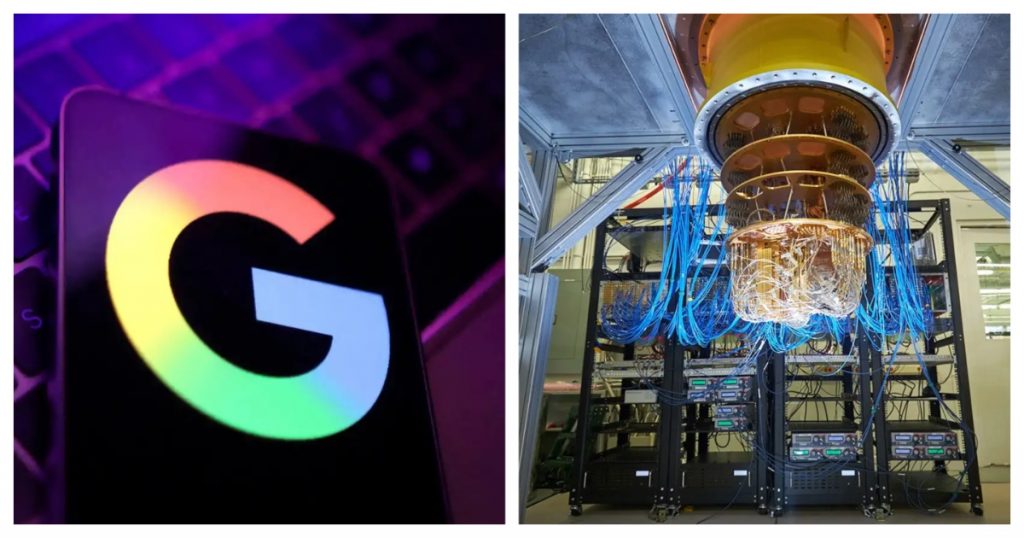
Google Quantum AI has pulled off a feat that researchers have been chasing for two decades — making “magic states” cheaply and reliably on real quantum hardware, cutting errors by roughly 40x in the process.
The result, published in Science, tackles what’s long been considered one of the most stubborn resource problems in quantum computing. Google CEO Sundar Pichai called it “magical progress” in a post on X, adding that the team had achieved a state-of-the-art 99.99% logical fidelity on its Willow processor.
Why “Magic States” Matter
To run the kind of quantum programs that actually go beyond what classical computers can do, a quantum computer needs to execute a specific set of error-corrected operations. The way to get there is by building “magic states” — special quantum states that unlock those operations.
The catch is that producing clean, error-corrected magic states is brutally expensive. Google notes that some estimates suggest up to 95% of a quantum computer’s entire capacity could end up going toward manufacturing these states alone, leaving very little room for actual computation. Making things worse, each magic state can only be used once before it’s discarded, so a quantum computer needs a constant, reliable supply of them.
Researchers have been trying to drive this cost down since 2004.
How Google Did It
The breakthrough traces back to 2024, when Google Quantum AI researchers Craig Gidney, Noah Shutty and Cody Jones built on an existing idea in the literature and developed a technique they call “magic state cultivation.” The approach works like a filter — a noisy state gets injected into a small region of the chip, and a sequence of coordinated measurements screens out errors and discards flawed attempts, “growing” a much purer state in the process.
Turning that theory into working hardware wasn’t straightforward. At one point, research scientist Emma Rosenfeld ran into data that appeared to violate the laws of physics, a mystery that took months of simulations and cross-checks to untangle. The team eventually traced it to electrical and temperature drift in the lab that was throwing off their benchmarking method, forcing them to build a new benchmarking technique that used cultivation to measure itself.
The payoff was worth it. On the Willow processor, the cultivation protocol delivered a 40-fold reduction in errors compared to uncultivated states, with T-states hitting a record logical fidelity of 99.99%.
What’s Next
Google also demonstrated that purified states could be transferred between two different types of quantum error correction — “color codes,” which suit cultivation well, and the more established “surface codes” — without losing their integrity, grafting a result from a smaller color code onto a larger surface code.
The company is clear that this isn’t the finish line; scaling magic state cultivation up further remains a significant engineering challenge. But it marks one more step in Google’s broader quantum roadmap, following its Quantum Echoes algorithm that claimed a verifiable quantum advantage on Willow last year, and the original Willow chip launch that first got the industry talking about Google’s error-correction gains.