Kunal Shah hogged headlines yesterday when he was appointed WhatsApp’s global leader, but the move likely didn’t come from out of the blue — Shah has always had plenty of ideas for WhatsApp, and he’s been sharing them on X over the years.
Kunal Shah is a prolific X user, and has regularly shared his opinions, insights, and even suggestions on how WhatsApp should be run. All the way back in 2018, when WhatsApp had just launched UPI payments in India, Shah had run a poll asking people when they thought WhatsApp would become the top UPI app in India. As many as 53% of the respondents thought that it would only take a few months, but as it turns out, nearly a decade later WhatsApp is nowhere in the picture in UPI payments.
He’d also shared a product idea for WhatsApp which involved bill payments all the way back in 2018. “Imagine in future telcos and utilities sending you a WhatsApp notification to remind you of low balance or due bills and you can simply approve using UPI in one click and voila recharge or bill payment done,” he had said.
He’d even claimed that existing UPI apps would try to brand WhatsApp as anti-national to compete against it. That never came to be, because WhatsApp never really threatened payment companies as its payments feature never saw much adoption.
He’d also been bullish on WhatsApp’s potential, particularly when paired with UPI.
He’d also astutely commented on how users from different demographics used WhatsApp.”Older people are chatting on WhatsApp like they’re writing a letter. Younger people are talking in real life like they’re chatting on WhatsApp,” he’d said in 2018.
Shah, who has a degree in Philosophy, had theorized about why WhatsApp would continue to be ubiquitous. “Chat messengers are like human language. They spread based on how open or closed are your nations borders. Languages can extend from communication to many other things with the intention of the owner of the language. English/Whatsapp are more ubiquitous by conscious spreading,” he’d said.
He’d also talked about “spam” messages on WhatsApp of the ‘good morning’ variety. “What you call as WhatsApp spam, is a way to feel important/less lonely for most,” he’d said.
He’d seemed concerned around the amount of spam that was on WhatsApp, hinting that all the spam could be an opportunity for a spam-free app to garner market share.
He’d also commented on the lock-in aspect of WhatsApp, talking about how hard it was to leave the service. “Trying to leave Whatsapp is as futile as adopting a new language to communicate between same folks. Feels cool for first 7 days like first week of a new year at the gym,” he’d said.
He’d theorized on how WhatsApp groups evolve over time. “All large whatsapp groups eventually regress to mutual admiration club,” he once said.
Shah had been closely keeping tabs on how payments were progressing on WhatsApp, running another poll in 2018 around how often people were using payments on the platform. Over 70% of respondents said they’d never tried it, which broadly mirrored the overall lukewarm reception to the feature.
But in spite of the low usage of WhatsApp’s payments feature, Shah had been predicting that it would eventually become the payments app of choice for India. “WhatsApp was the last to launch stickers amongst messaging players. WhatsApp maybe last to launch payments. The beauty of products with large distribution and network effects is that you can turn any product into your feature at will and win,” he’d predicted.
He’d also toyed around with some pretty out-there ideas for WhatsApp. In 2019, he’d wondered if WhatsApp could launch a cab service like Uber and Ola.
And he had another idea of WhatsApp launching business loans.
While WhatsApp was struggling to take off its payments feature in India, Shah remained bullish on it. In 2020, he’d predicted that WhatsApp payments was “ready to explode”.
By late 2020, he was still sticking to his theme of WhatsApp payments becoming a major product. “Whatsapp payments if used to pay someone in a whatsapp group will spread faster than COVID due to mimesis,” he’d said.
By 2021, he was still checking in on whether people were adopting WhatsApp payments, and an overwhelming majority continued to say that they weren’t.
In 2022, he was still bullish on WhatsApp payments, and felt that once regulatory hurdles were cleared, the company would grab most of the market.
He continued asking the question in late 2022, receiving similar responses.
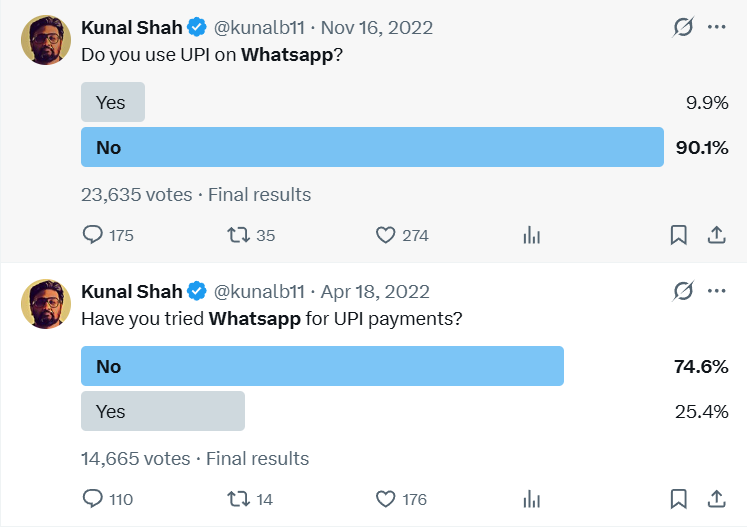
Shah seemed to have given up on WhatsApp payments post 2022, as it became apparent that PhonePe, Google Pay and Paytm would be impossible to dislodge. But as WhatsApp’s new global head, Shah has a unique opportunity to actually implement payments on the platform and make it mainstream in India. It won’t be easy — PhonePe and Google Pay are firmly entrenched, and will be hard to replace. But Shah has a headstart — he’s been thinking about the problem for nearly a decade.