Google’s been making plenty of breakthroughs in AI, but it’s also making breakthroughs in another futuristic technology — quantum computing.
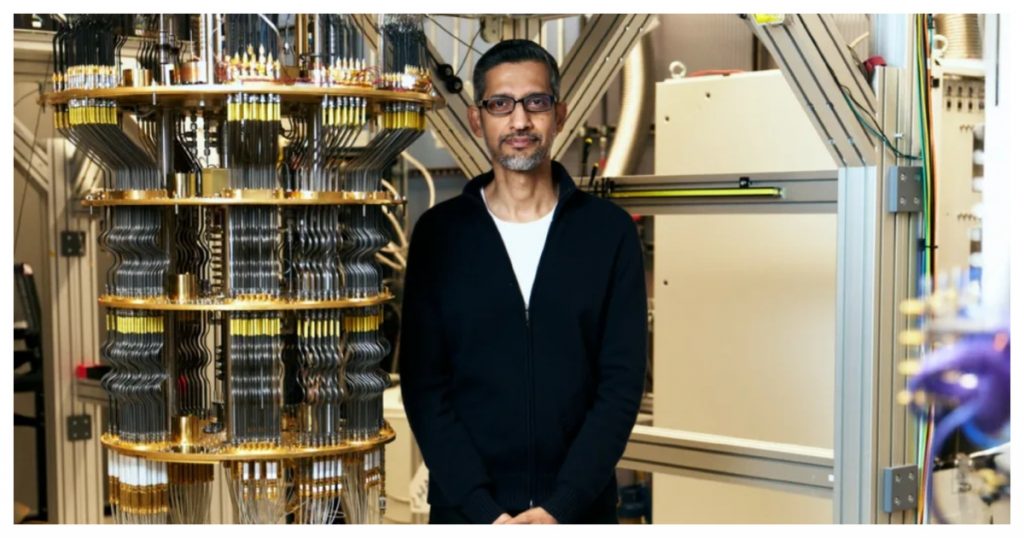
While the tech world has been captivated by the rapid scaling of large language models and AI-generated code, Google’s Quantum AI team has reached a milestone that shifts the conversation from theoretical “supremacy” to verifiable utility. Using their new Willow quantum chip, researchers have demonstrated the first-ever algorithm to achieve a verifiable quantum advantage on hardware. This breakthrough, centered on the Quantum Echoes algorithm, outperformed one of the world’s fastest supercomputers by a factor of 13,000x, solving a problem that models the complex dynamics of physical systems.
Solving the Error Suppression Paradox
For years, the “Holy Grail” of quantum computing has been error correction. Quantum bits, or qubits, are notoriously unstable; as systems grow in size, they typically become more prone to “noise” that destroys the computation. The Willow chip represents a significant hardware leap because it is designed to suppress these errors even as the system scales. This stability allowed Google to run a 105-qubit array with enough precision to execute an algorithm that is not just complex, but mathematically “clean” enough to be verified against physical reality.
The Mechanics of Quantum Echoes
To a technical audience, the Quantum Echoes algorithm—formally known as an out-of-order time correlator (OTOC)—functions as a high-fidelity stress test for quantum information. The process involves sending a signal into the qubit array, perturbing a single qubit to create a disturbance, and then precisely reversing the evolution of the entire system to listen for an “echo.” Because of a phenomenon called constructive interference, where quantum waves align to strengthen one another, the resulting measurement is incredibly sensitive. This sensitivity allows the chip to act as a “molecular scope,” capturing data about atomic interactions that classical supercomputers struggle to simulate.
The Significance of Verifiable Advantage
The defining characteristic of this breakthrough is its verifiability. In 2019, Google’s initial claim of quantum supremacy was met with some skepticism because the problem solved was abstract and difficult to verify. Quantum Echoes changes that paradigm. It represents a “verifiable advantage,” meaning the results can be cross-benchmarked and repeated on other quantum hardware of similar caliber. This provides a rigorous framework for trust, a necessity for any enterprise-grade application. It aligns with the 5-to-10-year timeline for practical quantum utility previously suggested by leadership, moving the technology closer to being a tool for industry rather than just a laboratory experiment.
Real-World Applications in Chemistry and Beyond
The practical implications of this “quantum-scope” are vast. In collaboration with UC Berkeley, Google used the algorithm to study the geometry of molecules with up to 28 atoms, matching the results of traditional Nuclear Magnetic Resonance (NMR) while providing information that standard NMR cannot reach. This has the potential to revolutionize drug discovery, allowing researchers to see exactly how a potential medicine binds to a target at the molecular level. It also promises advances in materials science, particularly for developing new battery components or polymers.
As the global race for quantum dominance heats up—with even homegrown startups now building full-stack systems—Google’s focus on verifiable precision marks the beginning of the “useful” era of quantum computing. The objective is no longer just to prove that quantum computers can outrun classical ones, but to prove they can do so while providing accurate, actionable data for modern science.