Stock market trading appears to be hitting the most vulnerable sections of society the most.
A new report by the Securities and Exchange Board of India (SEBI), titled “Profitability of Individual Traders in the Equity Derivatives Segment (FY25–FY26)”, shows a clear pattern along income lines: the lower a trader’s annual income, the more likely they are to lose money in the equity derivatives segment (EDS), and the harder those losses hit relative to what they actually own.
Lower-Income Traders Dominate The Market, And The Losses
Most individual derivatives traders in India fall into the below-Rs. 5 lakh annual income bracket. This group made up about 75% of all traders in FY25 and 73% in FY26 — meaning nearly three out of every four people trading derivatives earn less than Rs. 5 lakh a year.
This same group also recorded the highest proportion of loss-makers of any income category. In FY26, 88% of traders earning under Rs. 5 lakh annually ended the year with a net loss, the worst rate across all income brackets. That loss-maker share generally declined as income rose, bottoming out at 71% for traders earning between Rs. 50 lakh and Rs. 1 crore, before ticking back up to 81% for those earning over Rs. 1 crore.
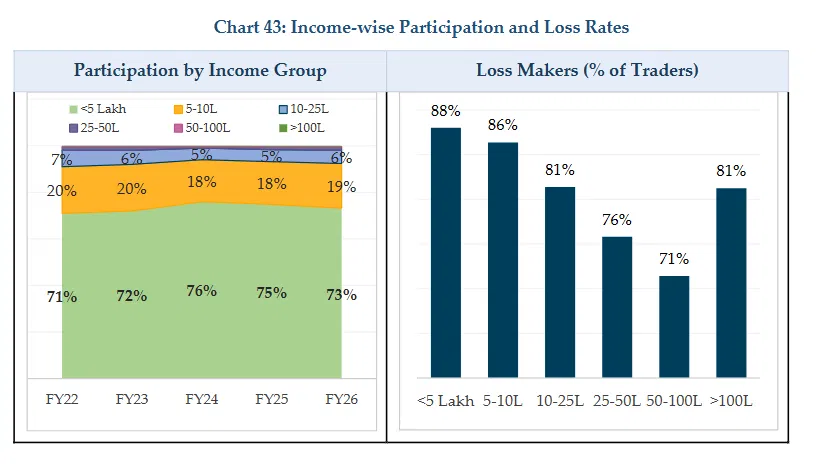
Because this income group is so large, it also accounts for the bulk of aggregate losses. Traders earning below Rs. 5 lakh a year contributed roughly 53% of total net losses in both FY25 and FY26, despite making up a shrinking share of the trader base over time.
The Real Damage Is In How Much It Hurts Their Portfolios
The starkest gap between income groups shows up when losses are measured against the size of a trader’s equity holdings. Traders in the below-Rs. 5 lakh income category lost an amount equivalent to about 45% of their equity portfolio value in FY25, and 39% in FY26. For traders earning over Rs. 1 crore annually, that figure was just 3% and 2% respectively.
In other words, a lower-income trader losing money in the derivatives market is losing a proportionally much larger chunk of their overall wealth than a higher-income trader would, even though the average loss per loss-maker tends to rise with income — a reflection of wealthier traders taking larger positions in absolute terms.
Women Traders Are Growing In Number, And Losing Less Often
The report’s gender breakdown offers a somewhat different story. Women’s participation in the EDS has risen steadily, from 13.7% of the trader base in FY24 to 17.1% in FY26. In FY26, women made up 17% of all traders but accounted for a slightly larger 21% share of both aggregate equity portfolio value and total derivatives turnover, while contributing 17% of total losses — broadly proportionate to their level of participation.
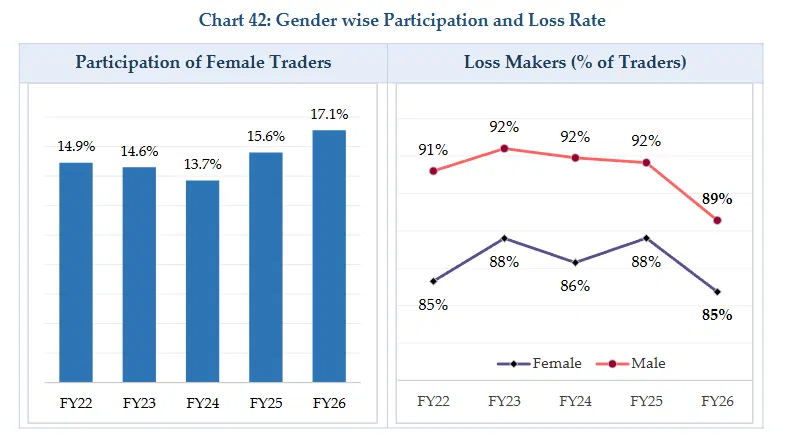
Women were also less likely to lose money than men. In FY26, 84.73% of women traders recorded a net loss, compared to 88.56% of male traders — a gap that has held fairly consistently over the past several years. However, the average loss per trader was nearly identical across genders: Rs. 1,16,117 for women versus Rs. 1,15,995 for men, and trading intensity, measured as turnover relative to portfolio value, was almost the same for both groups at around 42.5 times.
A Market That’s Still Overwhelmingly Retail And Modest-Income
These income patterns line up with what’s already known about the profile of India’s retail trading boom — a wave of participation driven heavily by first-time, modest-income investors using low-cost trading apps. That shift has been central to the rise of platforms like Groww, which overtook Zerodha to become India’s largest broker by number of active clients, even as the vast majority of users on these platforms hold relatively small amounts of capital.
Taken together, SEBI’s data suggests that while India’s derivatives market keeps drawing in large numbers of lower-income participants, it’s this same group that ends up bearing a disproportionate share of both the losses and the financial strain from those losses.