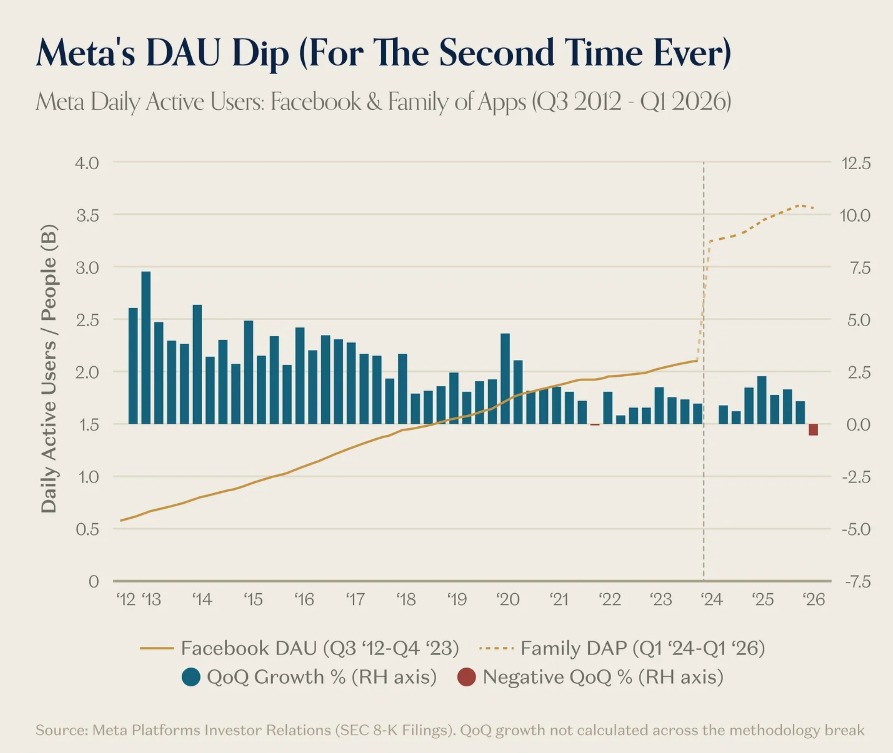
Meta has had an incredible record of growing its user-base since being founded, and it’s now hit a rare blip.
The company’s Q1 2026 results showed daily active people across its family of apps — Facebook, Instagram, WhatsApp, Messenger, Threads, and Meta AI — slip to 3.56 billion, down from 3.58 billion in Q4 2025. It’s only the second time in Meta’s history that this number has gone the wrong way; the first was a brief dip back in 2021. For a platform that reaches more than a third of the world’s population every single day, losing 20 million users in a quarter is, at minimum, worth a raised eyebrow.
Blaming the Map, Not the Product
Meta didn’t waste time pointing fingers. The company attributed the decline squarely to two geopolitical events: internet disruptions in Iran — where protests in January 2026 triggered widespread outages — and Russia’s ongoing restrictions on WhatsApp, part of Moscow’s push to funnel users onto state-controlled messaging alternatives. Meta also flagged possible user losses in Australia, which became the first country to enforce a nationwide ban on social media for users under 16.
CEO Mark Zuckerberg doubled down on this framing during the earnings call, insisting that underlying trends across the apps remain strong and that the drop was a geopolitical artifact, not a product problem. Some observers have been mildly skeptical — Meta has not broken out which specific platforms were hit hardest, leaving room for questions about the health of its flagship Facebook app in particular.
The Numbers That Actually Matter
Here’s the thing: even with the user dip, Meta put up one of its strongest financial quarters in years. Revenue hit $56.31 billion, up 33% year-over-year — the fastest growth rate since 2021. Ad impressions rose 19% and average ad prices climbed 12%. Net income jumped 61% to $26.8 billion. The company is, by any conventional measure, making more money from fewer daily users — a sign that its monetization engine is becoming more efficient, not less.
Average revenue per person came in at $15.66 for the quarter, beating analyst estimates, though down from the $16.56 recorded in Q4 2025. For Q2, Meta is guiding revenue to between $58 and $61 billion — roughly in line with Wall Street expectations.
Spending Like There’s No Tomorrow
Losing a few users hasn’t dimmed Meta’s appetite for investment. The company raised its full-year 2026 capex guidance to between $125 and $145 billion, a $10 billion bump from its prior forecast, citing higher component costs and the land and power constraints that are increasingly choking AI infrastructure buildouts. Meta CFO Susan Li made the strategic priority crystal clear on the earnings call: the company’s highest use of capital is positioning itself as a leader in AI. Zuckerberg himself referenced the company’s new Meta Superintelligence Labs and mentioned AI 49 times during the call.
That AI spending race is happening at a scale that is difficult to comprehend — the top four hyperscalers (Meta, Amazon, Alphabet, Microsoft) have collectively guided their 2026 capex to roughly $715 billion, up more than 70% from the already-record $410 billion they spent in 2025.
A Broader Shift in Attention
The DAU dip sits against a broader backdrop that’s worth watching. According to GWI’s tracking of 250,000 adults across 50+ countries, global daily social media usage peaked around mid-2022 at roughly 2.5 hours and has since fallen to about 2.3 hours — a decline of close to 10%. The sharpest drop has been among 16-to-24-year-olds, the demographic long considered most hooked on these platforms.
Teen restrictions — in Australia, and potentially more countries to follow — are not going away. The European Commission has also preliminarily found Instagram and Facebook in breach of the Digital Services Act over their handling of minors under 13. Meta has warned investors that ongoing legal and regulatory battles could “significantly” impact its business, with additional trials scheduled in 2026 following two defeats in March related to allegations of misleading consumers about product harms.
Context: Still a Colossus
None of this is existential — yet. A year-over-year comparison still shows Meta’s user base growing 4%. Its 3.56 billion daily users means that, even on a bad quarter, more than one in three people on Earth opened a Meta app yesterday. The platform’s ad business is running at a scale that most companies can only dream of. And Instagram’s Reels engagement drove a 10% lift in time spent in Q1, while Facebook video watch time posted its largest quarter-over-quarter gain in four years.
The story of Meta’s DAU dip is, in one reading, a story about Iran and Russia. In another, it’s a leading indicator worth monitoring — of regulatory pressure, of teens logging off, and of a world that may, slowly, be spending a little less time on social media. Meta has navigated rougher patches before. But for a company that has grown its daily active people count from 2.1 billion in 2019 to 3.56 billion today, even a second-ever blip is a moment to pay attention.