Masayoshi Son has never been shy about grand gestures, but his latest shareholder presentation may have taken the metaphor game to a new level entirely. In slides that have been making the rounds online, SoftBank’s founder used a white goose and a pile of golden eggs to explain, with complete seriousness, how his company creates value — and the argument is surprisingly hard to argue with.
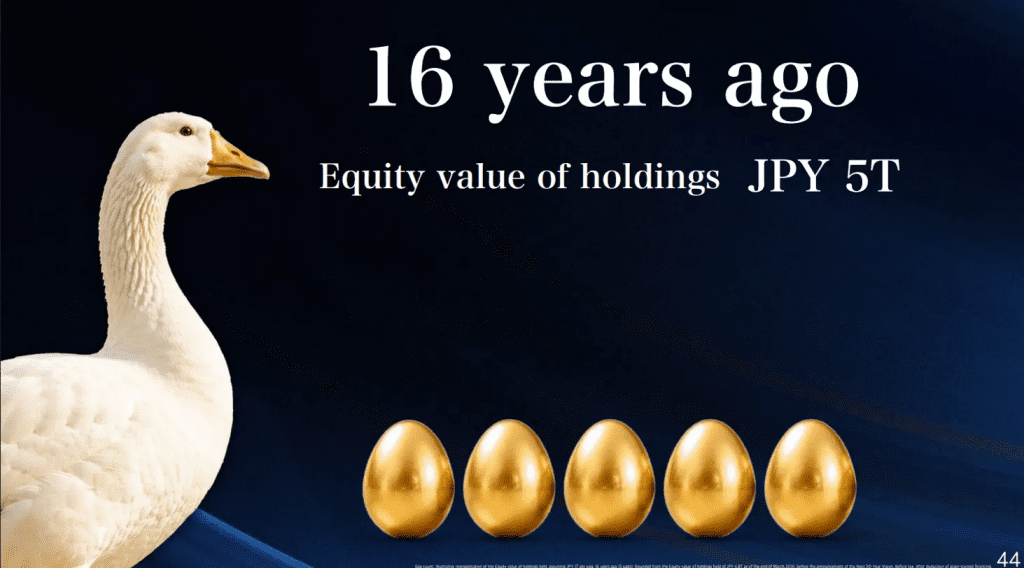
The setup is this: 16 years ago, SoftBank’s equity value of holdings stood at JPY 5 trillion. After netting out the JPY 2 trillion in net debt at the time, that left shareholders with a NAV (Net Asset Value) of JPY 3 trillion. Three eggs, as the slides helpfully illustrated. The market, looking at those three eggs, valued the company at exactly three eggs — a market cap of JPY 3 trillion.
Then came the punchline. As of June 23, 2026, SoftBank’s NAV stands at JPY 74 trillion. Its market cap is JPY 37 trillion — meaning the stock still trades at roughly half its NAV, a discount that has persisted stubbornly over the years even as the underlying numbers have grown beyond recognition. The gap between what SoftBank is worth and what the market is willing to price it at has become something of a running theme for Masa Son, who has long argued that investors are missing the bigger picture.
The bigger picture, in this case, is the goose.
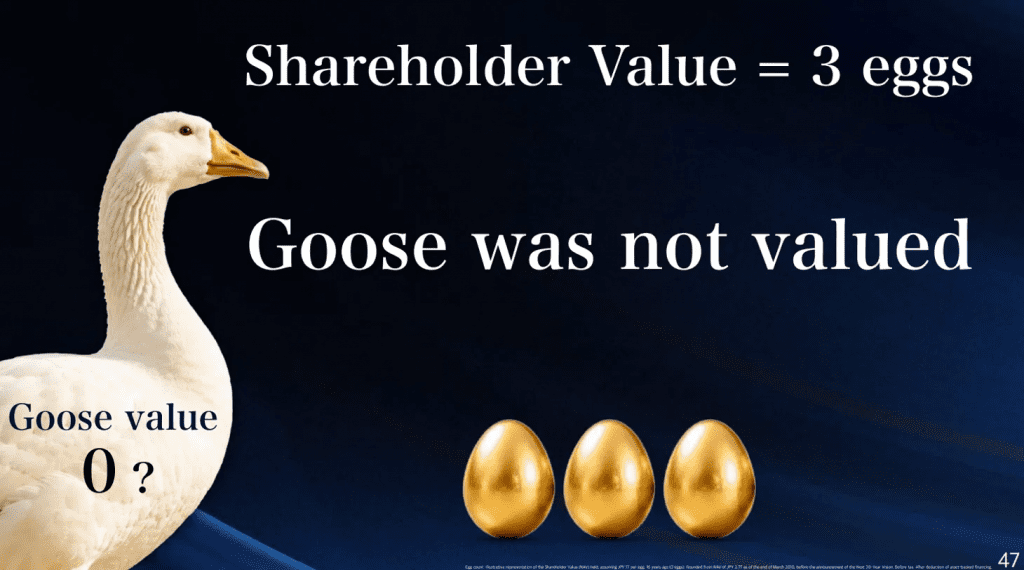
The presentation’s logic flows cleanly: in 2010, the market saw three eggs and valued three eggs. It gave the goose — SoftBank itself as an operating entity, as an investor, as a platform — a value of zero. But over the subsequent 16 years, the goose laid more eggs. A lot more. Shareholder value went from 3 to 74, an increase of 71 — all created by the goose that the market had initially decided wasn’t worth pricing in at all.
“Eggs do not lay eggs,” one slide declared. The eggs themselves weren’t compounding. The goose was.
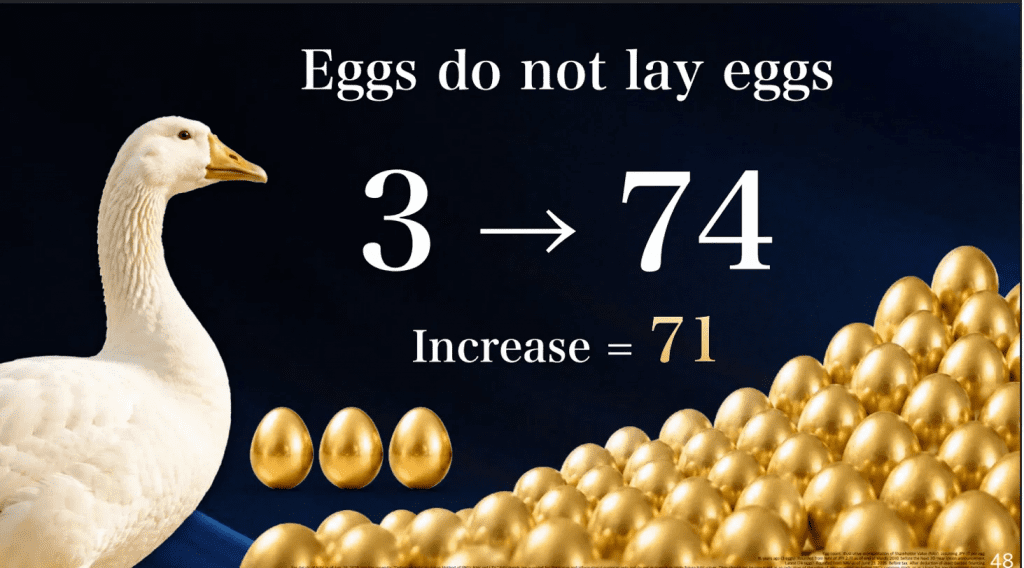
It’s a neat encapsulation of how SoftBank sees itself — less a holding company that happens to own stakes in tech businesses, and more a value-creation engine whose output (the portfolio companies, the NAV) keeps growing because of the judgment, capital allocation, and deal-making happening at the center. Whether you agree with that self-assessment probably depends on how you’ve felt about Masa Son’s investment track record over the years, which has included both the legendary Alibaba bet and the spectacular WeWork misadventure.
Son has spent years making the case that SoftBank should trade closer to its NAV. At the current share price of JPY 6,500 against a per-share value of JPY 13,000, the discount-to-NAV argument is genuinely striking. The company is essentially telling the market it’s getting the goose for free — and the goose, by the numbers, has already laid 71 trillion yen worth of eggs that weren’t there before.
The goose framing also does some useful rhetorical work. A goose that lays golden eggs is, in the original fable, killed by the farmer who gets impatient waiting for the eggs and wants all the gold at once. Son’s implicit message seems to be that the market, by only pricing the visible eggs, is making that same mistake — undervaluing the thing that actually produces the returns in favor of what’s already been produced.
Whether that argument gains more traction this time around is a different question. SoftBank’s bet-everything-on-AI positioning — with commitments running into the hundreds of billions toward OpenAI, Stargate, and related infrastructure — makes the goose either the most productive it’s ever been, or very exposed, depending on how the next few years of AI spending shake out. Son, for what it’s worth, has said he’d view any AI correction as a buying opportunity.
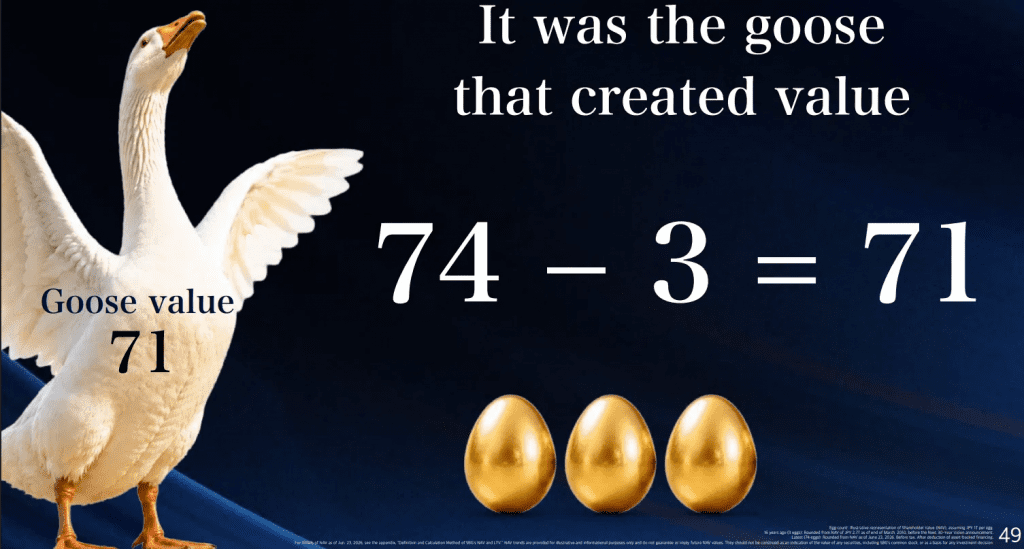
The slides end with the goose spreading its wings, looking triumphant, next to the equation: 74 – 3 = 71. Goose value: 71.
It’s the kind of presentation that’s easy to mock until you look at the numbers behind it. Three trillion to seventy-four is not a small move. And the NAV chart in the deck — a yellow step-function line that has been climbing steadily and then very sharply upward — does make the core case more visually than any analyst report would.
Say what you want about Masayoshi Son. He knows how to tell a story with a goose.