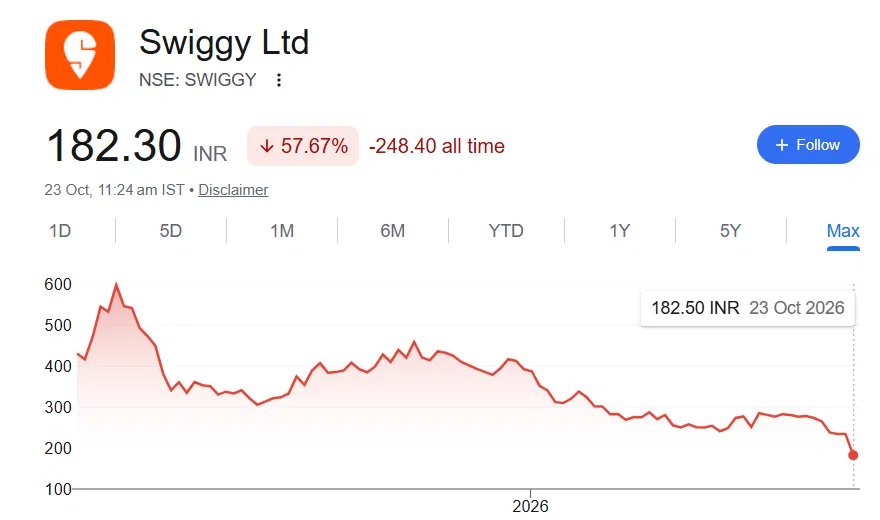
Swiggy had a rough Friday on Dalal Street. Shares of the food delivery and quick commerce major fell as much as 15% intraday to hit a record low of Rs 179.65, before paring some losses to trade around 13% down for the day. The stock opened at Rs 204.90 and has been sliding ever since the company’s September quarter results dropped a day earlier.
With this crash, Swiggy’s market capitalisation has fallen to roughly Rs 50,000 crore, down nearly 70% from the almost Rs 1.7 lakh crore valuation it commanded barely two months after its November 2024 listing, when the stock touched an all-time high of around Rs 617. The company’s stock debuted at a premium and briefly made Swiggy a part of the exclusive Rs 1 lakh crore market cap club, but the quick commerce losses that have piled up since have wiped out most of that value.
What Happened With Swiggy’s Q2 Results
Swiggy’s consolidated net loss for the July-September quarter of FY27 came in at Rs 922 crore, an improvement from the Rs 1,092 crore loss in the same quarter last year, but wider than the Rs 792 crore loss reported in the preceding June quarter. Revenue from operations grew 36% year-on-year to Rs 7,571 crore, while total expenses rose to Rs 8,703 crore from Rs 6,711 crore a year earlier. The adjusted EBITDA loss widened to Rs 760 crore from Rs 695 crore in the year-ago period.
Food delivery continued to be the company’s strong suit, with gross order value growing 17.7% YoY to Rs 10,054 crore and the segment posting what CEO Sriharsha Majety called its highest-ever profits and margins. The company has also been pushing Toing, a standalone budget-meals offering, to unlock growth in that business beyond the core app.
It’s Instamart that’s keeping investors on edge. The quick commerce arm’s net order value grew 31.4% YoY and 13.4% quarter-on-quarter to Rs 6,954 crore, and the business added 69 dark stores in the quarter, matching the combined additions of the previous three quarters and taking the total count to 1,240 stores. Majety also flagged that Instamart has now qualified as an Indian owned and controlled company, a regulatory milestone the company has been working toward. Still, none of that was enough to offset worries about how much longer the cash burn in quick commerce continues.
Why The Stock Fell So Hard
The timing didn’t help Swiggy’s case. The results landed days after rival Eternal, the parent of Zomato and Blinkit, posted its own September quarter numbers, and the comparison has investors asking tougher questions about Swiggy’s path to quick commerce profitability. Eternal’s Blinkit has pulled further ahead in scale, and brokerages have been explicit about the widening gap.
Several brokerages cut their target prices on Swiggy following the results. HSBC maintained a ‘Hold’ rating but slashed its target to Rs 240 from Rs 315, pointing to food delivery market share losses and Instamart’s relatively smaller scale as hurdles to profitability. CLSA kept an ‘Outperform’ call but trimmed its target to Rs 262, noting that Instamart’s order value growth missed expectations even as losses widened, and that the performance gap with Eternal grew across both businesses.
Nomura retained a ‘Buy’ rating with a reduced target of Rs 300, valuing Swiggy’s food delivery business at 40 times FY28 EBITDA in line with Eternal, but assigning no value at all to the quick commerce business given the execution uncertainty. Jefferies also stayed with a ‘Buy’ call, cutting its target to Rs 330, and said reducing Instamart’s losses is the key to unlocking value in the stock, even though the current price doesn’t fully reflect the food delivery business and Swiggy’s cash reserves.
The Bigger Picture
For Swiggy, the question now is whether Instamart can show real signs of narrowing losses in the coming quarters. The company has consistently guided toward improving quick commerce economics, even as the dark store race with Blinkit and Zepto keeps costs elevated. Until that shows up clearly in the numbers, brokerages seem content to keep discounting the business almost entirely, leaving food delivery to do the heavy lifting for the stock.