India’s semiconductor plans are slowly taking shape.
Tata Electronics and ASML have signed a Memorandum of Understanding (MoU) to advance India’s semiconductor manufacturing ecosystem, with the Dutch equipment giant set to supply its lithography tools and solutions for Tata’s upcoming 300 mm fab in Dholera, Gujarat. The MoU was signed during Indian Prime Minister Narendra Modi’s visit to Netherlands.
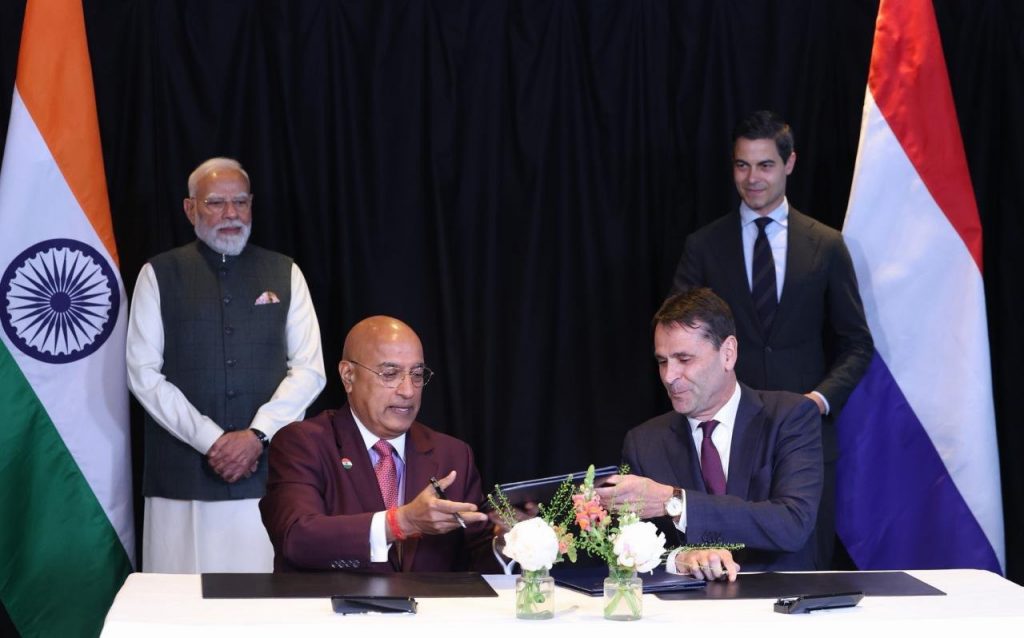
The partnership covers more than just hardware. The two companies will jointly work on training domestic talent, strengthening supply chain resilience, and building out the R&D infrastructure that India’s first commercial-scale fab will need for the long haul. ASML’s lithography machines are central to chipmaking — the company holds a near-monopoly on extreme ultraviolet (EUV) machines, and no advanced semiconductor facility can operate without them.
The Dholera fab, which carries a planned investment of $11 billion, will manufacture chips for automotive, mobile, and AI applications, targeting a broad global customer base. Tata Electronics had previously partnered with Taiwan’s PSMC (Powerchip Semiconductor Manufacturing Corporation) to access process nodes ranging from 28nm to 110nm — and the ASML tie-up now plugs the critical lithography gap in that stack.
“ASML’s deep expertise in holistic lithography solutions will ensure the timely ramp of our fab in Dholera, create a resilient and trusted supply chain for our global customers, drive innovation, and develop talent locally,” said Dr. Randhir Thakur, CEO & MD of Tata Electronics.
ASML CEO Christophe Fouquet — who also led the company’s $2 billion investment into Mistral AI — called India’s semiconductor ambitions “compelling” and said the company is committed to long-term partnerships in the region.
The announcement is a significant milestone in India’s broader semiconductor push. The Tata Group has been at the forefront of that effort, with the Dholera fab being only one part of a larger buildout that also includes an OSAT facility in Assam. India’s ambitions in the space have also attracted other big players: the Adani Group announced a $10 billion semiconductor plant in Maharashtra in partnership with Israel’s Tower Semiconductor.
The ASML-Tata partnership also carries geopolitical weight, given that ASML has found itself at the centre of export control disputes between the US and China over its machines. India, positioning itself as a reliable partner in the global semiconductor supply chain, benefits from being on the right side of that equation.
Construction at Dholera is reportedly moving quickly. The ASML deal suggests the fab’s ramp-up timeline is now backed by one of the most critical — and hardest to replace — suppliers in the entire semiconductor industry.