Even as AI progresses at breathtaking pace, Americans continue to remain wary of its impacts on society.
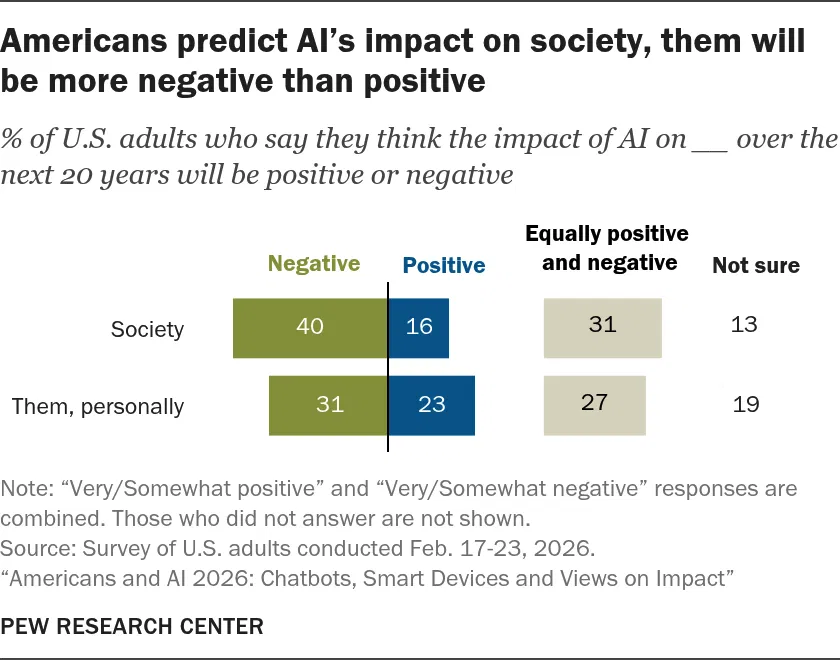
A new Pew Research Center survey of U.S. adults, conducted February 17–23, 2026, finds that 40% of Americans expect AI’s impact on society to be negative over the next 20 years, against just 16% who think it will be positive — a ratio of 2.5 to 1. On the personal level, the skepticism is somewhat more muted: 31% expect AI to affect them negatively, while 23% see it affecting them positively. Another 31% said the societal impact will be equally positive and negative, and 13% said they weren’t sure.
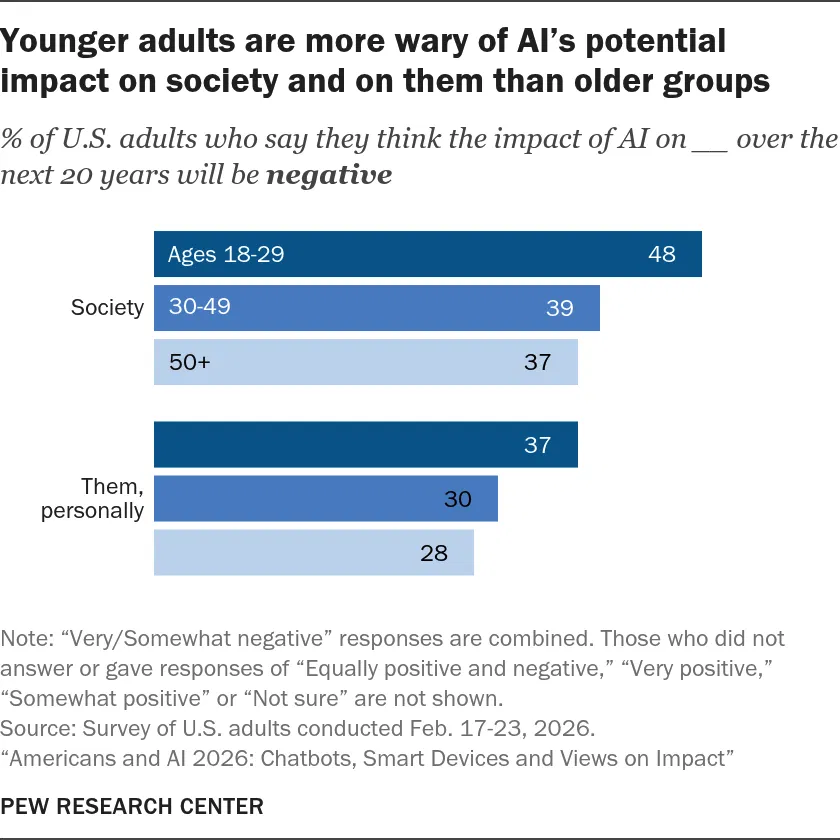
What makes the findings particularly striking is where the pessimism is concentrated. Younger adults — the demographic most likely to be actively using AI tools, and the one that stands to live longest with its consequences — are the most worried. Among 18–29 year olds, 48% said they believe AI’s impact on society will be negative, compared to 39% for the 30–49 group and 37% for those 50 and above. On the personal impact question, 37% of 18–29 year olds said AI would affect them negatively, versus 30% of 30–49 year olds and 28% of those 50+.
The generational pattern matters. Older adults holding more sanguine views might be partly explained by distance — AI’s disruptions will land more squarely on younger people’s careers and daily lives. And the data elsewhere supports that concern. Stanford and Harvard studies have both documented sharp declines in hiring for early-career workers in AI-exposed occupations like software development and customer service, with employment for software developers aged 22–25 down nearly 20% from its late 2022 peak. A Harvard study found that at AI-adopting firms, junior employment fell 7.7% relative to non-adopting firms within just six quarters. Young adults aren’t imagining the risk; they’re watching it play out in the hiring market.
The debate among business leaders, meanwhile, hasn’t settled anything. Groq’s CEO has argued that AI will actually cause labor shortages by creating more opportunities than workers to fill them. Goldman Sachs CEO David Solomon has pushed back on mass unemployment fears, contending that automating work hours isn’t the same as eliminating jobs. Others like David Friedberg have been more emphatic, flatly dismissing the job-loss narrative as overblown. But the company-level reality keeps intruding — Upwork cut 25% of its workforce citing AI-driven lean teams, Block eliminated 40% of its staff with Jack Dorsey naming AI as the reason, and S&P 500 companies shed roughly 400,000 workers in 2025, ending eight consecutive years of headcount growth.
The Pew data suggests ordinary Americans are watching this same scorecard. Society-level skepticism outstripping personal-level skepticism — 40% vs 31% seeing negative impact — likely reflects a sense that AI’s costs will be distributed broadly across jobs, institutions, and social fabric, even if one’s own exposure feels uncertain. The high “not sure” responses (13% on society, 19% personal) also point to genuine uncertainty rather than settled pessimism, which means public opinion is still malleable depending on how AI’s next few years actually play out.
For the tech industry, the gap between the optimism of its leaders and the skepticism of the public — particularly young people — is something to reckon with. The narrative of abundance and opportunity hasn’t landed the way the sector might expect, especially among the demographic that grew up with these tools and knows them best.