Anthropic’s long-awaited S-1 filing, published ahead of its Nasdaq listing, has a line item that puts some numbers on something most observers already assumed: the vast majority of the company’s money still comes from inside the United States.
According to the filing, 72.2% of Anthropic’s revenue in the first half of 2026 came from customers billed in the US, with the remaining 27.8% coming from customers outside the country. That’s based on where a customer’s billing address is registered, not necessarily where the underlying usage happens, but it’s the clearest regional breakdown Anthropic has given investors so far.
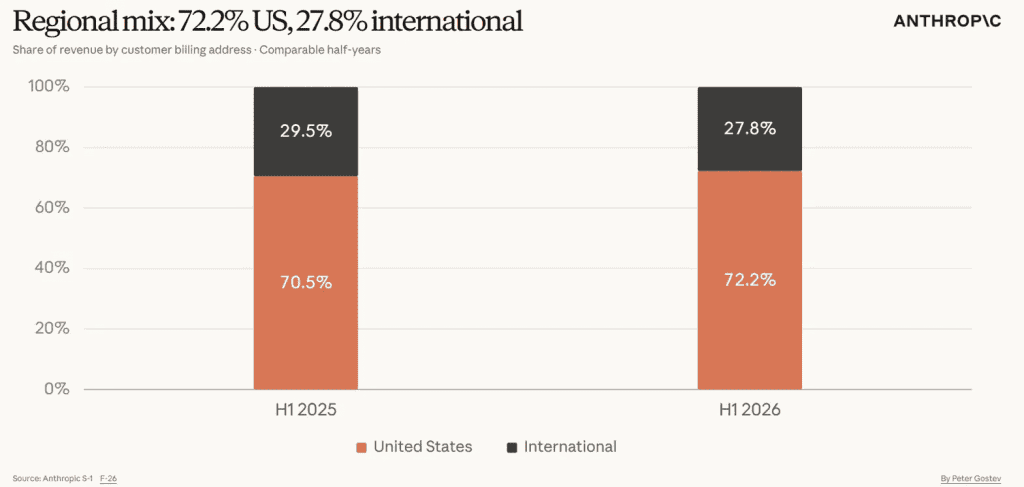
What’s notable is the direction of travel. In the same half-year period a year earlier, H1 2025, the US accounted for 70.5% of revenue and international customers made up 29.5%. So instead of Anthropic’s non-US business growing as a share of the pie as the company has expanded internationally, opening a Singapore office, signing government deals, and so on, the opposite has happened: the US share actually grew by about 1.7 percentage points, while the international share shrank by a similar amount.
It’s a reminder that even as Anthropic’s overall revenue has exploded (first-half 2026 revenue came in at $16.3 billion, up from about $1.16 billion in the same period last year), the growth has been disproportionately domestic. The S-1 attributes the company’s overall surge largely to usage-based revenue from enterprise and developer customers adopting Claude for coding and agentic workloads, and it appears American businesses have been quicker, or deeper, adopters than the rest of the world combined.
For context, the company counts more than 11,900 customers with $100,000 or more in trailing-twelve-month revenue, and names only two companies as direct frontier-model competitors in the filing: OpenAI and Google. That’s despite also counting Microsoft, Amazon and Google among its compute partners and cloud marketplace distributors, the kind of entangled relationship that’s becoming common across the AI industry’s biggest players.
A revenue mix skewed this heavily toward one market also raises questions about how much room for growth remains overseas, and whether regulatory friction, data residency requirements or local competition in markets like the EU, China (where Anthropic doesn’t operate) and India has slowed the company’s ability to diversify its revenue base. It could also point to greater AI adoption in the US compared to the rest of the world, which augurs well for US businesses. With Anthropic eyeing a valuation in the $1.5 trillion to $2 trillion range at IPO, investors will likely be watching whether that international share starts climbing back up, or whether Anthropic’s growth story remains, for now, largely an American one.