The biggest determinant in the AI race might not be AI models or chips — it could be the attitudes of the general population in the two countries in contention.
A new survey shows a wide gap in how people in different countries see AI. In China, 93% of respondents say AI will mostly help people in their country. In the US, only 36% say the same. The US is one of the five most pessimistic countries in the study.
The findings come from the 2026 Microsoft-Gallup AI Adoption Survey. Commissioned by Microsoft, the study has results from 37 countries so far, with about 1,000 people polled in each between April and July.
The most optimistic countries
Respondents were asked whether AI will mostly help or mostly harm people in their country. After China, the most optimistic were China, Vietnam, Singapore, Israel and Nigeria.
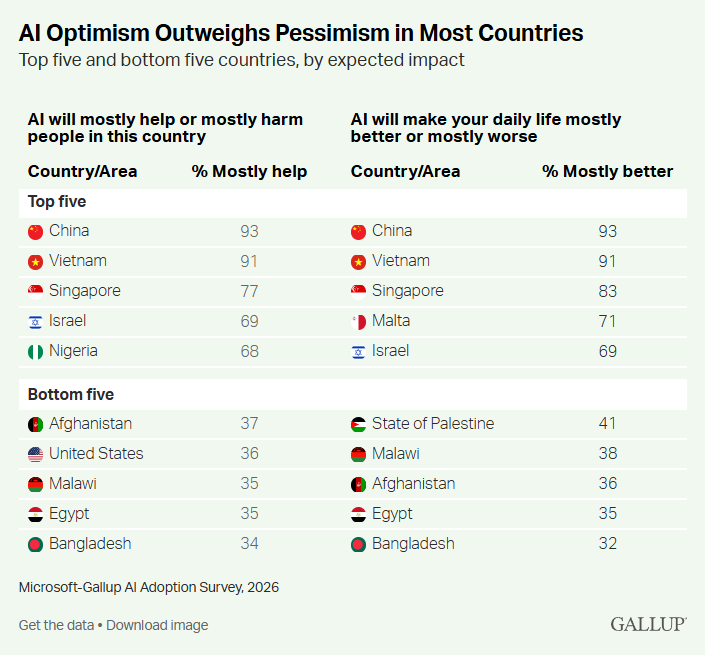
The least optimistic were Bangladesh (34%), Egypt (35%), Malawi (35%), the United States (36%) and Afghanistan (37%). The US is the only advanced economy on that list.
Daily life, not just the nation
A second question asked whether AI will make respondents’ own daily lives mostly better or mostly worse. China (93%) and Vietnam (91%) again led, followed by Singapore (83%), Malta (71%) and Israel (69%).
At the bottom were Bangladesh (32%), Egypt (35%), Afghanistan (36%), Malawi (38%) and the State of Palestine (41%). The US did not make the bottom five on this measure, so Americans are more skeptical about AI’s effect on the country than on their own lives.
Heavy users, and still worried
Using AI more doesn’t necessarily mean trusting it more. Gallup found that about 68% of Americans who use AI daily are worried about it, and concern is even higher among people who use it less often. In Singapore, which had the highest share of daily users at 46%, more than 80% of those aware of AI expect it to improve their everyday lives.
The US result matches other recent polling. Pew’s February 2026 survey found that more US adults expect AI to have a negative impact on them and on society than a positive one, even as about half now use AI chatbots.
Words versus behavior
Some in the tech industry argue that the skepticism in US polls is louder than actual behavior. Marc Andreessen recently said that Americans’ stated worries about AI don’t match how much they use it in real life. In his view, poll responses reflect opinions people are happy to voice, while their usage shows what they actually prefer.
The competitiveness angle
The sentiment gap has a business and geopolitical side. Nvidia CEO Jensen Huang has argued that Western pessimism is a strategic weakness. When he said that China is going to win the AI race, he blamed cynicism in the US and UK and called for more optimism. He also pointed to a patchwork of state-level AI rules in the US and to subsidized energy in China.
The Gallup data doesn’t show that optimism leads to better AI outcomes. It does show that Chinese users and businesses approach AI with far more enthusiasm than American ones, at a time when both countries are racing to deploy it. AI is also a lot more mainstream in China, with public robotics MMA bouts, a high-profile Humanoid Olympics, and even old people signing up in droves to AI agents like OpenClaw. Whether the US can close that gap, or whether it even needs to, is likely to keep shaping the debate over AI regulation and adoption.