If China is making waves in AI with the release of Kimi K3, it’s also doing some world-beating things in robotics.
On July 16, the Nanshan Culture and Sports Center in Shenzhen played host to the world’s first URKL (Ultimate Robot Knockout Legend) humanoid robot combat tournament, an event that brought teams from around the world together to pit their algorithms against each other inside a ring. The robots doing the fighting were all EngineAI’s T800, a standardized full-sized humanoid platform that every team was required to use, which meant the contest came down to software, tuning and strategy rather than whoever built the biggest or strongest machine.
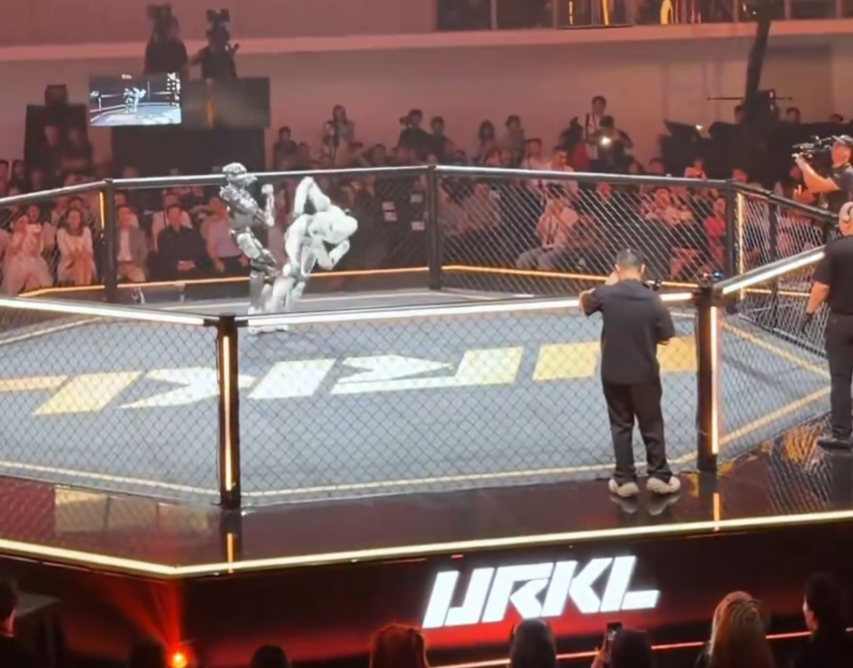
The tournament featured a standard MMA ring with a packed audience. The two robots slogged it out against each other with remarkably human-like moves. They punched, kicked, and even jumped back up if they fell to the floor.
Remarkably, in one instance, one of the robots’ heads came off during a bout. The head first hung precariously with some wires, until another kick separated it entirely from the body. Not to be deterred, the robot kept fighting, kicking and throwing punches. It was the kind of entertainment that MMA would find hard to reproduce.
The T800 itself has been EngineAI’s marquee product since its debut at the 2025 World Robot Conference, where the Shenzhen-based company positioned it as a “combat-ready” humanoid built for demanding physical tasks rather than the warehouse and factory-floor work most humanoid robot makers chase. Depending on the configuration, the robot stands somewhere between 1.73 and 1.85 metres tall and carries dozens of degrees of freedom across its joints and hands, giving it the range of motion needed for punches, kicks and the kind of recoveries that judges were watching for. EngineAI has supplied the robots to competing teams free of charge, choosing to treat hardware access as a way to pull in outside developers rather than a revenue line.
The tournament runs on a structure EngineAI co-founder Yao Qiyuan has described as three rings in one: a stage for showcasing raw technical capability, a ring where the actual matches play out for a prize purse worth 10 million yuan (roughly $1.44 million), and a platform meant to encourage open-source collaboration across teams long after the event wraps. Martial arts actor Donnie Yen made an appearance at the launch festivities, and the whole build-up leaned heavily into spectacle, complete with a six-metre mech suit outside a Shenzhen shopping mall days before the main event.
None of this is happening in a vacuum. China ran what it called the world’s first robot combat championship just over a year ago, but the robots back then felt like a pale shadow of what they’re capable of now. EngineAI is one of a growing list of firms, alongside names like Unitree, Galbot and UBTech, all fighting for position in a humanoid robot market that Chinese firms currently dominate by unit volume. What sets URKL apart is the framing: organizers and outside analysts alike have described combat as a shortcut to real-world testing, a way to force robots to absorb impacts, lose balance and recover in front of a paying audience instead of a lab full of engineers.
Whether robot boxing turns out to be a genuine R&D accelerant or mostly marketing dressed up as sport is still an open question. But between a competitive fighting league and a frontier AI model climbing past Fable 5 and GPT-5.6 Sol on independent leaderboards, Shenzhen made a strong case this week for where a lot of the world’s hardest engineering is currently happening.