As of today, a Chinese open-source model is better than anything dished out by Google.
The Artificial Analysis Intelligence Index — one of the more rigorous third-party benchmarks for comparing AI models — now has GLM-5.2 from Beijing-based Z.AI sitting at a score of 51, ahead of Google’s Gemini 3.1 Pro Preview which scores 46. That gap, five points, may not sound like much, but the context makes it significant: this is the first time an open-source Chinese model has cleared every Google offering on this particular index. Z.AI, formerly known as Zhipu AI had released GLM-5.2 last week.
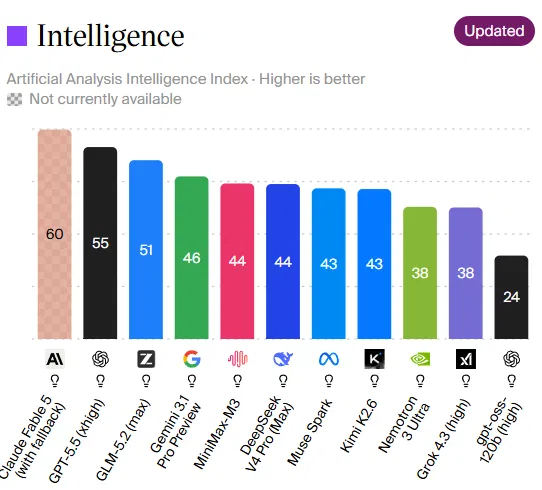
Z.AI’s GLM line has been building toward this for a while. GLM-5, released earlier this year, briefly displaced Kimi K2.5 to become the top open model globally. GLM-5.1 followed, and now GLM-5.2 has extended that trajectory further. The model scores 51 on the Intelligence Index v4.1 — placing it fourth on the overall leaderboard, behind only Claude Fable 5 (60), Claude Opus 4.8 (55), and GPT-5.5 (55). Claude Fable 5, notably, is no longer accessible outside the US following American export controls that pulled it from international availability. Among models that can actually be used today, GLM-5.2 is in the top three.
The architecture is a 744-billion-parameter Mixture-of-Experts model with 40 billion active parameters per inference call. What’s changed from GLM-5.1 isn’t the size — it’s the training. Z.AI introduced a new optimization called IndexShare, which shares a single attention index across multiple sparse layers instead of recalculating it at each step. At one million tokens of context, this reduces per-token compute by 2.9 times. The context window itself has expanded fivefold from GLM-5.1’s 200,000 tokens — a practical change for developers working with large codebases who no longer have to break projects into chunks and stitch together outputs.
On coding benchmarks, GLM-5.2 scored 62.1 on SWE-bench Pro, ahead of GPT-5.5’s 58.6. On FrontierSWE, which tests long-horizon autonomous engineering work measured in hours rather than minutes, it scored 74.4 — just behind Claude Opus 4.8’s 75.1, and ahead of GPT-5.5 at 72.6. The reaction from the developer community when the model dropped was immediate: Vercel CEO Guillermo Rauch called it a model that “changes things,” and Jeremy Howard of Answer.AI described it as performing at the level of Claude Opus 4.8 and GPT-5.5 in terms of nuance, judgment, and long-context reliability.
The model ships under an MIT license — no usage restrictions, no regional limits. Weights are downloadable from Hugging Face. That licensing decision, combined with pricing around $1.40 per million input tokens through providers like OpenRouter, puts it far below GPT-5.5 ($5 per million input) and Claude Opus ($5 per million input). Among the top open-source models available right now, GLM-5.2 leads the pack by seven points over its nearest open-weights rival.
There’s also the hardware story, which is worth noting separately. GLM-5.2 was trained entirely on Huawei Ascend chips — no Nvidia hardware anywhere in the pipeline. That’s a deliberate signal. US export controls have progressively restricted Chinese labs’ access to high-end American chips, and Z.AI has essentially demonstrated that those restrictions haven’t stopped it from producing a model that outperforms Google’s best publicly available offering on a major independent benchmark. The training cost was estimated at roughly $25 million, with 80% of that in post-training — a relatively modest figure for a model of this capability tier.
Google still leads in deployment scale, ecosystem, and the breadth of its AI-integrated products. But on the intelligence index that matters to developers and enterprises deciding which model to build on, a Chinese open-source model is now ahead of Mountain View. That’s a milestone the AI industry will be noting for some time.