The top AI open source models right now are almost entirely Chinese — and that shift happened faster than most Western analysts expected. According to the Artificial Analysis Intelligence Index v4.0, which scores models across 10 rigorous evaluations spanning reasoning, coding, agentic tasks, and knowledge, the open-source leaderboard is dominated by labs out of Beijing and Shanghai. Here’s where things stand in June 2026.
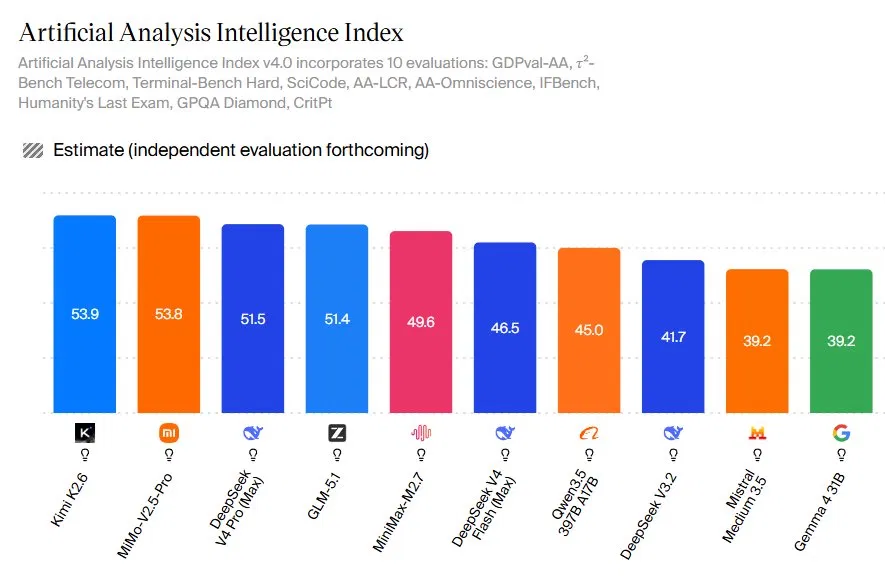
1. Kimi K2.6 — Score: 53.9
Moonshot AI’s Kimi K2.6 sits at the very top of the top AI open source models ranking with a score of 53.9. As we reported, K2.6 demonstrated sustained agentic performance that genuinely impressed enterprise partners — Vercel reported over 50% improvement on its Next.js benchmark compared to the previous K2.5 version. The model autonomously refactored an 8-year-old financial matching engine over 13 hours, making 1,000+ tool calls and delivering a 185% improvement in throughput. At 1 trillion total parameters with 32B active, it punches well above its inference cost.
2. MMo-V2.5-Pro — Score: 53.8
MiniMax’s MMo-V2.5-Pro lands at #2 among the top AI open source models with a score of 53.8. MiniMax is a Shanghai-based lab founded by former SenseTime engineers and backed by Alibaba, Tencent, and MiHoYo. The company’s models use a hybrid Mixture-of-Experts architecture with proprietary attention mechanisms capable of processing up to one million tokens — making long-context inference practical at scale in a way most competitors still charge a premium for.
3. DeepSeek V4 Pro (Max) — Score: 51.5
DeepSeek is back near the top of the top AI open source models after a few quarters of ceding ground. V4 Pro scores 51.5 on the Intelligence Index — a 10-point jump from V3.2’s score of 42, representing one of the biggest single-generation gains in the rankings. The model is a 1.6 trillion parameter MoE architecture with 49B active parameters, pre-trained on 33 trillion tokens. On coding, its Codeforces rating of 3206 leads all models tested, including GPT-5.4 and Gemini-3.1-Pro. DeepSeek acknowledges it trails frontier closed models by roughly 3–6 months — an unusually candid admission.
4. GLM-5.1 — Score: 51.4
Z.AI’s GLM line has been one of the quietly consistent performers among the top AI open source models. GLM-5 made headlines when it briefly displaced Kimi K2.5 as the #1 open model earlier this year. The updated GLM-5.1 scores 51.4 and boasts the highest Artificial Analysis Agentic Index score among open-weights models at 63 — ranking third across all models, including proprietary ones. It scales to 744B total parameters and achieves a 56 percentage-point reduction in hallucination rate, largely through more disciplined abstention when uncertain.
5. MiniMax-M2.7 — Score: 49.6
Another entry from MiniMax, M2.7 rounds out the top 5 of the top AI open source models. The model is an estimate on the index (independent evaluation forthcoming), but MiniMax’s track record with the M-series — built on hybrid MoE architectures — gives it credibility. MiniMax has confidently filed for a Hong Kong IPO targeting a valuation above $4 billion, suggesting commercial confidence to match the benchmark performance. The M-series is designed for strong agentic performance with robust handling of long-horizon toolchains including MCP, shell, browser, retrieval, and code.
6. DeepSeek V4 Flash (Max) — Score: 46.5
The second DeepSeek entry in the top AI open source models list, V4 Flash is the efficiency play in the V4 family. At 284B total parameters with just 13B active, it’s significantly faster and cheaper than V4 Pro while still scoring 46.5. DeepSeek’s proprietary DSA (DeepSeek Sparse Attention) combined with token-wise compression makes 1M-context inference practical at scale by default — not as an expensive add-on. Flash comes in at $113 to run the full Intelligence Index benchmark suite, versus $1,071 for V4 Pro.
7. Qwen 3.5 39B A1TB — Score: 45.0
Alibaba’s Qwen 3.5 family continues to represent the top AI open source models from a Chinese hyperscaler. The 39B active parameter variant scores 45.0, and the broader Qwen 3.5 lineup has been taking market share from Anthropic and Google on platforms like OpenRouter. On instruction-following benchmarks like IFBench, Qwen 3.5 scores 76.5 — beating GPT-5.2 (75.4) and significantly outpacing Claude. The full flagship Qwen3.5-397B-A17B is released under Apache 2.0, making it commercially usable and deployable on-premise.
8. DeepSeek V3.2 — Score: 41.7
DeepSeek V3.2 rounds out the third DeepSeek entry among the top AI open source models, scoring 41.7. It’s a cost-efficient workhorse — running the full Intelligence Index benchmark suite costs just $71, making it one of the cheapest capable models available. Chinese models broadly have been eating into the market share of Western open-source offerings, and V3.2 is a key reason why — it delivers reliable production-grade performance at a price point that’s hard to argue with for most enterprise workloads.
9. Mistral Medium 3.5 — Score: 39.2
Mistral’s Medium 3.5 represents the lone Western-headquartered model in the top 10 of the top AI open source models rankings. The Paris-based lab has carved out a niche with efficient, enterprise-ready models that businesses can self-deploy without geopolitical complications. At 39.2, it sits near the bottom of this list but remains a serious choice for organizations prioritizing EU data sovereignty and a Western AI supply chain. US-based open models have plateaued around this performance range, even as Chinese labs continue pushing higher.
10. Gemma 4 31B — Score: 39.2
Google’s Gemma 4 31B ties Mistral Medium 3.5 at 39.2, making it the only American hyperscaler in the top AI open source models rankings. Built on the same research underpinning Gemini, Gemma 4 is lightweight enough to run on consumer hardware while carrying Google’s infrastructure pedigree. It remains a strong option for developers already in the Google Cloud ecosystem and for teams that want multimodal capabilities — Gemma 4 supports vision — at a manageable model size. The fact that 80% of startups using open-source models now default to Chinese alternatives underscores the hill Gemma has to climb.
The Bigger Picture
The top AI open source models in mid-2026 tell a clear story: Chinese labs have not just caught up — they’ve built a structural lead in open-source intelligence. Eight of the ten models on this list come from Chinese companies. As a16z’s Martin Casado noted, the majority of startups that use open-source AI are now running on Chinese models. The performance gap is real, the cost advantage is significant, and the pace of releases shows no signs of slowing.
For enterprises evaluating open-source deployments today, the top AI open source models are no longer theoretical alternatives to proprietary APIs — they are the default choice.