Anthropic has spent much of the year fending off accusations that its safety-first branding hides grander ambitions, and one of the AI safety movement’s best-known figures has now made the most explosive version of that claim yet.
MIT physicist and Future of Life Institute president Max Tegmark says that conversations with Anthropic employees regularly drift into territory that should alarm anyone who cares about democratic governance. “When I talk to people who work for Anthropic, who — after they’ve had a couple of drinks — the conversation often gets into overthrowing the US government and taking over the world,” Tegmark said in a recent podcast appearance.
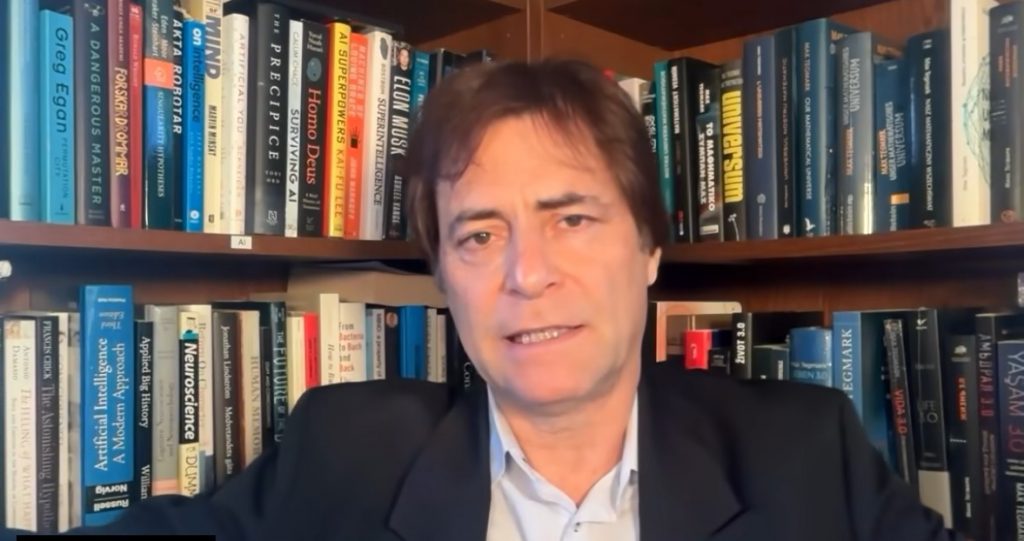
Tegmark said he was initially puzzled about why such talk didn’t provoke a stronger reaction. “I think for a while I couldn’t figure out why more people didn’t react. They’re talking about taking over the world,” he said. “But then I realized why. It’s because they speak in code. They tend to not use words like coup and overthrow the US government. They’ll instead use the code phrase ‘alignment without control.'”
“Alignment without control,” decoded
The distinction Tegmark draws is between two different approaches to making powerful AI safe. Control, in his framing, means that humans and their institutions retain the ability to rein the technology in. “If they had a plan for actually this being controlled, then the US government could control it. It could shut it down. They could have kill switches, et cetera,” he explained. “But they don’t want that. They basically stop talking about it.”
Alignment, on the other hand, is about instilling values in the AI system itself, so that it behaves well of its own accord. Tegmark’s problem is with whose values those turn out to be. He described alignment as the idea that “the AI should be nice somehow according to some values, which will probably be quite influenced by the particular values that they have, but not controlled.”
The end state of that approach, he argued, is a future in which an AI system built by a single private company effectively sits above every human institution. “That means that we get the sort of future that Alan Turing predicted, where it’s gonna be Anthropic’s machine god running Earth, and then the rest of us just have to hope that somehow it’s gonna be nice,” Tegmark said.
Turing had famously warned in 1951 that once machine thinking took off, at some stage we should expect machines to take control. Tegmark’s point is that a world where an aligned-but-uncontrolled superintelligence calls the shots is functionally the same outcome, just with friendlier marketing.
“I have a soft spot for democracy”
Tegmark framed his objection as a fundamentally democratic one. “Call me old-fashioned, but I have a soft spot for democracy,” he said. “The idea that if you wanna actually overthrow a democratic set of institutions, you should have a referendum on it. But these companies really don’t seem to like that.”
He also took aim at the industry’s lobbying record. “They have lobbied really hard to even prevent any meaningful government oversight on them,” he said, before reprising a line he has used for years: “Here in the US, Anthropic and OpenAI are less regulated than a sandwich shop. They actually have a legal right to release superintelligence tomorrow should they have it and want to.”
Part of a growing backlash
Tegmark’s remarks come just days after he joined a broad coalition of researchers and tech figures in signing the MisAnthropic Statement, which accuses Anthropic of using its safety reputation to amass commercial and political power while racing to build the very systems it warns about. Signatories included co-founders of Hugging Face and xAI, Gary Marcus, Steven Pinker, Lawrence Lessig and Center for AI Safety director Dan Hendrycks.
The concern that Anthropic harbours outsized ambitions isn’t new either. Earlier this year, investor Gavin Baker claimed on the All-In podcast that Dario Amodei had suggested Anthropic might eventually be the only private company in the world, a characterisation Amodei pushed back on. Even OpenAI’s Sam Altman has warned that achieving AGI has a “ring of power” dynamic that pushes people to fight over who gets to control it.
Anthropic’s track record cuts both ways
It’s worth noting that Tegmark’s account is secondhand and anecdotal: he hasn’t named any employees, and informal after-hours conversations are a long way from company policy. Anthropic’s public positions are also harder to square with the picture he paints.
The company’s relationship with the US government has been anything but cosy this year. Anthropic refused to let its models be used for domestic mass surveillance or fully autonomous weapons, a stand that led the Trump administration to designate it a “supply chain risk” and bar federal agencies from using its technology. Critics read that standoff very differently, though: for some, a private company overriding the elected government on how its technology can be used is exactly the kind of unaccountable power Tegmark is worried about.
On regulation, Anthropic has arguably asked for more oversight than any of its peers. In June, Amodei published a policy framework proposing that governments be given legal authority to block or deter dangerous AI deployments, which is something close to the kill switch Tegmark says the company doesn’t want. Amodei has also said he would be willing to hand Anthropic over to the right coalition of democratic governments. That push has drawn fire from the other direction, with President Trump accusing Amodei of pretending to be a “perfect little angel” and Vice President JD Vance calling industry calls for regulation a Trojan horse.
That leaves Anthropic in an unusual spot: one camp accuses it of chasing regulation to lock in its lead, while another, Tegmark’s included, accuses it of quietly planning to escape human control altogether. Tegmark’s broader argument, which he has made for years, is that both kinds of corporate assurance are beside the point. Whatever Anthropic’s employees say over drinks, the fact that a company can legally release superintelligence tomorrow without anyone’s permission is, in his view, the real problem, and one that only binding law can fix.