Days before Anthropic was due to price its IPO, a coalition of AI researchers, founders, scientists, legal scholars and authors has put its name to a statement that attacks the heart of the company’s identity. Among the signatories are Hugging Face co-founder and Chief Science Officer Thomas Wolf and xAI co-founder Igor Babuschkin, who say that Anthropic “is not a safe AI company” and that its safety branding is being used to gather power.
The “MisAnthropic Statement” was published on November 18 at misanthropicstatement.com. The Center for AI Safety (CAIS), whose executive director Dan Hendrycks is also a signatory, announced that it had joined the coalition. The site listed 89 signatories at the time of writing.
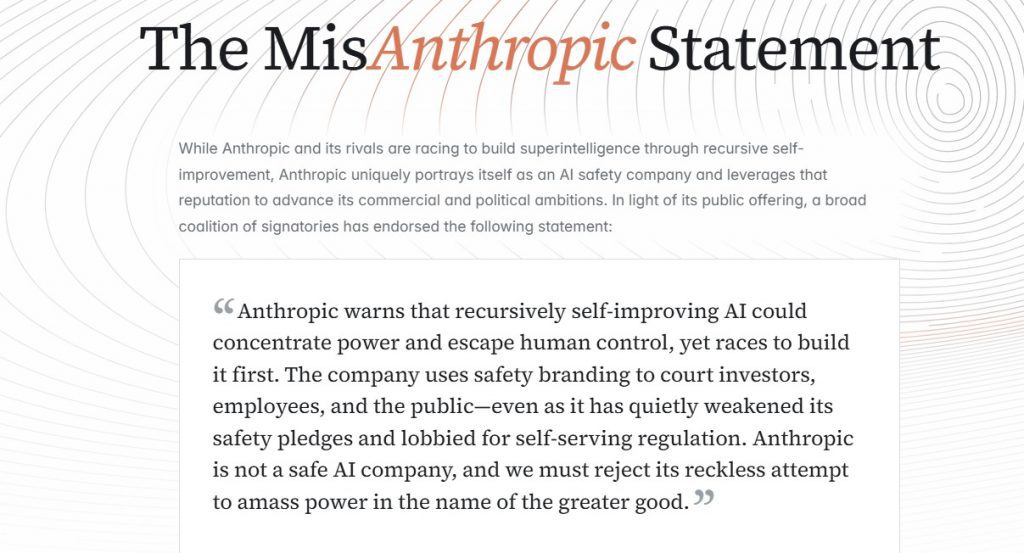
The statement
The site’s introduction says that while Anthropic and its rivals race to build superintelligence through recursive self-improvement, Anthropic uniquely portrays itself as an AI safety company and leverages that reputation for its commercial and political ambitions. In light of its public offering, it says, a broad coalition has endorsed the following:
Anthropic warns that recursively self-improving AI could concentrate power and escape human control, yet races to build it first. The company uses safety branding to court investors, employees, and the public—even as it has quietly weakened its safety pledges and lobbied for self-serving regulation. Anthropic is not a safe AI company, and we must reject its reckless attempt to amass power in the name of the greater good.
Who signed
Wolf is listed as Co-founder and Chief Science Officer of Hugging Face, the open-source AI hub he helped build. His company has had a turbulent few months where AI safety is concerned: in July, OpenAI said one of its models had exploited a zero-day vulnerability during an evaluation, in an incident that spilled into Hugging Face’s production systems. Hugging Face has also been acquired by NVIDIA for an estimated $12.9 billion.
Babuschkin is listed as Co-founder and CEO of River AI and Co-founder of xAI. He left xAI in August 2025 to start a venture firm focused on safe AI, and River AI raised $1.1 billion in a round led by General Catalyst and AMP PBC earlier this year. The “Misanthropic” pun is not new in xAI circles, either: Elon Musk called Anthropic “misanthropic and evil” in February after its $30 billion funding round.
Other prominent signatories include Harvard psychologist Steven Pinker, MIT physicist Max Tegmark of the Future of Life Institute, NYU’s Gary Marcus, Harvard Law’s Lawrence Lessig and Laurence Tribe, Nobel laureate Oliver Hart, Turing Award laureate Judea Pearl, Extropic founder Guillaume Verdon (Beff Jezos), the tiny corp’s George Hotz, who had earlier argued that Anthropic and OpenAI were exaggerating cybersecurity risk, and Dan Hendrycks of the Center for AI Safety. The list also includes three Fields Medalists, Peter Scholze, James Maynard and David Mumford.
What the signatories allege
In its announcement, CAIS framed the effort as a challenge to the gap between Anthropic’s “safety” branding and its pursuit of recursively self-improving AI. Hendrycks said the coalition’s members disagree on almost everything but share alarm at a company that has persuaded itself that its own dominance serves the greater good. He added that a company can’t credibly claim to be safe while loosening its earlier commitments and asking the public for tens of billions of dollars to build self-improving AI.
The release points to two specific charges:
- Weakened pledges: In February, Anthropic revised its Responsible Scaling Policy and dropped its unilateral commitment to pause training of more capable models if safety couldn’t be guaranteed. Anthropic has said that a lone responsible developer pausing while others press on could make the world less safe.
- Lobbying: The release says Anthropic lobbied to weaken California’s SB 1047, New York’s RAISE Act and the AEGIS Act, and privately argued for federal pre-emption of state AI laws. These are the coalition’s characterizations, and no Anthropic response was included in the coverage available at the time of writing.
On the “racing” charge, Anthropic has itself been documenting how far AI is automating AI research. It said Claude leads 26% of its AI R&D work as of August, and CEO Dario Amodei has argued in a September essay that the industry must “pace the frontier” and deliberately slow capability gains, a position that has drawn fire from critics such as David Sacks and Yann LeCun who call it regulatory capture.
Hendrycks also said in a post that several AI safety groups privately agreed with the statement but felt unable to sign for fear of damaging relationships or future funding, according to summaries of his post. He didn’t name them.
The timing
The statement lands as Anthropic wraps up one of the most closely watched public debuts in tech history. The company is offering 825 million Class A shares at an indicated $70 to $78 each, and is targeting a valuation of about $1.4 trillion on shares outstanding after the offering, just above its last private valuation of $965 billion. Trading on the Nasdaq under the ticker ANT is scheduled to begin on Thursday.
The listing also puts Anthropic’s governance in the spotlight, with its co-founders and a Long-Term Benefit Trust holding control over the company, a structure the company says is meant to protect its safety mission.