OpenAI isn’t done with mathematics just yet.
Days after claiming a solution to the Navier-Stokes existence and smoothness problem, the company has said it’s already sitting on progress on a second Millennium Prize Problem — one of the seven grand unsolved questions in mathematics for which the Clay Mathematics Institute has offered a $1 million bounty since 2000.
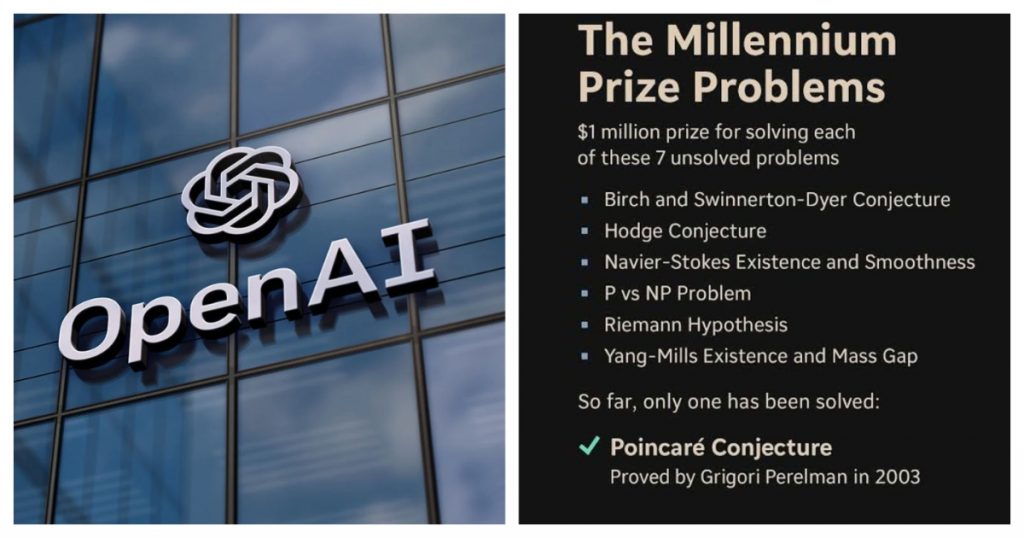
In a statement put out Wednesday night and reported by the New York Times, OpenAI said: “In addition, since the completion of Navier-Stokes, we have made substantial progress on another Millennium Prize problem. We are working through how to share these results thoughtfully.”
A Fast Follow-Up To A Bruising Week
The statement lands just days after OpenAI said an unreleased internal model had produced a machine-checked proof for the Navier-Stokes problem, which describes how fluids like air and water move and underpins everything from aircraft design to weather forecasting. OpenAI said the effort involved thousands of AI agents working over roughly 88 hours, and that it does not intend to claim the associated prize money, framing the whole exercise as a demonstration of how fast its frontier models are improving.
That announcement didn’t land cleanly, though. It set off a credit dispute with mathematicians Tristan Buckmaster and Levent Alpöge, who had been quietly working on a closely related question for months and accused OpenAI of moving in on their approach after learning of it. Separately, mathematician Andreas Thom has questioned whether OpenAI drew on his own ChatGPT chat history while working on an unrelated proof about non-sofic groups.
As such, the line about “sharing these results thoughtfully,” reads like a company that’s learned something from the blowback of the last ten days.
What’s Next: Social Media Bets On The Hodge Conjecture
OpenAI hasn’t named the problem it’s working on, but that hasn’t stopped speculation from filling the gap. Chatter across social media has zeroed in on the Hodge Conjecture as the likely candidate. It’s worth stressing this is speculation, not anything OpenAI has confirmed.
So what is the Hodge Conjecture?
Mathematicians study shapes called algebraic varieties — essentially, the shapes you get when you plot the solutions to systems of polynomial equations in many dimensions at once, the way a circle is the shape you get from x² + y² = 1, just far more complicated and in far more dimensions. These shapes can have holes, loops, and higher-dimensional voids running through them, and mathematicians have tools to catalogue this “shape information” in a very abstract, purely topological way, without any reference to the equations that produced it.
The Hodge Conjecture, put forward by the Scottish mathematician W.V.D. Hodge in 1950, asks a deceptively simple question: does every one of these abstract “holes” actually correspond to something you could describe using algebra — a real, definable sub-shape sitting inside the larger one, built out of polynomial equations of its own? In other words, is the topology of these spaces always secretly traceable back to algebra, or can a shape have holes that have no algebraic explanation at all?
It’s known to be true in some restricted, easier settings, but the general case has resisted every attack for more than 70 years. It matters well beyond pure algebraic geometry too, with links to number theory, string theory, and Grothendieck’s theory of motives, which is one reason the Clay Institute picked it as one of its seven flagship problems in 2000.
Only One Down, So Far
For context: of the seven original Millennium Prize Problems, only the Poincaré Conjecture has been formally solved and verified, by the reclusive Russian mathematician Grigori Perelman in the early 2000s. Navier-Stokes, contingent on independent verification of OpenAI’s proof, would be the second. If OpenAI’s next claim does turn out to be the Hodge Conjecture, and it holds up to scrutiny, it would be a third scalp within a matter of weeks — an extraordinary pace for a set of problems that took mathematicians collectively over two decades to make a single dent in.
Whether that scrutiny holds is the real story here. The Navier-Stokes proof is still being independently checked by the mathematics community, and the credit disputes around it are unresolved. OpenAI saying it’s made “substantial progress” on something else is not the same as a verified result — and the company’s own caution about how to “share these results thoughtfully” suggests even OpenAI knows the difference.