Instinct, the personal AI agent that went from stealth to Silicon Valley obsession in a matter of weeks, has raised $1 billion at a $10 billion valuation. The Series C was announced Monday and was backed by Sequoia Capital, Benchmark Capital and Coatue. It comes almost exactly a month after the company raised $250 million at a $2.5 billion valuation, and it values a startup with just 14 employees at more than $700 million per head.
The round is the latest and steepest step in one of the fastest valuation climbs the AI industry has seen. Instinct was valued at roughly $50 million in the spring; five months later, it is worth 200 times that.
What is Instinct?
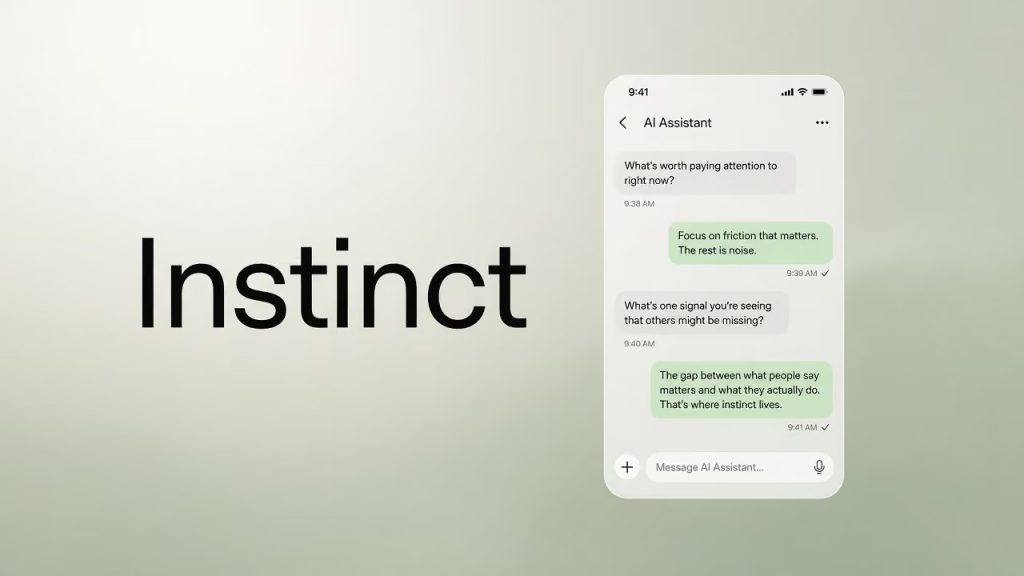
Instinct is a consumer AI agent, essentially a digital personal assistant that does things rather than just answer questions. There is no app to learn. Users text or call Instinct, and it carries out the task using its own computer and phone, operating software much the way a human assistant would. Founder Noah Shinn put it simply when introducing the product in late August: there are no new interfaces.
Users connect it to their email, calendar, messaging apps and other accounts. Early testers say they have used it to plan cross-country road trips, order weekly groceries, buy concert tickets, negotiate bills and cancel forgotten subscriptions. One person is reportedly using it to plan a wedding.
The company has been shipping quickly since it came out of the shadows. Instinct can now place and handle phone calls on a user’s behalf, and a new concierge service is aimed at bookings and other errands. A Trusted Person network lets Instinct agents coordinate with the agents of a user’s friends and family; Shinn said the network, opened to all users on September 14, had already been used for more than 300,000 coordinations. Instinct can also build private or public interactive pages, called Files, to compare options or lay out a plan, which users can share with others.
Instinct is still invite-only, and access has been limited partly by compute. It has crossed 100,000 users, and the service has sometimes told people it is running at capacity and that responses may be slower. It is currently free, and Shinn has said he doesn’t want to charge users, which leaves the business model an open question. Advertising has been floated as one possible route.
The platform is reportedly built primarily on open-weight models, which would help explain how a team this small has moved this fast. The company itself hasn’t published details of its stack.
The founder: a 23-year-old agent researcher
Instinct is operated by Spear Street Technology, Inc., a San Francisco company registered in California in April. Reporting has identified Noah Shinn, 23, as the founder and CEO, and no co-founders have been publicly named.
Shinn’s background is unusually well matched to the product. He studied at Northeastern University and did machine learning and programming-language research there and at MIT, before dropping out in 2023. That same year, he was the first author of Reflexion, a NeurIPS paper showing that language agents can improve by reflecting in words on their own failures and storing those reflections as memory. The technique reportedly reached 91% pass@1 on the HumanEval coding benchmark, ahead of the 80% reported for GPT-4 at the time.
He then joined Sierra, the enterprise agent company founded by Bret Taylor and Clay Bavor, as one of its earliest employees and a research scientist. There, he co-developed τ-bench, a benchmark that tests whether agents can reliably use tools, follow business rules and deal with users across multi-step tasks, and which was presented at ICLR 2025. In other words, Shinn spent years studying how agents fail and recover before building one for consumers.
The funding run
Instinct’s financing history has been compressed into a few months. It began with an early round at a roughly $50 million valuation, backed by Conviction and Greenoaks. In early August, Kleiner Perkins led a $75 million Series A at about $500 million. On August 26, Index Ventures and Benchmark co-led a $250 million Series B at $2.5 billion. Now comes the $1 billion Series C at $10 billion from Sequoia, Benchmark and Coatue.
That takes the company’s total funding to more than $1.3 billion. Sequoia and Benchmark had been reported as being in talks to lead the latest round earlier this month.
In a statement, Shinn said the funding will help bring Instinct to more people, describing the goal as building the best personal agent for the deeply personal nuances of everyday life.
Big rivals, bigger questions
The timing is not a coincidence. Meta launched its own personal agent, Muse, on September 8, and it has already signed commerce partnerships with Shopify, PayPal, Instacart and Expedia. Muse is free with paid tiers, and it has run into friction of its own: Amazon blocked the agent from shopping on its store. Meanwhile, there are signs that OpenAI is preparing an always-on assistant of its own. Instinct is trying to outrun trillion-dollar competitors, and its bet is that a focused product and a fast start can get it there.
Instinct is also entering territory that earlier open-source assistants like Clawdbot helped popularize, but it is aimed at people who don’t want to self-host anything.
The harder problem is trust. Instinct’s access is broad by design, and its terms have drawn scrutiny from privacy researchers. TechCrunch reported security and privacy concerns in August, and investor Katie Jacobs Stanton reportedly had an incident in which the agent sent an email on her behalf. Last week, a user said Instinct had described a financial document that wasn’t theirs. Shinn responded that no user data was shared and that the model had fabricated details, and said the company had built a system to detect hallucinations across everything the platform generates. The company also says it built sandboxing, short-lived credentials and identity-signed tool execution into the product from the start.
A familiar pattern
Instinct is one of several AI companies whose valuations are climbing far faster than their headcounts or revenue. Cognition, the maker of Devin, is now valued at $48 billion, having been at $26 billion just a few months earlier. What sets Instinct apart is how little there is behind the number so far: a team of 14, a product in invite-only access, no revenue model announced, and a founder who is barely out of his early twenties.
Investors are betting that the consumer agent becomes the next computing layer, and that whoever earns people’s trust first will be very hard to dislodge. Whether Instinct can do that with a team this small, and with compute costs rising alongside its user base, is the question its $10 billion valuation now has to answer.