It’s easier than ever to build apps, but it seems that it’s also harder than ever for them to find users.
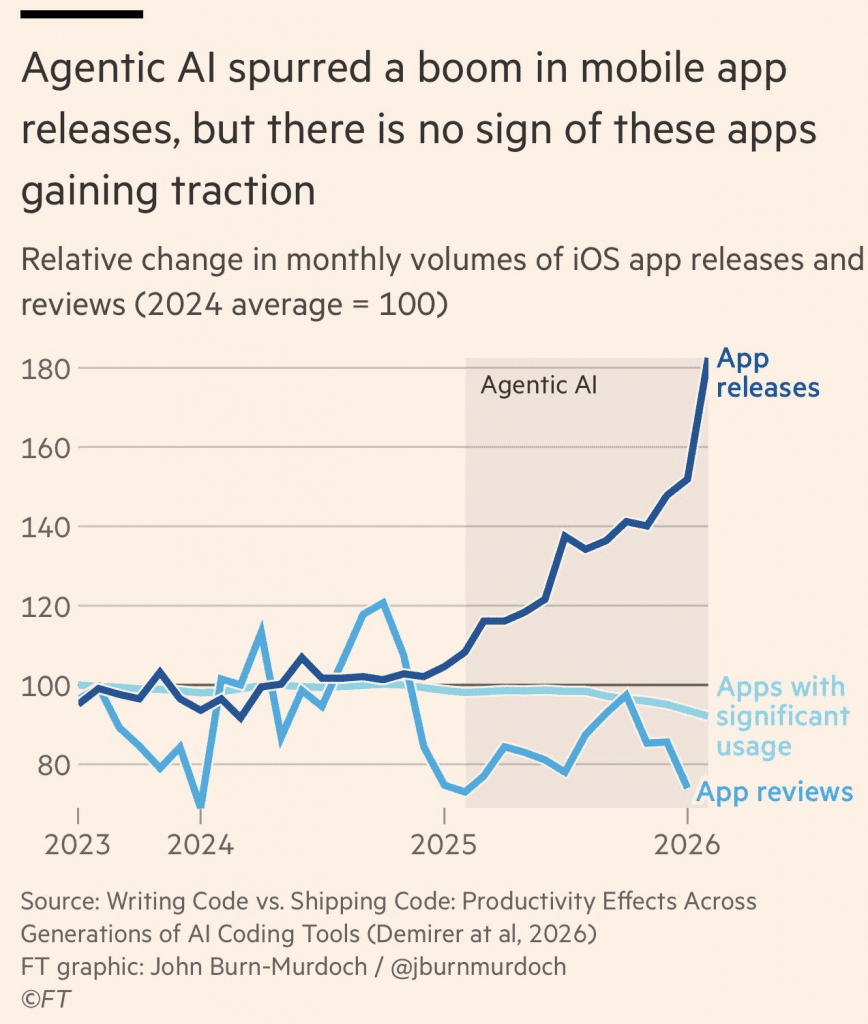
A new chart from the Financial Times, drawing on research by Demirer et al. (2026), makes this gap visible in stark terms. iOS app releases have climbed from an index of 100 in 2024 to nearly 180 by early 2026 — an 80% surge in just over two years. Two other lines on that same chart barely move. Apps with significant usage and app reviews have stayed essentially flat, hovering right around where they were in 2024. The supply of apps has exploded. The demand hasn’t followed.
The proximate cause is vibe coding. The term was coined by Andrej Karpathy, a co-founder of OpenAI and former AI lead at Tesla, in a February 2025 social media post describing a mode of software creation where you describe what you want in plain language and let a large language model write the actual code. What was initially a weekend-project curiosity became, over the following year, the dominant paradigm for how software gets built. Tools like Claude Code, Cursor, and Replit made it possible for people with minimal programming backgrounds to ship functional iOS apps in an afternoon.
The numbers reflect that shift. According to data from Sensor Tower, App Store submissions grew 30% for the full year of 2025 versus 2024. Then in Q1 2026, submissions hit 235,800 — an 84% year-over-year jump, the largest single-quarter surge in a decade. Apple processed upwards of 200,000 weekly submissions at the peak, and review times that had historically taken 24 to 48 hours ballooned to as long as 30 days.
But the chart from the FT tells a quieter, more consequential story than any of those submission figures. Volume went up. Engagement didn’t.
The App Store has long had a discoverability problem, but agentic AI has compounded it significantly. When the barrier to shipping an app dropped to almost zero, what flooded in wasn’t just ambitious solo builders and first-time founders — it was also low-effort clones, thin wrappers around AI APIs, and apps optimized for submission rather than for use. As one analysis noted, the signal-to-noise ratio in the store degraded sharply. Legitimate apps got buried. Apple’s own search algorithms, which already favor larger publishers, weren’t built for this volume.
Naval Ravikant has argued that software will proliferate the way writing and music did when their respective barriers to entry collapsed — punk rock stripped away the need for conservatory training; vibe coding strips away the need for engineering education. The analogy is useful, but it cuts both ways. The music streaming era produced millions of tracks that no one listens to alongside the ones that define culture. The same dynamic now appears to be playing out in the App Store.
Replit’s CEO Amjad Masad has said that you don’t need development experience to build software today — you need grit and the ability to learn fast. That may be true for building. It says nothing about distribution, which remains as hard as it’s ever been. Getting someone to download your app, return to it, and eventually pay for it involves product intuition, user research, marketing, and timing — none of which AI tools materially help with yet.
Apple has responded to the flood by tightening enforcement. In March 2026, it quietly blocked updates for several vibe-coding platforms, including Replit and Vibecode, citing rules against apps that generate other apps. The company is simultaneously integrating agentic coding capabilities into its own Xcode — a move that effectively positions Apple as the gatekeeper for how AI-assisted iOS development is allowed to work.
What the FT’s chart ultimately shows is a mismatch that the tech industry tends to rediscover in every platform wave: building is not the bottleneck. The top AI coding tools have solved a real problem — they’ve genuinely compressed the time and expertise required to go from idea to working software. What they haven’t changed is the attention economy on the other end. Users have the same number of hours in a day, the same reluctance to try new apps, and the same low tolerance for anything that doesn’t immediately work well.
The app reviews line on that chart, sitting stubbornly flat while releases soar, is the market giving its verdict. More apps is not the same thing as more good apps, and users have shown they know the difference.