Global call-center employment, which grew at a steady clip for more than a decade, has turned sharply negative, and new data suggests AI is a major reason why. The numbers come from workforce analytics firm Revelio Labs and were highlighted by venture capital firm a16z, which has otherwise argued that broader fears of an AI jobs apocalypse remain unsupported by the evidence. Call centers, it says, are the exception.
From steady growth to steep decline
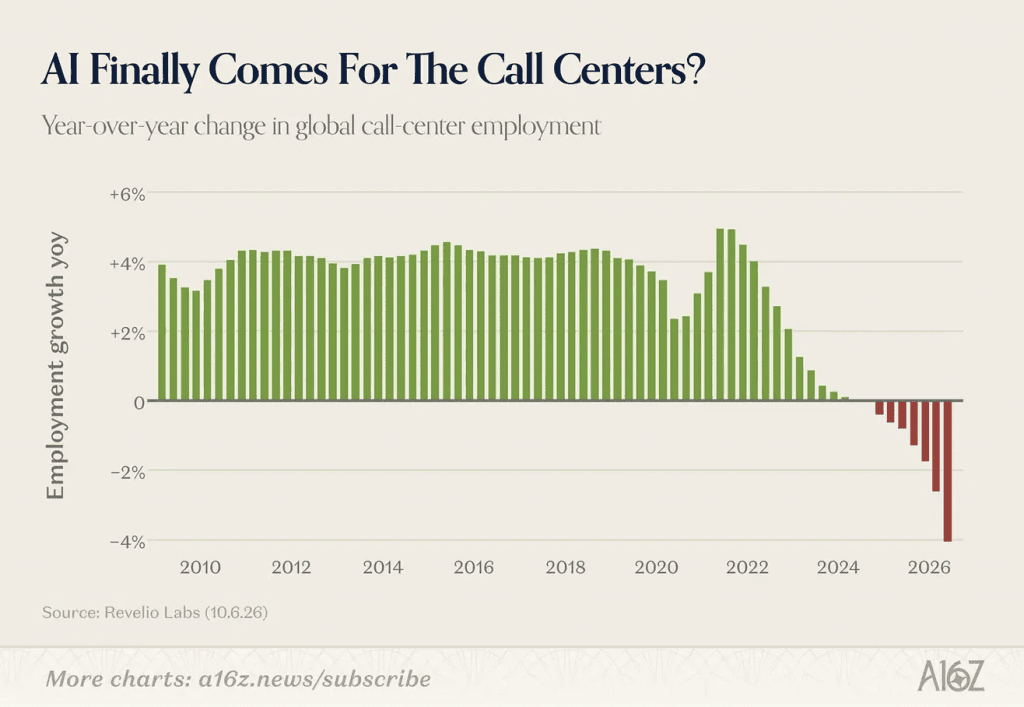
According to Revelio’s data, year-over-year growth in global call-center employment hovered around 4% for most of the 2010s. It briefly spiked to nearly 5% in 2021, then began to slow. By early 2024 growth had fallen to roughly zero, and it has since gone negative, with the most recent reading showing employment shrinking by about 4% from a year earlier.
The slowdown didn’t start with AI. Growth began cooling when interest rates rose, which was slightly before ChatGPT was released in November 2022. But the downtrend steepened after that point and has accelerated in recent months, which is hard to explain through the rate cycle alone.
Even poorer countries are now shedding jobs
The data also shows who has been hit first. Higher-income countries saw their contribution to call-center employment growth turn negative in 2022. Lower-middle-income countries, where much of the world’s outsourced call-center work is done, stayed in positive territory for roughly two more years and were relatively insulated through most of 2024.
That buffer is gone. According to a16z’s reading of the Revelio data, call-center employment growth had turned negative in every income bracket by Q4 2025. Across the 18 countries in the dataset, the overall contribution to annual employment growth is now roughly -2 percentage points, with high-income countries accounting for the largest share of the drop.
It’s not just white-collar work in general
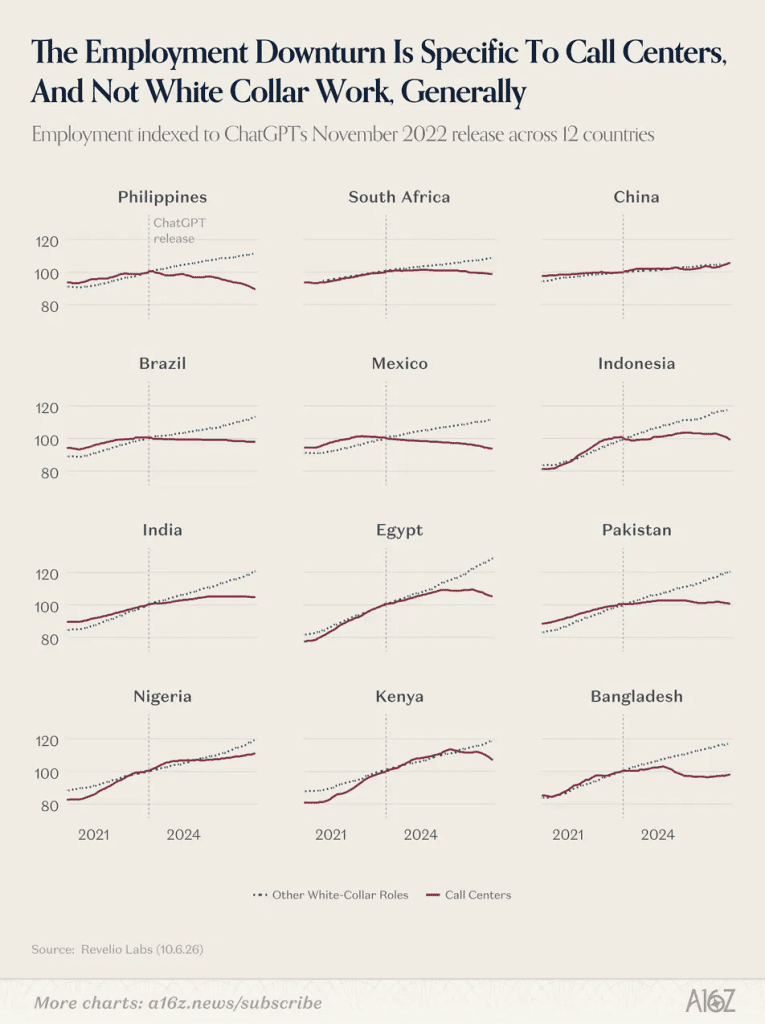
A natural question is whether call centers are simply caught in a broader white-collar slowdown. Revelio’s country-level data suggests they aren’t. Indexing employment to ChatGPT’s November 2022 release (set to 100) across 12 countries, other white-collar roles have kept growing in nearly every market, while call centers have lagged or fallen.
The gap is widest in places with big outsourcing industries. In the Philippines, call-center employment has slipped to around 90 on the index, while other white-collar roles sit above 110. Mexico shows a similar divergence, with call centers at roughly 94 against about 112 for other white-collar work. In Bangladesh, Pakistan, Indonesia and Brazil, call-center employment is flat to down while other white-collar employment has climbed roughly 13% to 20% above its 2022 level. Egypt and Kenya saw call-center employment keep rising after ChatGPT’s release, but both have rolled over recently while other white-collar jobs kept climbing.
China is the one notable exception, with call-center employment tracking other white-collar work and ending slightly above it. In every other major non-US market in the dataset, call centers have trailed the broader category.
The company-level picture
The aggregate data lines up with what individual companies have been doing. In India, for instance, Zomato laid off over 500 customer service executives as it rolled out Nugget, an in-house AI customer support platform that now handles millions of support interactions a month across its brands. Customer support work involves language skills and fairly set patterns of response, which is exactly the kind of task large language models handle well.
Is AI really the cause?
There could be other contributing factors, and the Revelio data can’t isolate AI as the sole driver. But a16z argues that call centers were always expected to be among the first targets for AI substitution, which makes AI the most reasonable explanation for the pattern, particularly the divergence from other white-collar roles after late 2022.
There is also a more reassuring note. In the US, overall unemployment has remained relatively stable, which suggests that people leaving call-center jobs have largely found work elsewhere. That would make the shift look more like a reshuffling than a collapse, at least for now.
Still, the call-center numbers give some early evidence for warnings that have been circulating for a while. Anthropic CEO Dario Amodei has said that AI could wipe out half of all entry-level white-collar jobs within one to five years. Call centers, with their scripted, high-volume work, may simply be the first place that prediction is visible in the data. If so, other categories of routine office work could follow.