Many tech leaders are now downplaying the concerns around AI-related job losses, but Anthropic only seems to be doubling down on its claims.
Christopher Olah, co-founder of Anthropic and the head of its interpretability research, made a stark warning about AI and employment while speaking at the Vatican on May 25, alongside Pope Leo XIV at the launch of Magnifica Humanitas — the Pope’s first encyclical, focused on the protection of human dignity in the age of AI.
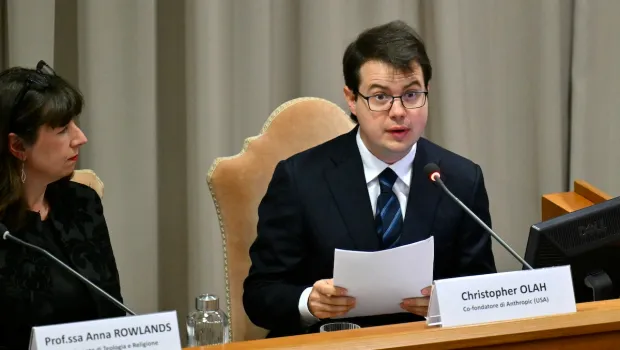
“There is a real possibility that AI will displace human labour at a very large scale,” Olah said. “If that happens, supporting those displaced will be a moral imperative of historic proportions.”
But Olah did not stop there. He argued that most public debate on the subject is missing the harder problem entirely.
“This task will be difficult enough, but I worry that most dialogue misses an even harder challenge. AI development is concentrated in a handful of wealthy nations. How will we ensure that the gains from AI are shared globally? We do not have mechanisms for this. It is an unsolved problem.”
The remarks land at a moment when the evidence of displacement is already accumulating. Salesforce cut 4,000 customer support roles by replacing them with AI agents. Block laid off 40% of its staff in early 2026, with Jack Dorsey explicitly citing AI. Customer support hiring has collapsed industry-wide, with the share of new hires going into those roles falling from 8.3% to under 3% in under two years. Finance job openings are at their lowest since the 2008 financial crisis.
Olah’s warning puts Anthropic at odds with some of the most influential voices in tech. Jensen Huang, CEO of Nvidia — the company whose chips underpin virtually all of AI’s growth — has consistently pushed back on the jobs apocalypse narrative. His well-worn formulation is that workers won’t lose their jobs to AI, but to other workers who use AI. He has argued that AI could put 30 to 40 million people back into the workforce, and has directly dismissed Anthropic CEO Dario Amodei’s prediction that AI would wipe out half of all entry-level white-collar jobs. “He thinks AI is so scary, but only they should do it,” Huang said of Amodei. Marc Andreessen has been similarly dismissive. “The job loss thing is very reductive,” he said, arguing that any displacement will be “swamped” by macro growth. He has also attributed much of the current wave of tech layoffs not to AI but to pandemic-era overhiring — suggesting the AI excuse is just a convenient cover for companies cleaning up their balance sheets.
The stakes of this disagreement are high. If Huang and Andreessen are right, the main policy task is ensuring workers upskill fast enough to ride the wave. If Anthropic is right, the task is far harder — and far less tractable. Governments would need to build support systems for displaced workers at a scale and speed that has no modern precedent, while simultaneously finding ways to distribute AI’s gains to the billions of people in countries that had no hand in building it. That’s the problem Olah described as unsolved — and the uncomfortable truth is that nobody in the industry, including Anthropic, has a concrete answer for it either.