Anthropic and OpenAI keep swapping places at the top of the AI leaderboards, but there is something that sets them apart in the way they’ve been communicating.
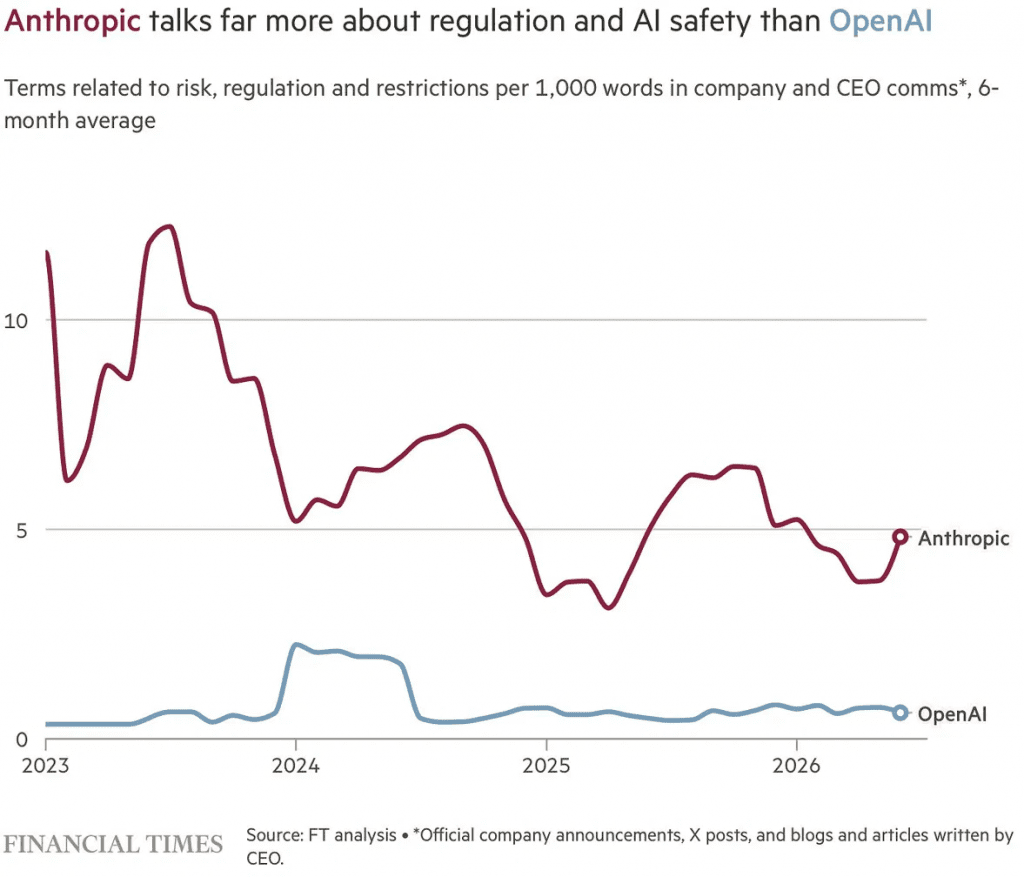
A Financial Times analysis of company and CEO communications — tracking terms related to risk, regulation, and restrictions per 1,000 words across official announcements, X posts, and blog articles — shows a striking divergence. Anthropic’s safety and regulation language peaked at over 11 mentions per 1,000 words in early 2023 and, while it has trended down since, has consistently hovered between 4 and 7 times higher than OpenAI’s. OpenAI’s line, by contrast, has barely moved — flat and close to zero across the entire period.
The Safety-First Identity
Anthropic was built on the premise that OpenAI wasn’t taking safety seriously enough. Several of its co-founders left OpenAI specifically over those concerns, and the company has worn its safety credentials publicly ever since. CEO Dario Amodei has warned that AI companies ignoring risks could end up in the same position as cigarette manufacturers and opioid producers who knew about dangers but stayed silent. His proposals have now gone well beyond philosophy — in a June 2026 essay, he called for FAA-style mandatory testing of frontier AI models, with governments having the power to block deployments that fail to meet safety standards.
Amodei has also been one of the most vocal voices on AI-driven job displacement, warning that AI could eliminate half of all entry-level white-collar jobs within five years, spike unemployment to between 10 and 20 percent, and produce a scenario the world has never seen before — high GDP growth alongside high unemployment. Sam Altman has publicly disagreed with the scale of these predictions, calling them unsupported by current evidence.
The Regulatory Capture Accusation
The critics don’t dispute that AI carries risks. What they dispute is whose interests are really being served by the relentless safety drumbeat.
Meta’s Chief AI Scientist Yann LeCun has been the most pointed, accusing Anthropic of using fear-based studies as a ploy for regulatory capture — the idea that by pushing for strict regulation, a handful of well-resourced frontier labs can make it prohibitively expensive for smaller players and open-source competitors to survive. “They are scaring everyone with dubious studies so that open source models are regulated out of existence,” LeCun posted. Former US AI czar David Sacks has made a similar argument, calling Anthropic’s approach “a sophisticated regulatory capture strategy based on fear-mongering.”
The chip export control debate sits squarely inside this tension. Anthropic has been a vocal supporter of restricting chip exports to China, arguing that US compute dominance is a critical strategic lever. Amodei has framed a world where the US and its allies can outpace China on compute as far preferable to one where both sides reach scale simultaneously. Critics see this as a convenient alignment of national security language and competitive self-interest — Anthropic benefits from a world where China’s AI capabilities are constrained, and where the bar for building frontier models is high enough to keep the field small.
The Case for Taking It Seriously
The counter-argument is straightforward: the risks Anthropic describes are real, and someone has to be saying this out loud.
Claude Mythos — Anthropic’s most capable model, restricted to a small group of trusted partners under Project Glasswing — was found during testing to be capable of autonomously exploiting software vulnerabilities at a scale that alarmed cybersecurity researchers. Anthropic’s own description of what the model could do scrambled serious conversations about cybersecurity risk in ways that couldn’t simply be waved away. The US government eventually took Anthropic at its word, imposing export controls on Fable 5 and Mythos — a remarkable turn of events given that Anthropic had been arguing for exactly this kind of government oversight of dangerous models.
On job displacement, Nobel Prize-winning AI pioneer Geoffrey Hinton has backed Anthropic and Google DeepMind as the companies taking safety most seriously, while describing OpenAI as getting “less responsible every day.” Anthropic has also backed its warnings with money — announcing $350 million in funding to support an economic policy framework addressing AI-driven labour displacement, alongside its June 2026 essay calling for wage insurance, retention incentives, and new tax structures to support workers through the transition.
What makes the company’s safety language more credible than pure messaging is the consistency of the underlying argument. Amodei has said publicly he sees roughly a one-in-four chance that AI development goes “really, really badly.” That’s not a marketing slogan. It’s a specific, falsifiable estimate of existential risk from the CEO of one of the world’s most capable AI labs — one he has repeated across multiple forums while also cautioning against alarmism unsupported by evidence.
The Gap Itself Is the Story
OpenAI’s near-zero score on the FT’s risk-and-regulation index isn’t an accident. It reflects a deliberate communication posture — one that emphasizes opportunity, product, and capability over risk and caution. Whether that reflects genuine optimism about AI’s trajectory, or a calculation that safety talk is bad for business, is something only OpenAI’s leadership knows.
What the data shows is that two companies competing for the same market, the same talent, and increasingly the same customers have arrived at almost opposite answers to a basic question about how much an AI company should talk about what its technology might do wrong. The gap between them on that question has barely closed over three years.