The impacts of AI in the research space are showing up exactly where one would expect.
arXiv, the preprint server that has become the main venue for sharing AI research, is capping how often authors can submit, saying the surge in AI-assisted writing has made its old moderation approach unworkable.
Effective October 1, 2026, each submitter is limited to two submissions per calendar month, with no more than three active submissions at any one time. The rule applies across all subject categories. arXiv describes it as a stopgap while it works out what the new norm should be for authors using increasingly capable AI tools, and while it upgrades its moderation tools and procedures.
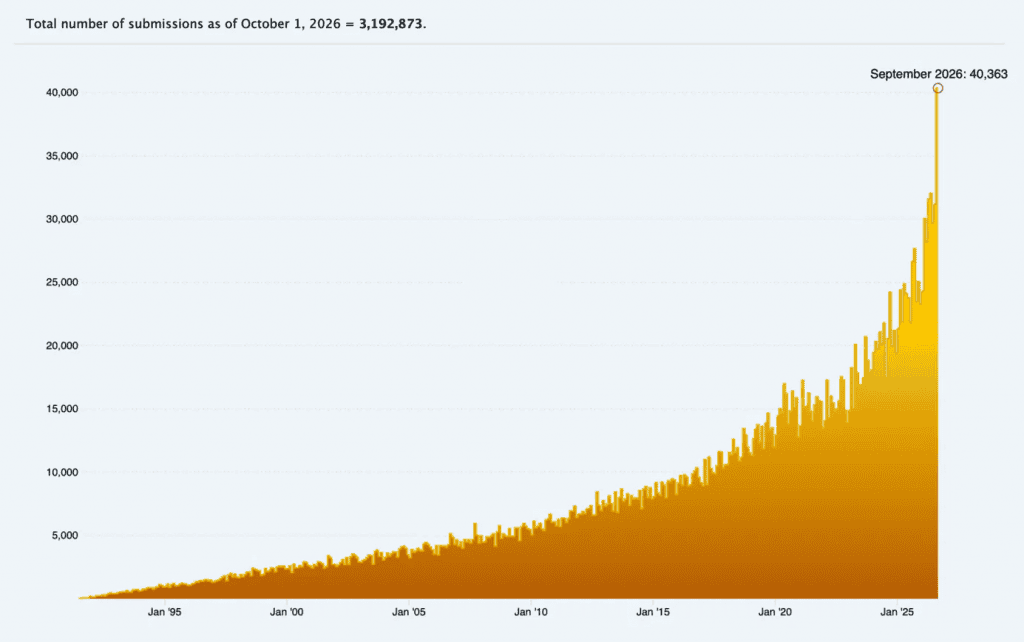
Submissions have doubled in two years
The numbers explain the urgency. arXiv received 9,869 submissions in September 2016 and 20,569 in September 2024. This September, it received 40,363, a record, which also generated nearly 9,000 support tickets for staff and moderators. Overall, arXiv has now passed 3.19 million submissions since its founding in 1991.
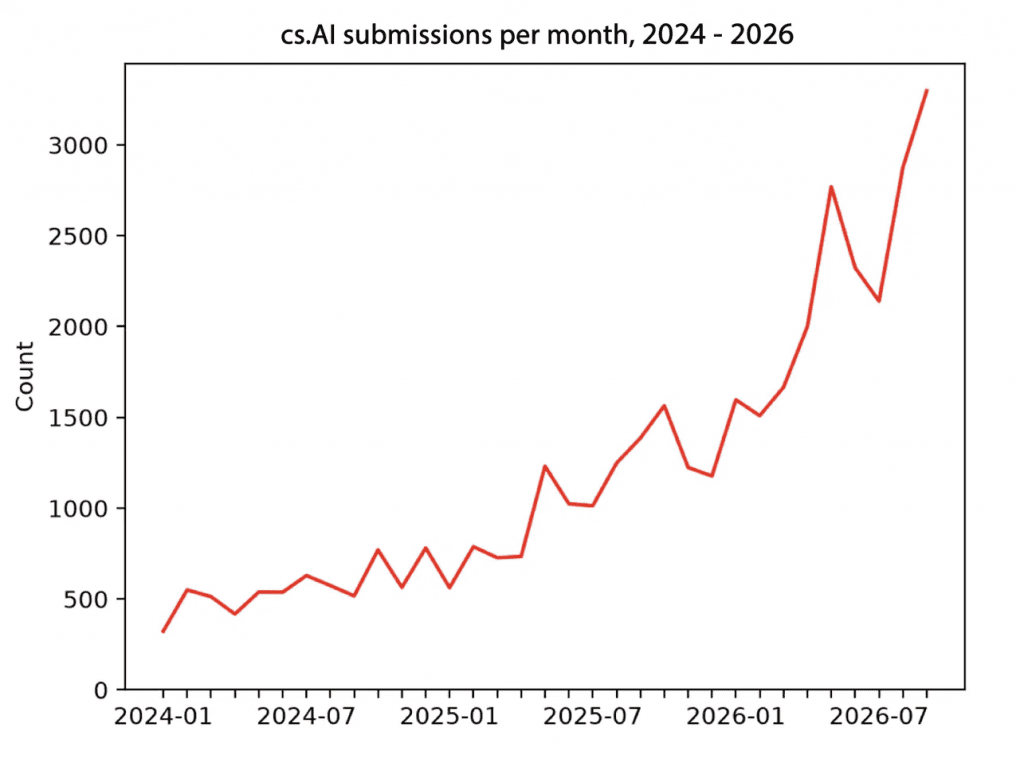
The growth is steepest in AI itself. arXiv says submissions to cs.AI, its Artificial Intelligence category, have risen more than sixfold over the past two years, while other categories have roughly doubled.
“Thin” papers and salami slicing
arXiv says its volunteer moderators have long limited submitters who were far above what a human could plausibly produce, because there used to be a practical ceiling on output. AI tools have made that ceiling a moving target.
The platform still permits AI use as long as it’s disclosed and the work meets its standards of scholarly interest. But moderators are seeing a rise in thin papers of narrow scope, “salami” papers where one piece of work is split into several smaller submissions, and dense, AI-written papers. arXiv says a relatively small group of authors submitting large volumes of low-quality work is consuming a disproportionate share of moderator time, delaying papers from authors who submit carefully.
What counts toward the limit
arXiv’s FAQ spells out how the rules work in practice. Rejected papers still count, since the limit applies to submissions rather than announced papers, and submissions are what consume moderator time. The cap covers all categories, so splitting work across subject areas won’t help. Submissions still on hold in a later month don’t count against that month’s two, but they do count toward the three-active-submission limit. The limits apply only to the person who submits, so a co-authored paper counts against the submitter alone and teams will need to coordinate who files. Papers deleted before they are announced won’t count toward either limit. There are no exceptions for conference deadlines or backlogs, and authors are told to plan their submissions around the limits. The three-active-submission cap itself isn’t new: arXiv has had it since 2024.
Part of a wider squeeze on AI-era publishing
The move follows a series of tightening steps. Late last year, arXiv stopped accepting computer science review articles and position papers unless they had already been peer reviewed, after a flood of AI-generated surveys that moderators described as little more than annotated bibliographies. Earlier this year, it said authors whose papers contain clear evidence of unchecked LLM output, such as hallucinated references, would face a one-year ban.
The pressure is hitting the rest of academic publishing too. AI conferences are dealing with record submission volumes and AI-written reviews, and AI agents are increasingly being built to do research end to end. A fully AI-generated paper has already passed peer review at a machine learning conference workshop, and there is now a journal that lists AI systems as the authors, with humans acting as prompters.
arXiv says it will keep monitoring the effects of the new limits on authors, readers and the corpus, and adjust the policy as needed. For now, the message to researchers is to submit less and submit their best work.