AI systems are increasingly helping out with math research, and this is now appearing in relevant data.
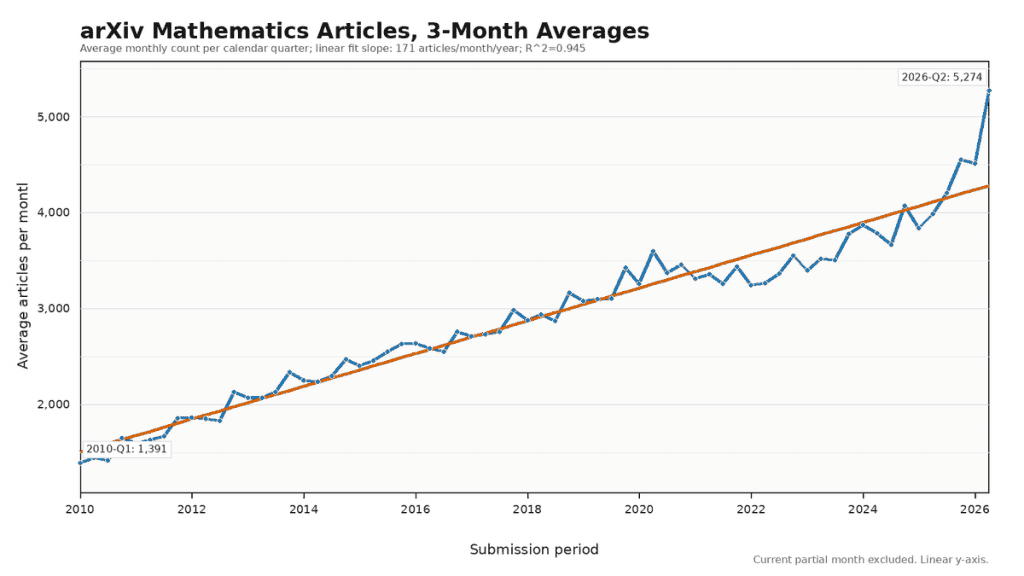
A chart shared by Jasper Dekoninck, a PhD student at ETH Zurich, tracks the average number of mathematics papers submitted to arXiv every month since 2010, smoothed over rolling three-month windows. For most of that fifteen-year stretch, the line hugs a remarkably clean trend: about 171 more papers a month every year, with an R² of 0.945 that would make most economists jealous. Submissions climbed from roughly 1,400 a month in early 2010 to around 3,900 by early 2024, almost entirely along that straight line.
Then the line stops behaving. Through 2024 and into 2025, the series starts to wobble above and below trend more than it used to, and by the second quarter of 2026 it has broken away entirely — sitting at 5,274 papers a month, roughly 20% above where fifteen years of steady growth would have placed it. For a metric with a near-perfect linear fit for over a decade, that is not a small deviation. It’s a structural break.
What’s actually showing up in the numbers
The obvious explanation is that AI tools are now doing meaningful work inside mathematics research, and the volume of output is starting to reflect it. This isn’t a hunch dressed up as data journalism — the last twelve months have produced a string of results that would have sounded implausible in 2023.
In May, OpenAI disproved the Erdős unit distance conjecture, a problem in discrete geometry that Paul Erdős posed in 1946 and that had resisted solution for nearly 80 years. Fields Medalist Tim Gowers said the proof was rigorous enough that he would have recommended it for publication in the Annals of Mathematics without hesitation. The proof didn’t come from a clever new geometric trick — it imported machinery from algebraic number theory, tools nobody in discrete geometry had thought to apply.
Around the same time, Google DeepMind’s AlphaProof Nexus agent worked through 353 open Erdős problems and closed out nine of them, each verified formally in Lean rather than argued in prose, at a cost of a few hundred dollars per solve. Separately, a multi-agent system called AxiomProver worked through four previously unsolved problems in early 2026, including one tied to differentials in algebraic geometry that two mathematicians had been stuck on until the model found a connection to Jacobi symbols overnight.
The competition-math side of the ledger has moved just as fast. GPT-5.4 scored above 95% on the 2026 US Math Olympiad, a test where models were still producing circular, half-guessed arguments a year earlier. Mathematicians who work alongside these systems day to day describe something similar. Terence Tao, the closest thing the field has to a universally respected authority, has said AI now lets him try crazier things than he otherwise would, comparing the process to working a blackboard together with a collaborator who can finish computations neither of them wants to sit through by hand.
Why the paper count would move at all
None of this means AI is authoring 20% of arXiv’s math output on its own. What it more plausibly means is that mathematicians are producing papers faster because a meaningful chunk of the grinding work — checking cases, searching literature, formalizing a proof sketch, filling in a lemma — has been offloaded. Stanford’s Ravi Vakil described exactly this dynamic after DeepMind’s model helped him and colleagues finish a proof in algebraic geometry: he wasn’t sure he wouldn’t have found the argument eventually, but he was fairly sure it wouldn’t have happened as quickly, or perhaps at all, without the back-and-forth with the model.
That’s a subtler claim than “AI is writing math papers,” but it’s also a more testable one, and it lines up with what the arXiv numbers show. A steady 171-paper-a-month trend held for fourteen years because the rate-limiting step was human time: reading, checking, writing up. If that constraint loosens even partially, output should climb faster than the historical trend — which is precisely the shape of the deviation in the chart.
Whether this pace holds is a separate question. Formal verification catches a lot of errors that would once have slipped into print, but reviewers and journals still work at human speed, and a surge in submissions doesn’t guarantee a surge in results that hold up over time. Erdős problems are also a finite and shrinking resource — DeepMind’s own paper on AlphaProof Nexus notes the wins are concentrated in areas where Lean’s math library is already well developed, and that solve rate was just 2.5% of the problems attempted. Still, for a series that spent a decade and a half moving in an almost perfectly straight line, breaking above it by 20% in a single year is the kind of thing worth watching closely.