AI written text had surpassed human written text on the internet last year, and the same flip has now happened with web traffic.
Cloudflare data shows that bots now account for 57.5% of all HTTP requests to HTML content on the internet, with human traffic at just 42.5%. It is the first time in the internet’s history that automated traffic has overtaken real users — and it happened ahead of schedule.
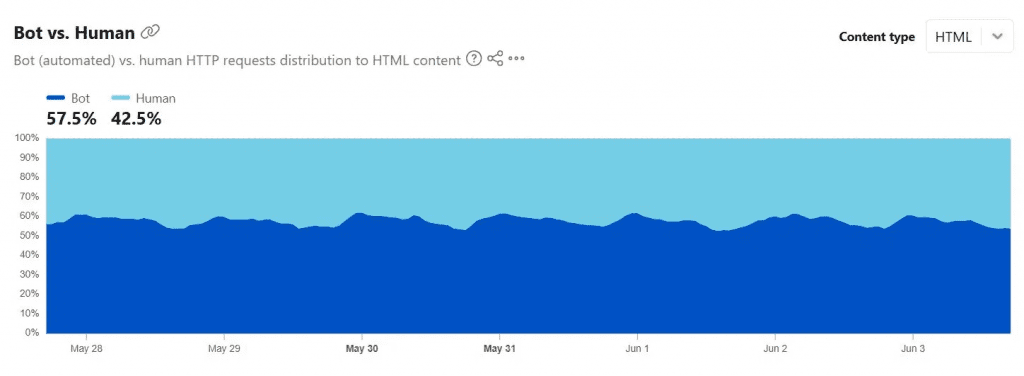
Cloudflare CEO Matthew Prince had predicted at SXSW in March 2026 that bot traffic would surpass human traffic by 2027. He has now walked that back. “Welp, that happened faster than I predicted,” Prince posted on X. “Thought it would be end of 2027, then early 2027, but agentic traffic growing so fast that bots have now passed human traffic online for the first time in the Internet’s history.”
The driving force appears to be agentic AI. When a person shops for a product, they might visit five websites. An AI agent completing the same task could hit thousands. That multiplier effect — applied across millions of users delegating tasks to AI — has fundamentally altered the composition of internet traffic. Prince put the ratio at roughly 1,000x: one human task, one thousand bot page visits.
This is not a fringe phenomenon. Cloudflare sits between roughly one-fifth of all websites on earth and the traffic hitting them. The data is not a sample or a projection — it is a live read of the internet’s infrastructure.
The trajectory had been visible for some time. Cloudflare’s own 2025 year-in-review found that non-AI bots alone started that year responsible for half of all HTML page requests, already seven percentage points above human traffic. A separate report from cybersecurity firm Human Security found that AI traffic nearly tripled across 2025 and was growing eight times faster than human activity. Agentic AI — bots that act on behalf of users — made up just 1.7% of automated traffic by end of 2025, but that category grew nearly 8,000% over the course of the year.
The crossover that Prince had flagged as a 2027 event has arrived in mid-2026.
For website owners and publishers, the implications are significant and already being felt. Bot traffic — even when it represents genuine user intent delegated to an agent — does not translate into the kind of engagement metrics websites have optimized for. AI agents don’t linger on product images, scroll through articles, or click display ads. Analytics tools built for human behavior are increasingly blind to what is actually happening on the web.
Cloudflare has been building for this transition. The company launched Pay Per Crawl in 2025, allowing publishers to charge AI scrapers for access to their content. It has since blocked over 416 billion AI bot requests at the request of website owners, and introduced tools to cryptographically verify the identity of agents. More recently, it rolled out a Markdown-for-Agents format to make content easier for AI systems to consume — a recognition that the agentic web is not going away, and that infrastructure needs to be redesigned around it rather than simply defended against it.
Prince has called this a platform shift comparable to the move from desktop to mobile. The difference is pace. The desktop-to-mobile transition played out over nearly a decade. The bot-to-human traffic inversion — which seemed far off as recently as early 2026 — has already happened.
The internet was built on the assumption that there is a human being on the other side of the screen. That assumption no longer holds.