OpenAI hasn’t yet introduced ads within its platform at scale, but it already seems to have laid the groundwork for a sizable ads business.
OpenAI CFO Sarah Friar, speaking at an All In podcast event, made the case for why ChatGPT is better positioned for advertising than either Google or Meta — and dropped a striking claim along the way: ChatGPT already commands at least 11% of the search market.
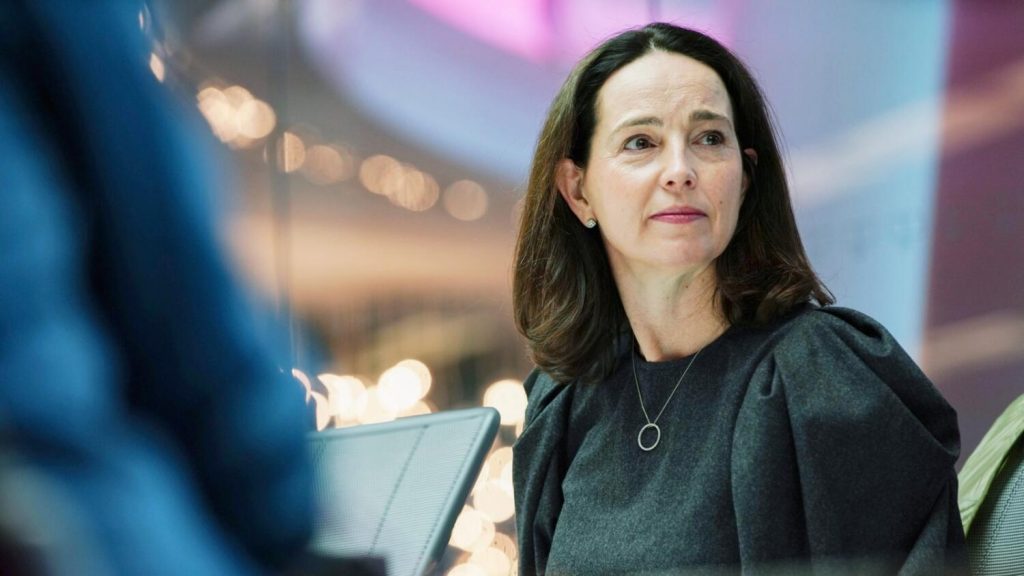
Friar was careful to frame the ads conversation around principles first. “We want to stick by our principles,” she said. “We want to make sure that you’re always getting the best result based on the model, not by something that was sponsored. So that has to hold true.” She also committed to keeping an ad-free paid tier for users who don’t want ads — a nod to the trust OpenAI has built with its user base and doesn’t want to erode.
But the more striking part of her remarks was the competitive framing. Friar cited a line from fellow OpenAI exec Fidji Simo: “If Google and Meta had a baby, it would be ChatGPT.” She used that as a jumping-off point to explain why the platform is uniquely suited to advertising. On the Google side, she pointed to search intent. “We know we have at least eleven percent of the search market,” she said, while noting that the number is almost certainly understated. She said that a single Google search counts as one query. A full ChatGPT conversation with fifty back-and-forth exchanges also counts as one. “So in reality, we have a much higher portion, very high intent.” The implication being that on a query-adjusted basis, ChatGPT’s actual share of search-like activity is considerably larger than the headline figure suggests.
On the Meta side, she pointed to targeting depth. She said that Meta uses demographic and behavioural signals to infer intent, but ChatGPT goes further, because users state their intent directly. And layered on top of that is memory. “I just told you it knows who I am. So imagine putting memory and context next to intent. You should have a very potent ad platform.”
She then addressed the tension at the heart of OpenAI’s strategy — the gap between where the money is today and where the company is trying to go. “If I was optimizing only for today, I would give every token to the API. Every token to the API. Order of magnitude more than to the consumer.” OpenAI makes money on all API tokens, but not necessarily on those for free consumers on ChatGPT’s platform. But she made clear that’s not the game OpenAI is playing. “We have a strategy where we believe there’s an AI infrastructure layer, a utility like electricity, and in a future state, you’ll want to be able to serve the world writ large. Consumers, small businesses, large enterprises, governments. That’s our strategy.”
The remarks land at a genuinely complicated moment for OpenAI. The company announced it would begin testing ads in ChatGPT’s free and Go tiers earlier this year — a significant pivot from years of resisting the model. That resistance wasn’t always principled; as tech analyst Ben Thompson argued sharply, OpenAI’s prolonged reluctance to introduce ads may have cost it time it can’t get back. Meanwhile, Sam Altman had previously warned that allowing sponsored results to surface above better ones would be “catastrophic” for user trust — the exact concern Friar’s comments were designed to pre-empt.
The financial pressure context also matters. Friar herself has reportedly flagged concerns internally about OpenAI’s ability to meet computing contracts if revenue doesn’t grow fast enough, and the company has missed its own user and revenue targets. At the same time, OpenAI’s API market share has eroded significantly, with Anthropic and Google making substantial inroads — which makes building a durable consumer revenue stream even more urgent. Friar’s point about tokens going to the API paying “an order of magnitude more” than consumer use is an honest acknowledgment of this bind: the consumer product is what the world knows, but it’s currently the less profitable bet. Ads, done right, could change that math — and if the search market share claim holds, the audience is already there.