Pricing data sourced from Artificial Analysis. Blended price uses a 7:2:1 cache-hit/input/output token ratio. Lower is better.
The AI pricing war is well and truly over — and developers won. A wave of open-weight Chinese models, aggressive API strategies from xAI, and OpenAI’s own budget tiers have collapsed token costs by an order of magnitude in under two years. If you’re still paying frontier prices for workhorse tasks, you’re leaving serious money on the table. Here’s a look at the 10 cheapest AI models available right now, ranked by blended price — and why the cheapest AI models on this list aren’t just cheap, they’re genuinely capable.
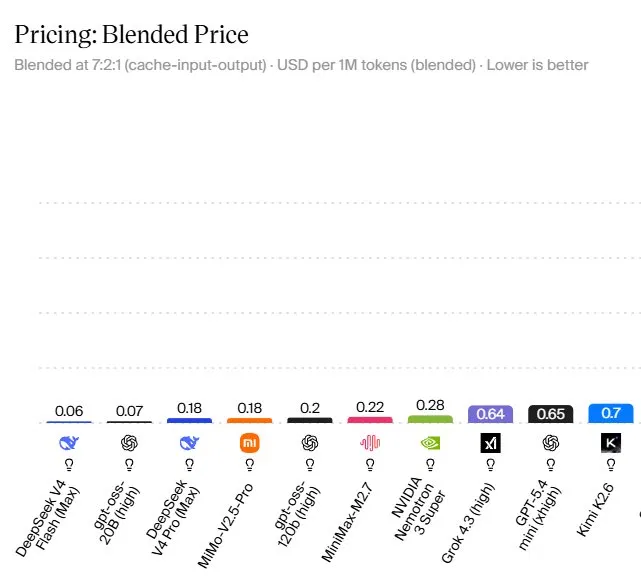
1. DeepSeek V4 Flash (Max) — $0.06/1M token
The undisputed price champion right now, the cheapest AI models conversation invariably starts here. DeepSeek V4 Flash is a 284B-parameter Mixture-of-Experts model that activates just 13B parameters per token, which is how DeepSeek keeps inference costs so brutally low. Released on April 24, 2026, it supports a 1 million token context window and dual Thinking/Non-Thinking modes. At a blended rate of $0.06 per million tokens, it costs less than almost anything else on the market — and benchmarks comparably to what would have been a frontier closed-source model as recently as mid-2025. For output-heavy workloads like document generation, V4 Flash is the cheapest AI models story of the year.
2. GPT-OSS-20B (High) — $0.07/1M tokens
OpenAI’s open-weights answer to the Chinese cost offensive, GPT-OSS-20B is among the cheapest AI models from a US lab, sitting at just $0.07 per million tokens blended. At only 20 billion parameters, it’s the smallest model on this list and trades raw intelligence for extraordinary throughput and economy. It’s not going to win benchmarks against DeepSeek V4 or Kimi K2.6, but for high-volume classification, summarisation, and simple agentic routing tasks, the cost-per-useful-output ratio is hard to beat. OpenAI’s gpt-oss series briefly held the title of strongest open-weights model before Chinese labs pulled ahead — GPT-OSS-20B is the lean, budget-friendly entry point of that family.
3. DeepSeek V4 Pro (Max) — $0.18/1M tokens
The flagship of DeepSeek’s latest family, V4 Pro is a 1.6 trillion parameter model that activates 49B parameters per inference pass — and still manages a blended price of $0.18 per million tokens, making it one of the cheapest AI models at the frontier tier. It scores 52 on the Artificial Analysis Intelligence Index, placing it second among open-weights reasoning models globally, behind only Kimi K2.6. For teams that need near-frontier reasoning but can’t stomach GPT-5.4 or Claude Opus prices, V4 Pro is the most compelling cost-performance trade-off available. DeepSeek itself acknowledges it trails US frontier labs by 3–6 months — but at these prices, that gap barely matters for most production applications.
4. MiMo-V2.5-Pro — $0.18/1M tokens
Tied with DeepSeek V4 Pro at a blended $0.18, MiMo-V2.5-Pro is part of the growing cohort of cheapest AI models pushing into the mid-tier efficiency sweet spot. MiMo (Mini Model) is a small reasoning model from Xiaomi, originally designed for on-device deployment but increasingly competitive in cloud API contexts. Its V2.5-Pro variant delivers strong performance on reasoning and coding benchmarks relative to its size, making it an attractive option for developers who need reliable results at minimal cost — particularly in mobile-adjacent or edge-computing workflows where the cheapest AI models also need to be the leanest.
5. GPT-OSS-120B (High) — $0.20/1M tokens
A step up in capability from GPT-OSS-20B, the 120B variant is one of the cheapest AI models that credibly competes with mid-tier frontier outputs. At a blended $0.20, it occupies the territory where you get meaningfully better reasoning depth than the 20B model without approaching the cost of proprietary alternatives. OpenAI’s OSS-120B has been benchmarked as broadly comparable to Qwen and NVIDIA Nemotron alternatives, while delivering substantially higher throughput on equivalent hardware. For engineering teams building multi-step agent pipelines where the cheapest AI models need to handle genuine complexity, GPT-OSS-120B hits a practical sweet spot that few models at this price point match.
6. MiniMax-M2.7 — $0.22/1M tokens
MiniMax M2.7 is Shanghai-based MiniMax’s latest flagship, and at a blended rate of $0.22 per million tokens it represents one of the most striking value propositions among the cheapest AI models available today. It runs a sparse MoE architecture with roughly 230 billion total parameters but only 10B active per token. M2.7 delivers approximately 90% of Claude Opus 4.6’s quality on coding tasks at roughly 7% of the total cost — a head-to-head that speaks for itself. Built with agentic workflows in mind, it handles multi-step debugging, document generation across Word, Excel, and PowerPoint, and long-horizon tool chains well above its price point. Its automatic caching cuts repeated-context costs further, making it an especially compelling pick for RAG-style production workloads.
7. NVIDIA Nemotron 3 Super — $0.28/1M tokens
NVIDIA is famous for building the chips that power AI models. Nemotron 3 Super proves the company can also build some of the cheapest AI models worth running on them. Released at GTC in March 2026, it’s a 120B-parameter hybrid Mamba-Transformer MoE model with just 12B active parameters per token, a 1 million token context window, and inference throughput 2.2x higher than GPT-OSS-120B. The blended price of $0.28 per million tokens puts it within reach of high-volume agentic workloads where speed matters as much as cost. For developers self-hosting, NVIDIA releases the full weights, training recipe, and 10 trillion pretraining tokens under a permissive open model license — making it the most open model on this list by a wide margin.
8. Grok 4.3 (High) — $0.64/1M tokens
Grok 4.3 is xAI’s current flagship API model and, at a blended $0.64 per million tokens, is the most expensive entry on this list — though still dramatically cheaper than comparable proprietary models from OpenAI or Anthropic. Released April 30, 2026, it scores 53.2 on the Artificial Analysis Intelligence Index and supports a 1 million token context window with vision input and full tool use. The cheapest AI models capable of this level of reasoning are hard to come by, and Grok 4.3 earns its place here: at $1.25/$2.50 per million input/output tokens before blending, it’s 20% cheaper than its predecessor Grok 4.20 while outperforming it on benchmarks. xAI also gives developers up to $175/month in free API credits through its data-sharing program, making the effective cost even lower for qualifying workloads.
9. GPT-5.4 Mini (xHigh) — $0.65/1M tokens
OpenAI’s GPT-5.4 Mini is one of the cheapest AI models in its own lineup and a serious performer at that tier. Released March 17, 2026 — twelve days after the full GPT-5.4 launch — it scores 54.38% on SWE-Bench Pro, remarkably close to the standard GPT-5.4’s 57.7%, at roughly one-sixth the cost. The API list price of $0.75/$4.50 per million input/output tokens blends to approximately $0.65, putting it in direct competition with Grok 4.3. For teams already embedded in the OpenAI ecosystem, GPT-5.4 Mini is the most cost-efficient on-ramp to the GPT-5.4 family’s capabilities. It’s the model that makes building high-volume, latency-sensitive applications — customer support, content pipelines, lightweight coding assistants — financially sensible without leaving the OpenAI stack.
10. Kimi K2.6 — $0.70/1M tokens
Kimi K2.6 from Moonshot AI rounds out the list as the most intelligent of the cheapest AI models surveyed here. Released April 20, 2026, it scores 54 on the Artificial Analysis Intelligence Index — the highest of any open-weights model, period. With 1 trillion total parameters and 32B active per token across 384 MoE experts, it sits in the top tier of global AI rankings while pricing in at a blended $0.70 per million tokens. On SWE-Bench Pro, K2.6 edges out GPT-5.4 (57.7) with a score of 58.6 and beats Claude Opus 4.6 on Toolathlon and Humanity’s Last Exam with tools. For agentic coding tasks specifically, it’s the leading open-source model in the world — and at these prices, one of the most remarkable cost-performance stories in AI right now.
The Takeaway
The cheapest AI models in 2026 aren’t compromises. Seven of the ten models on this list are either open-weight or priced below $0.30 per million blended tokens — a level of access that was unthinkable for frontier-grade capabilities even 18 months ago. Chinese labs (DeepSeek, MiniMax, Moonshot AI) dominate the bottom of the price curve, while xAI and OpenAI have pushed their own budget tiers to stay competitive. For businesses running production AI workloads, the cheapest AI models available today aren’t the ones you pick when you can’t afford something better — they’re often the ones you pick because they’re genuinely the smartest buy.