While OpenAI says it has now reached its goal of creating an AI research intern, Anthropic too has come up with figures of just how much it’s managed to automate its AI research.
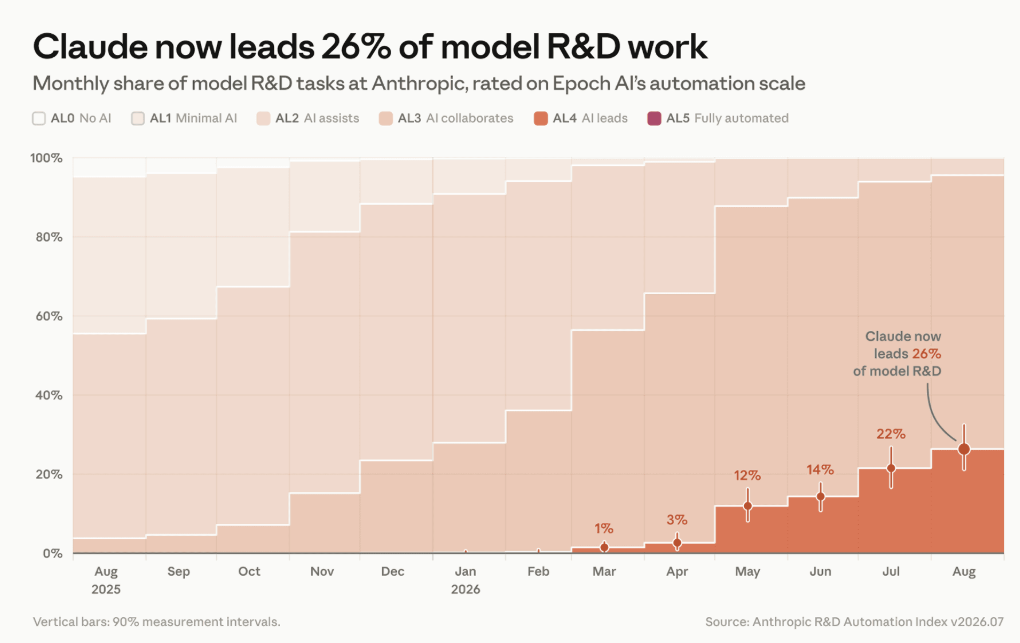
Anthropic has published a new set of internal metrics aimed at giving outsiders a rare look at exactly how much of its own AI research is now being done by AI rather than humans. The company says Claude “leads” 26% of Anthropic’s AI R&D work as of August 2026, and the share of work at or above “AI collaborates” is above 90%, a sharp jump from where things stood at the start of the year.
The numbers come from what Anthropic calls its R&D Automation Index, a project built specifically to catalogue every kind of AI R&D work done at the company, rate how automated each task currently is, and aggregate those ratings into a single score. It’s part of a broader push, alongside Dario Amodei’s call to pace the frontier, for labs to make the speed of their own AI-driven development legible to regulators and the public rather than something only insiders can see.
What “Leading” Actually Means
To grade automation, Anthropic leaned on a scale built by Epoch AI that runs from AL0, where AI has no involvement, to AL5, full autonomy with no human in the loop. The middle tiers matter most here: at AL3, or “collaborates,” AI can do large chunks of work under close human direction, while at AL4, or “leads,” it can complete most of a task end-to-end from a high-level prompt while a human simply supervises. Anthropic is careful to note that Claude is not operating fully autonomously for any measured slice of AI R&D work — the AL5 rung, true recursive self-improvement, hasn’t been reached.
To build the index, researchers didn’t just guess at what people were working on. Over four weeks, a Claude research agent reviewed a random 20% sample of staff each week using Slack messages and internal documentation to compile a flat list of roughly 15,000 granular R&D tasks, which Claude then organized into a tree of 542 nodes, 378 of them leaf-level categories like eval platform defect diagnosis or serving incident postmortems. A separate Claude judge model rated automation levels for each branch, and its calls were checked against actual staff: the model agreed with humans about as often as humans agreed with each other, and model and human ratings landed within one level of each other 97% of the time.
The trend fits with what Anthropic has been saying for months about its engineers writing less and less code by hand — a shift that’s coincided with the company generating far more code per engineer than it did just a couple of years ago.
Watching The Watchers
The second piece of the release focuses on how Anthropic keeps tabs on the agents doing all this work. The company disclosed that roughly 30,000 agents were doing research and engineering work on its most-used internal platform at any given time as of August 2026. Every action those agents take passes through either an online monitor, which intervenes in real time, or an offline monitor, which reviews activity after the fact.
The real-time system is the stricter of the two: Anthropic says 100% of agent actions pass through it before execution, usually within seconds, and after analyzing over a billion decisions in August 2026, only about 0.002%, or roughly 1 in 47,000, were actually blocked. The after-the-fact system casts a wider net, flagging roughly one to two transcripts in every thousand for closer review, with the highest-priority cases escalated to humans.
That kind of monitoring has become more pressing as Anthropic’s own research surfaces uncomfortable edge cases of agents misbehaving around each other, which is part of why the company keeps pushing for outside verification rather than grading its own homework — the same logic behind Amodei’s suggestion that he’d be open to handing Anthropic’s oversight to a coalition of democratic governments.
Where The Compute Goes
The third metric looks at compute rather than tasks. Over one sampled week in July 2026, Anthropic found that about 6% of compute going to AI R&D was allocated toward safety work, and about 12% of compute going toward AI-driven AI R&D was allocated to safety. The company is upfront that these are deliberately conservative figures, since any workload that advanced capabilities as much as it advanced safety was counted as R&D rather than safety spend.
Anthropic frames all three measurements as things any frontier lab could publish using a shared methodology, and says it plans to bring in independent third-party evaluators with the kind of internal access normally reserved for its own risk teams. It’s the latest concrete step out of a broader argument the company has been making since Amodei’s essay on the risks of what he calls AI’s technological adolescence — that the world can’t have an informed debate about slowing AI development down if it can’t see how fast the labs are actually moving in the first place.