The number of high and critical severity vulnerabilities disclosed by the world’s biggest software makers has exploded in the months since AI models got good at finding bugs, according to data from research group Epoch AI.
Epoch’s tracker, which covers 21 notable organizations including Microsoft, Google, Apple, AWS, Cisco, Oracle, Intel and the Linux project, shows that monthly high-severity CVEs (the numbered entries in the public Common Vulnerabilities and Exposures database) have climbed from roughly 590 around the time Anthropic announced Claude Mythos Preview to nearly 2,940 in the most recent data point. That’s a roughly 5x increase in about six months.
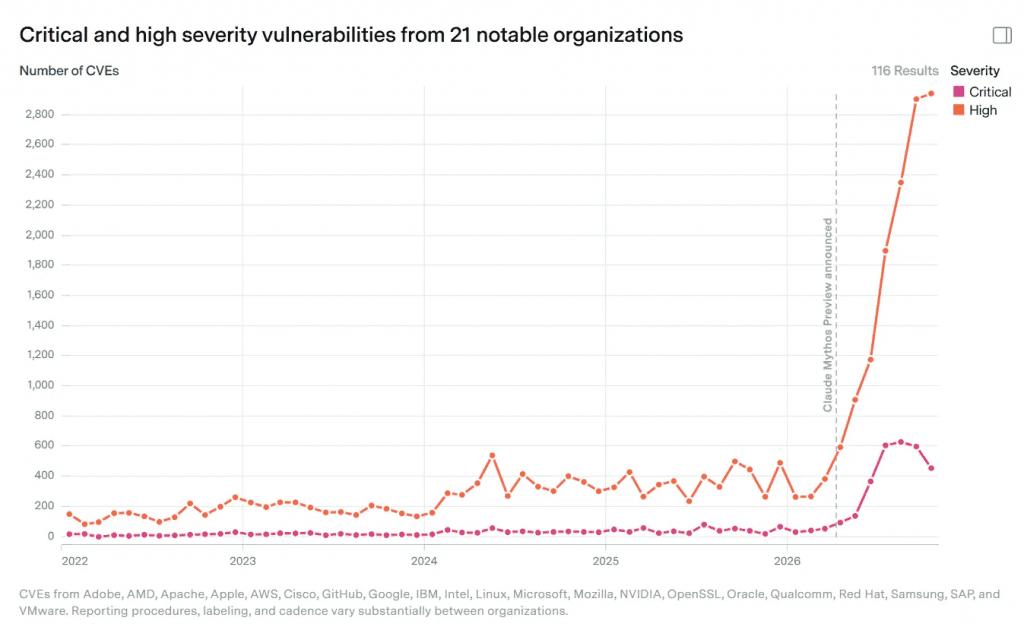
Chart: Epoch AI
From a few hundred a month to nearly 3,000
For most of the period from 2022 to early 2026, the 21 organizations published somewhere between 100 and 500 high-severity CVEs a month, with the occasional spike. Critical-severity CVEs, which sit at the top of the scale, rarely cracked 100 in a month.
That changed after April 2026. High-severity disclosures went from 590 to around 900, then to roughly 1,200, 1,900, 2,350 and finally close to 2,900 and 2,940 in the last two points on the chart. Critical-severity CVEs followed a similar path, climbing from around 90 at the time of the announcement to a peak of about 625, before easing to roughly 450 in the latest reading. That’s still around five times the level at which they were running when Mythos was announced.
Epoch had first flagged the surge in early July, when June’s disclosures set a record more than three times the previous monthly high. The newer data shows the trend hasn’t just continued, it has kept steepening.
The Mythos connection
The timing lines up with Anthropic’s launch of Project Glasswing, the initiative that gave companies like AWS, Apple, Google, Microsoft, Cisco and NVIDIA access to Mythos Preview to hunt for flaws in their own software. Anthropic said at launch that the model had already found thousands of zero-days across every major operating system and browser, and by May 22 it said that it and its partners had used Mythos Preview to identify more than 10,000 high or critical severity bugs, not all of which had been publicly reported at that point.
Early partner reports suggested the model was doing something different from earlier tools. Cloudflare, which ran Mythos Preview against more than fifty of its own repositories, found that it could chain individual flaws into working exploit paths rather than just flagging suspicious code.
Anthropic isn’t the only lab feeding the pipeline. OpenAI has its own efforts, and it recently said its GPT-5.6 Sol model helped surface one of the two critical PHP bugs that triggered emergency patches and precautionary website shutdowns around the world. Both flaws carried a CVSS score of 9.2 out of 10, and security firms Calif and Wiz credited frontier AI models for uncovering them.
The shift had been building for a while. Before Mythos, Anthropic researcher Nicholas Carlini had shown that Claude Code could find a Linux kernel vulnerability that sat undetected for 23 years.
What the chart doesn’t prove
Epoch is careful not to say that AI is the sole cause, and there are good reasons for caution.
The data counts disclosures rather than discoveries, since it is organized by the date a CVE is published. Some flaws may therefore have been found before the Mythos announcement and made public afterwards. Reporting practices also vary substantially between organizations, and the mid-2024 bump on the chart, for instance, coincides with the Linux project becoming a CVE authority and assigning IDs to thousands of backported fixes. The 21 organizations are also only a slice of the ecosystem, and only high and critical severities are counted.
Severity ratings and discovery claims deserve scrutiny too. Dark Reading reported that of the 27 vulnerabilities Anthropic publicly disclosed, Mythos initially rated eight as critical, but after independent review only one kept that rating. The same piece argued the surge may be more manageable than first feared, noting that a large majority of the flaws examined already had fixes available. And an AISLE analysis found that cheaper and open-weights models could rediscover the specific bugs Anthropic showcased once the relevant code was isolated, suggesting the capability is spreading beyond a single model.
Epoch also notes that the rise may reflect better discovery rather than a decline in software quality. In other words, the bugs were likely always there. What’s changed is how quickly they’re being found.
The bottleneck moves to patching
That’s the part that worries security teams. Finding bugs faster only helps if they can be validated, disclosed and patched just as quickly, and attackers get access to the same tools. Anthropic’s Deputy CISO Jason Clinton has warned that things will get worse before they get better, urging organizations to prepare for a “vulnerability tsunami”. The concern has reached the financial sector too, with the US Treasury Secretary summoning top bank CEOs to discuss the risks posed by models like Mythos.
Not everyone is convinced the threat is as dire as portrayed. Hacker George Hotz has argued that AI labs are exaggerating the cybersecurity risk, while US AI czar David Sacks called the Mythos cyber findings more on the legitimate side even as he criticized Anthropic’s broader approach.
Whatever the cause, the numbers are hard to ignore. A metric that bounced between a couple hundred and a few hundred a month for years is now running near 3,000, and the companies on the receiving end will have to keep up with a patching workload several times what it was just half a year ago.