The amount of money being spent to build datacenters continues to climb to new heights.
Private construction spending on datacenters in the US has now crossed above public spending on transportation — roads, highways, bridges, all of it. Two lines that spent most of the last decade in completely different weight classes have converged, and the datacenter line didn’t just catch up; it blew past.
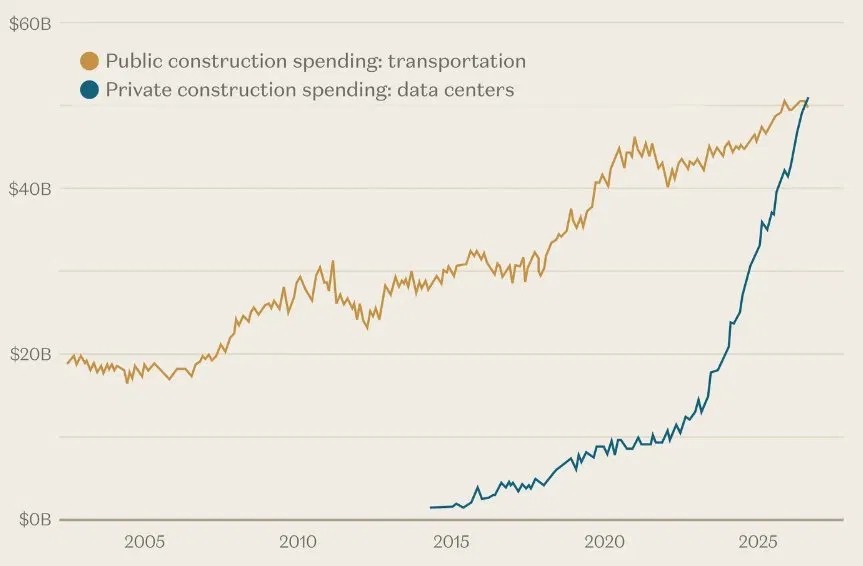
Ten years ago, this comparison would have seemed absurd. In 2014, datacenter construction spending sat at roughly $1.4 billion annually. Public transportation spending, meanwhile, was a steady, predictable line somewhere around $20 billion. The gap was enormous. Then ChatGPT launched in late 2022, and the math changed completely.
What Triggered the Surge
The inflection point is visible in the chart with unmissable clarity. From 2022 onward, datacenter construction spending curves sharply upward — a near-vertical line that has no real precedent in modern US construction history. The underlying driver is AI. Training and running large language models requires vast quantities of specialized hardware — GPUs, high-bandwidth networking, dense compute — that must be housed in purpose-built facilities with industrial-scale power and cooling. You can’t just rent an old office park.
The four largest hyperscalers — Amazon, Google, Microsoft, and Meta — have collectively guided their 2026 capital expenditures to roughly $715 billion, up more than 70% from the already-record $410 billion they spent in 2025. Amazon alone is projecting $200 billion in capex for 2026, a 60% jump in a single year. Most of that flows into AWS infrastructure and datacenters.
Datacenter construction spending grew by more than 33% in 2025 and is expected to grow by another 20% in 2026. Annual growth rates have exceeded 80% since 2022. In 2025, construction starts spending rose nearly 188%. These are not normal construction numbers.
A Structural Shift, Not a Cycle
It’s worth stepping back to appreciate what the a16z chart is actually showing. Transportation infrastructure spending is public money — state and local government budgets, bond issuances, federal allocations. It moves slowly, governed by political cycles and procurement processes. Datacenter construction spending is private capital, and it moves at the speed of an AI arms race.
Datacenter construction jobs are now outpacing office and home construction jobs combined. The employment chart from a16z shows the same shift playing out in labor markets. While residential specialty contractors have been shedding jobs, the “Total” line for construction employment flipped sharply positive in late 2025 — driven almost entirely by the datacenter subcategory.
This is not a temporary blip from one or two large projects. The spending is broad-based, geographically distributed, and being driven by companies that have explicitly told investors they have no intention of slowing down. Google’s Sundar Pichai put it plainly: “We are compute constrained in the near term.” The spending is the cure for that constraint.
The Bottlenecks That Come Next
None of this means the build-out will be frictionless. The single biggest constraint right now is power. More datacenter projects are being delayed by long wait times for electrical grid connections than by any other factor. Getting a new datacenter connected to the grid can take years in markets where transmission and distribution infrastructure hasn’t kept pace with demand.
Labor is another pinch point. The same construction workers being pulled into datacenter projects are being pulled away from roads, housing, and commercial buildings. The industry faces compounding shortages from retirements and tighter immigration policy. When a single datacenter campus can cost between $250 million and $500 million to build — at roughly $600 to $1,100 per square foot — and dozens of them are going up simultaneously, the competition for qualified workers gets fierce fast.
What This Means Going Forward
The trajectory shows no sign of bending. Goldman Sachs projects total hyperscaler capex from 2025 through 2027 will reach $1.15 trillion. What’s changed is the nature of American infrastructure investment itself. For most of the country’s history, “infrastructure” meant physical connectivity — the things that let people and goods move. The new definition, being written in real-time by capital allocation decisions at Amazon, Microsoft, Google, and Meta, is digital: the things that let compute scale. The crossover in the chart marks the moment one definition started overtaking the other.