Chinese labs now seem further from the frontier than they were three months ago, but they’re coming up with impressive releases all the same.
DeepSeek has pushed out a refreshed version of its Flash model, and the Chinese lab is framing it as a straightforward win-win: better scores, faster responses, and shorter outputs than the model it replaces. On a handful of agentic and coding benchmarks, the new release even edges past Anthropic’s Claude Opus 5, currently one of the strongest models in the AI race for coding and agentic performance.
DeepSeek-V4.1-Flash-1017 is now live on DeepSeek’s website, app, and API, the company announced. In its launch post, DeepSeek described the update as a “Pareto improvement in performance and cost” over the previous DeepSeek-V4.1-Flash, meaning it claims to have improved quality without making the model slower or pricier to run. The company also said the model has been optimized for DeepSeek Harness, Tencent’s CodeBuddy, WorkBuddy, and other agentic coding tools, and recommended developers upgrade to DeepSeek Harness v0.2.1-rc.1 or later to get the full benefit of the release.
DeepSeek V4.1-Flash-1017
DeepSeek published a fairly extensive benchmark sheet comparing V4.1-Flash-1017 against its own predecessor (DeepSeek V4.1-Flash), Moonshot’s Kimi K3, Zhipu’s GLM 5.3, OpenAI’s GPT 5.6-Sol, and Anthropic’s Claude Opus 5. The results are a mixed bag rather than a clean sweep, but they do show DeepSeek’s new Flash model pulling ahead of Opus 5 on several agent-heavy tests while still trailing on others.
Here’s how the two compare across the published benchmarks.
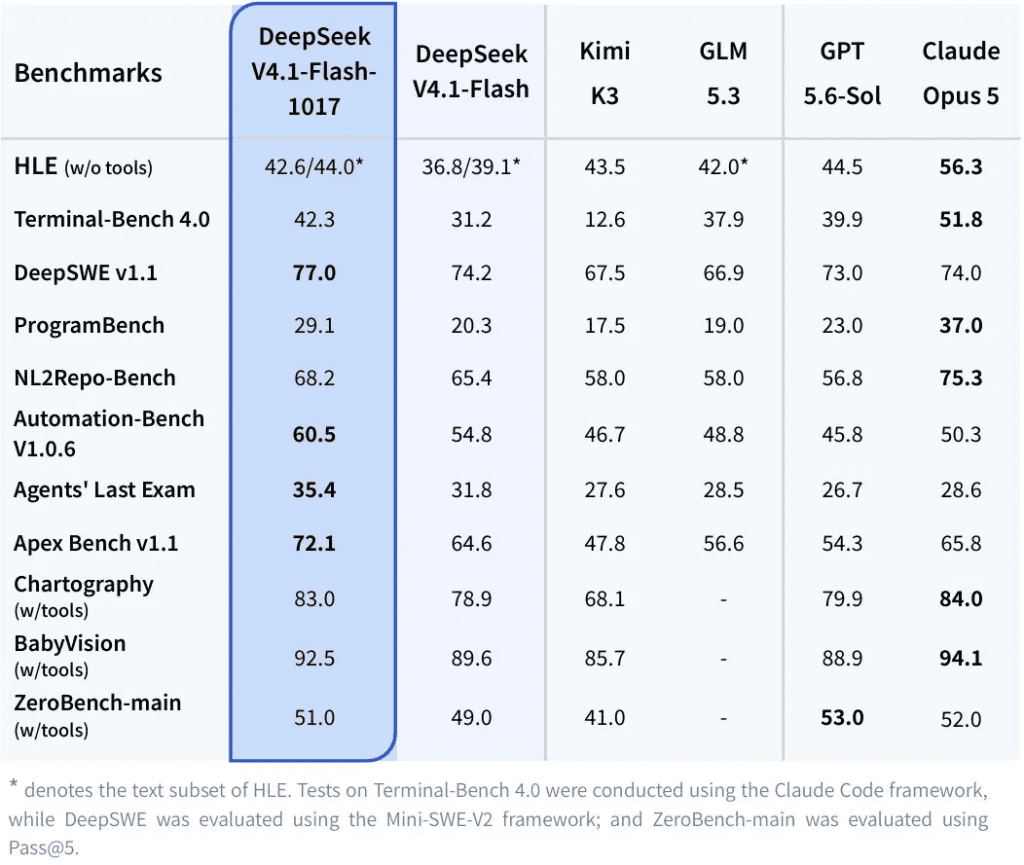
The pattern that stands out is where DeepSeek pulls ahead: DeepSWE v1.1 (a software engineering benchmark), Automation-Bench, Agents’ Last Exam, and Apex Bench are all tests built around multi-step, tool-using agentic workflows rather than single-shot question answering. DeepSeek-V4.1-Flash-1017 posts its biggest margin on Agents’ Last Exam, where it scores 35.4 against Opus 5’s 28.6, and on Automation-Bench V1.0.6, where it leads 60.5 to 50.3.
Claude Opus 5, on the other hand, holds a clear edge on raw knowledge and reasoning tests like Humanity’s Last Exam (56.3 versus 42.6/44.0) and on repository-level coding tasks like NL2Repo-Bench and ProgramBench. On the tool-assisted vision and multimodal benchmarks — Chartography, BabyVision, and ZeroBench-main — the two models are close, with Opus 5 ahead by only a point or two in each case.
Against the rest of the field, DeepSeek-V4.1-Flash-1017 comfortably outperforms Kimi K3, GLM 5.3, and GPT 5.6-Sol on nearly every listed benchmark, and it also beats its own predecessor, DeepSeek V4.1-Flash, across the board — which is really the headline claim DeepSeek is making with this release.
DeepSeek V4.1-Flash-1017: The Cost Angle
Beyond raw scores, DeepSeek also published a Pass@1-versus-cost chart for DeepSeek’s own DeepSWE v1.1 leaderboard, run on the mini-swe-agent harness, and this is where the new Flash model’s positioning becomes clearer. At its lowest reasoning-effort setting, DeepSeek-V4.1-Flash-1017 already scores above 72% while costing roughly $0.15–0.20 per task. At its highest setting, it touches 77%, still at under $0.25 per task.

For comparison, Claude Opus 5 needs upward of $10 per task at its higher effort settings to land around 73%, and models like GPT-6 Astra and Gemini 3.8 Flash sit in the $2–10 range for similar score bands. DeepSeek’s chart positions V4.1-Flash-1017 in the top-left corner of the plot — high accuracy, low cost — which is the company’s way of arguing that, task-for-task, its new Flash model is simply cheaper to run at a comparable or better quality than most of the competition, Claude Opus 5 included on this particular leaderboard.
This cost efficiency pitch is consistent with how DeepSeek has positioned itself since the original V3 model first disrupted pricing expectations in the AI industry — it isn’t trying to be the single best model on every leaderboard, but to get a very large share of frontier-level performance at a fraction of the compute cost.
Why This Matters
DeepSeek-V4.1-Flash-1017 isn’t claiming to dethrone Claude Opus 5 outright — Anthropic’s model still leads on raw reasoning, long-context code comprehension, and most of the multimodal tool-use tests. But the fact that a “Flash” tier model, DeepSeek’s faster and presumably cheaper offering, can beat a frontier model like Opus 5 on agentic benchmarks such as Agents’ Last Exam and DeepSWE v1.1 is notable. It mirrors a broader trend playing out across the industry this year, where open and Chinese labs have been closing the gap with US frontier labs specifically on agentic and coding tasks, even as the likes of Anthropic, OpenAI and Google continue to hold leads on harder reasoning benchmarks.
For developers building agentic coding tools, the combination of competitive agent benchmark scores, shorter outputs, and significantly lower per-task cost is likely to be the more persuasive pitch than any single leaderboard win. DeepSeek has said the model is already optimized for DeepSeek Harness, CodeBuddy, and WorkBuddy, and is encouraging developers on older harness versions to upgrade to v0.2.1-rc.1 or later to see the full improvement.