Palantir CTO Shyam Sankar has waded into the ongoing AI safety debate with a pointed comparison, arguing that the Effective Altruism-flavoured version of AI doomerism shares a structure with 20th century vanguardist politics.
“EA AI safetyism increasingly looks like Marxism-Leninism for the algorithmic age,” Sankar wrote in a post on X. “The old vanguard claimed privileged knowledge of the inevitable course of History. The new one claims privileged knowledge of the probabilistic course of Humanity. Both use an elaborate intellectual framework to reach the same political conclusion: a small group of enlightened people must constrain everyone else for their own good. That has never lead to anything except monumental human suffering.”
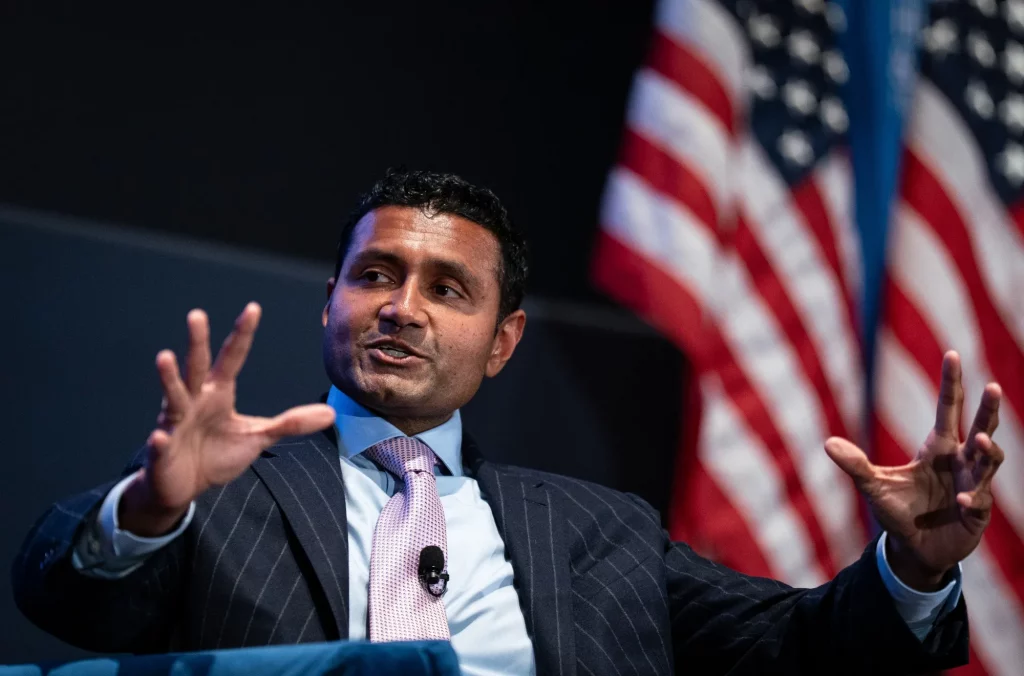
Sankar’s argument is essentially about epistemics and power. He’s not disputing that AI carries real risks, but objecting to how those risks get converted into a mandate for a small set of people to make decisions on behalf of everyone else. To make the point, he reached for a historical comparison of his own, one meant to show what he considers the right way to weigh catastrophic risk against acting anyway.
“Contrast the present hysteria with Los Alamos,” he wrote. “The Manhattan Project scientists thought the first nuclear explosion could ignite the atmosphere and end humanity. They did the math. They determined it wouldn’t. And they proceeded. Because they weren’t fighting a thought experiment. They were fighting the Nazis.”
From there, Sankar drew the contrast he was building toward, framing Effective Altruism’s approach to AI risk as an inversion of the Los Alamos calculation, one that trades a concrete, calculable threat for an abstract one dressed up in the language of probability.
“Effective Altruism inverts this,” he wrote. “Multiply a sufficiently horrifying hypothetical future by enough hypothetical future humans and suddenly speculation acquires the moral authority of fact. That’s not empiricism. It’s secular eschatology.”
He closed by drawing a distinction between engineering against risk and using the mere possibility of catastrophe as license to dictate present-day policy. “Take risks seriously. Do the work. Engineer against them,” he wrote. “But don’t confuse the ability to imagine the apocalypse with the authority to rule the present.”
Sankar’s comments land at a particularly heated moment for AI safety discourse. Just days earlier, a 27-year-old Anthropic researcher named Jacob Coxon quit the company with a viral post warning that AI could “kill us all,” a claim that Anthropic’s own alignment lead Evan Hubinger publicly said he agreed with, pegging the odds at over 10 percent within the next decade. The episode set off a fierce backlash from prominent voices in the industry, with David Sacks calling the whole affair a coordinated “psyop” engineered by EA-adjacent doomer networks, and David Friedberg comparing the movement’s use of fear to that of religious institutions. NVIDIA CEO Jensen Huang also dismissed Coxon’s claims.
Just yesterday, Anthropic CEO Dario Amodei published his own essay, “We Must Pace the Frontier,” arguing that frontier labs need to deliberately slow how fast they improve model capabilities, a call that both Sam Altman and Elon Musk quickly endorsed, despite their well-documented rivalries with Amodei. Sankar’s post, notably, doesn’t single out any individual or company by name, but it arrives squarely in the middle of this argument between AI industry leaders who believe the risks warrant deliberate caution and critics who see that same caution as a vehicle for concentrating power in the hands of a few labs and their allied advocacy networks.
Palantir has long positioned itself on the opposite end of this spectrum from EA-aligned safety advocates, building its business on embedding AI deeply into defense and government operations rather than pausing to study downside risk. Sankar himself has been a vocal critic of what he calls AI “doomerism” in recent months, arguing elsewhere that fears about AI destroying jobs amount to Americans being “lied to,” and that the technology should be treated as a tool to empower workers rather than a civilizational threat to be managed by a small class of credentialed experts.