The ease of making apps seems — predictably — to be inversely correlated with how easy they are to monetize.
New data shared with the Financial Times by Sensor Tower shows that US consumer spending on Apple’s App Store fell year-on-year in the second quarter of 2026, the first such decline in ten years of quarterly tracking. The drop itself is modest, around 6%, but the symbolism is hard to miss. This is a chart that has been green for forty straight quarters, through a pandemic, through interest rate hikes, through Apple’s own periodic run-ins with regulators, and it just turned red for the first time since 2016.
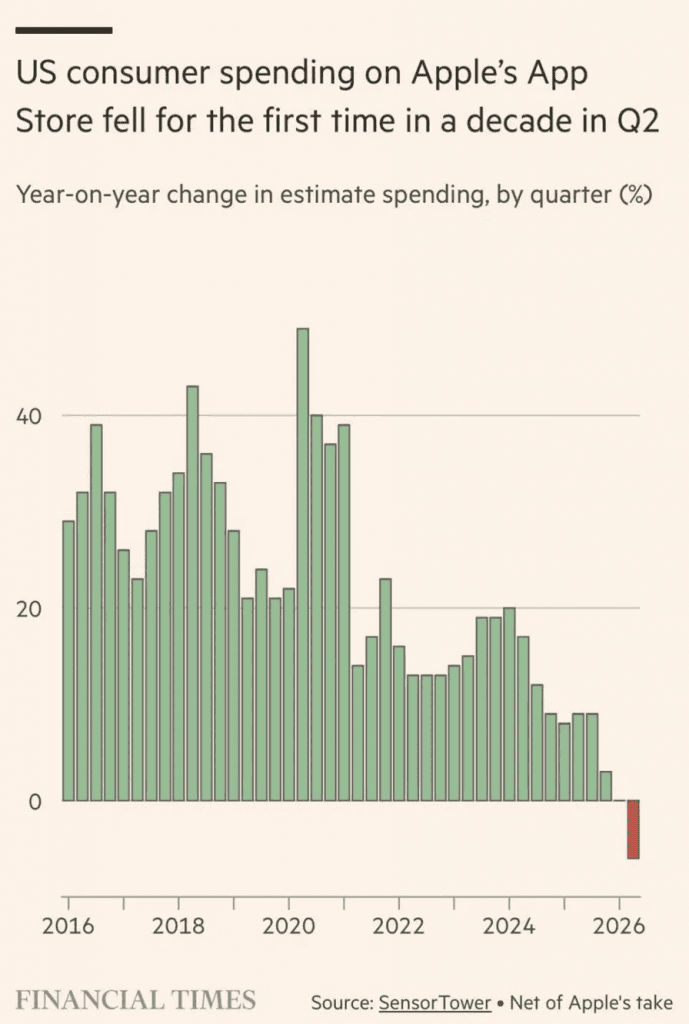
What makes the timing notable is that this is happening at the exact moment the App Store is more crowded than it has ever been. Apple has been fielding a record wave of app submissions over the past year, driven almost entirely by how trivially easy it has become to build something with AI coding tools and ship it. Nearly 236,000 app submissions occured in a single quarter earlier this year, an 84% jump from the year before and the largest quarterly surge Apple has seen in a decade. Review queues that used to clear in a day or two were stretching out under the sheer volume. More apps than ever are landing on the store, and Americans are spending less money on it than they did a year ago.
That is not a contradiction so much as a fairly direct cause and effect. When the cost of building an app drops to nearly zero, what shows up is not primarily a wave of ambitious new businesses. It’s clones, thin wrappers around someone else’s AI model, and submissions optimized to exist rather than to be used. Flooding a marketplace with supply doesn’t automatically create demand for that supply, and in this case it appears to be diluting it. Users have a finite amount of attention and a finite tolerance for discovering which of the 236,000 new listings is actually worth a subscription. Also, given how easy it is now possible to code apps, it appears that users are more reluctant to pay for them — they either expect lower prices, or they could be simply coding apps for their own use-cases themselves.
Sensor Tower’s broader Q2 numbers back this up. Global App Store spending did grow, but only 3% year-on-year, down sharply from 13% growth in the same quarter a year earlier. Gaming, historically the store’s biggest earner, saw revenue decline 4.5% globally. Non-gaming categories held up better, rising nearly 15%, but almost all of that growth came from one place: generative AI apps, where consumer spend more than doubled with a 108% year-on-year surge. ChatGPT alone accounted for roughly 60% of category revenue. Everything else in the store, in other words, is being asked to grow against a backdrop where the one category with real momentum is crowding out the rest of the conversation and much of the money.
Apple’s own numbers have started reflecting the strain. On its fiscal Q3 earnings call last month, the company pointed to weaker mobile gaming performance and regulatory changes as drags on Services revenue, which came in at $30.7 billion for the quarter, a record for the period but still short of what analysts had modeled. App analytics firm Appfigures separately found that Apple’s US commission revenue has fallen 18% since the start of the year, with declines also showing up in markets like Brazil and Japan following new local regulations that have chipped away at Apple’s cut.
The regulatory piece matters here as much as the AI glut does. Court rulings tied to the long-running Epic Games fight have forced Apple to allow developers to point users to outside payment options within the US, meaning a growing share of transactions that would once have run through Apple’s 15-30% commission are now happening off-platform entirely. That doesn’t necessarily mean less money is being spent on apps overall, but it does mean less of it is showing up in the numbers Sensor Tower and Apple itself are able to track. Some of this quarter’s decline is real demand softness; some of it is spending that simply moved out of view.
Put together, the picture is of an App Store that is winning on volume and losing on the metric that actually funds it. But that shift comes at the expense of the rest of the app economy, not in addition to it. Consumers are not spending more on apps overall; they are concentrating the spending they already had into a narrower band of products while ignoring most of what AI-assisted development has poured into the store around them.
For the thousands of developers who used AI tools to ship something new this year, that is the uncomfortable part of the story. Getting into the store was never the hard part to begin with. Getting anyone to notice, let alone pay, has always been the actual business, and that part hasn’t gotten any easier just because building the app got faster.