Even as more and more people are publishing proofs of decade-old conjectures using AI, this year’s Fields medalist — the highest prize in Math — is going where the action is.
Jacob Tsimerman, a 38-year-old Canadian mathematician at the University of Toronto, stood on stage in Philadelphia at the International Congress of Mathematicians on July 23 and did something Fields medalists don’t typically do at the moment they receive the award. Asked about his next project, he said he was moving to OpenAI to work on AI safety. Tsimerman won the medal for his work reshaping o-minimality theory into a foundational tool for arithmetic geometry, and for proving the André-Oort conjecture, a problem that had resisted a full solution for years. He also holds a perfect score at the International Mathematical Olympiad and became a full professor while still in his twenties.
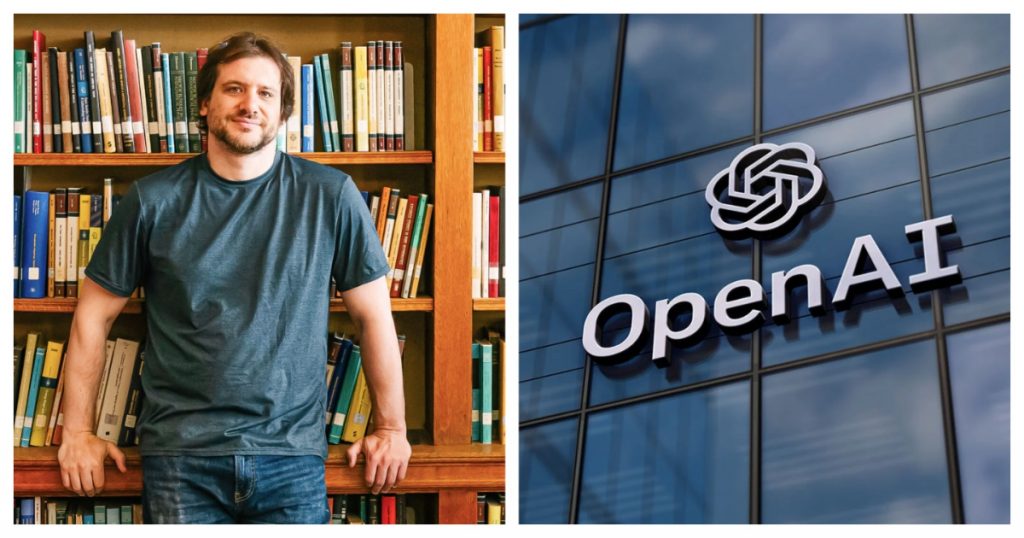
His reasoning, laid out at the press conference and in posts afterward, is that mathematics as a profession is closer to being automated than most of his colleagues are willing to admit. He has said he expects AI to soon do everything mathematicians do, only better and faster, and that the discipline he has spent his career in is likely to look unrecognizable within a matter of years. Rather than treat that as a reason to stay in a university department, he decided it was a reason to go work on the systems doing the automating.
Tsimerman has also been candid that safety, for him, is not a separate concern bolted onto an otherwise neutral technology. He has floated the idea that he supports pausing frontier AI development, but does not believe a pause is realistic, so he would rather be inside a lab shaping how these systems behave than watching from a faculty office. He has even sketched out, with the same rigor he’d bring to a paper, a taxonomy of the ways AI could go badly wrong for humanity. And when asked why a mathematician who talks about extinction risk would join the company building the thing he’s worried about, his answer was blunt: if it can’t be stopped, better to understand it and help shape it than to be left behind.
He has also pushed back on the idea that mathematicians only do the work for some higher, disinterested pursuit of truth. In his telling, he does math because he’s good at it and enjoys it, and mathematicians, like anyone else, need money, stability and a life outside the subject. That framing matters here, because it strips away the assumption that a Fields medalist joining an AI safety team is some kind of noble sacrifice. He’s describing it more as a rational bet on where the interesting and consequential work will be over the next decade.
The timing of his announcement lines up with a run of results that have made his prediction feel less theoretical. OpenAI’s models produced a new proof breakthrough on an 80-year-old open Erdős problem, a conjecture about how many unit-distance pairs can exist among points scattered on a plane, first posed in 1946. Fields medalist Tim Gowers, who has been publicly documenting his own reaction to these results, called the proof a milestone. Within days, a Princeton mathematician had improved on the exponent by hand, and shortly after that, Anthropic said its own model had independently arrived at a structurally similar proof of the same result, without any coordination between the two labs.
Then came the Jacobian conjecture. Levent Alpöge, a number theorist at Anthropic who, notably, was once advised by Tsimerman during a Junior Fellowship at Harvard, posted a counterexample on X that appeared to disprove a problem in algebraic geometry that had been open since 1939 — one that made it onto Steve Smale’s list of the most important math problems of the century, alongside the Riemann Hypothesis. Alpöge credited the work to Claude Fable 5, saying the model had done the work over the World Cup final. A separate researcher then said GPT-5.6 had disproved the 30-year-old Dinitz-Garg-Goemans conjecture using what amounted to four prompts. That pace of results is what pushed physicist Sabine Hossenfelder and cosmologist Will Kinney to warn that AI could be an extinction-level event for theoretical math, a post Elon Musk responded to with a single emoji.
Tsimerman is not the only academic mathematician who has decided the frontier has moved from the university to the AI labs. Ken Ono, a number theorist and tenured chair at the University of Virginia, resigned his position last December to join Axiom Math, an AI mathematics startup founded by his former student. Roughly forty mathematicians, Ono among them, are now writing research-level problems for FrontierMath, a benchmark backed by OpenAI, effectively getting paid by industry to set the exams that industry’s own models are then measured against. Google DeepMind has also released its own AI co-mathematician, which Oxford mathematician Marc Lackenby used to resolve an open problem in group theory after a reviewer agent caught a flaw in the model’s first attempt.
OpenAI’s leadership welcomed Tsimerman publicly. Mark Chen wrote that his mathematical talent is extraordinary, and that the seriousness he brings to AI safety is just as notable. Whether Tsimerman’s prediction holds — that mathematicians will soon be doing less of the mathematics themselves — is still an open question. But for at least one Fields medalist, the answer was clear enough to change his entire career two days after winning the field’s biggest prize.