Most observers can tell that AI progress seems to be accelerating, and this seems to be borne by hard data as well.
New data from ARK Investment Management, based on Artificial Analysis figures as of April 28, 2026, shows a sharp decline in the median number of days between frontier model releases across the five leading U.S. AI labs — OpenAI, Anthropic, Google, xAI, and Meta. In 2023, the industry median sat at 37.5 days between releases. By 2024, that had compressed to 13.5 days. In 2025 it ticked slightly higher to 17 days as the sample grew larger (n=17), and in 2026 year-to-date, it has dropped to just 11 days. The pace, in short, is relentless.
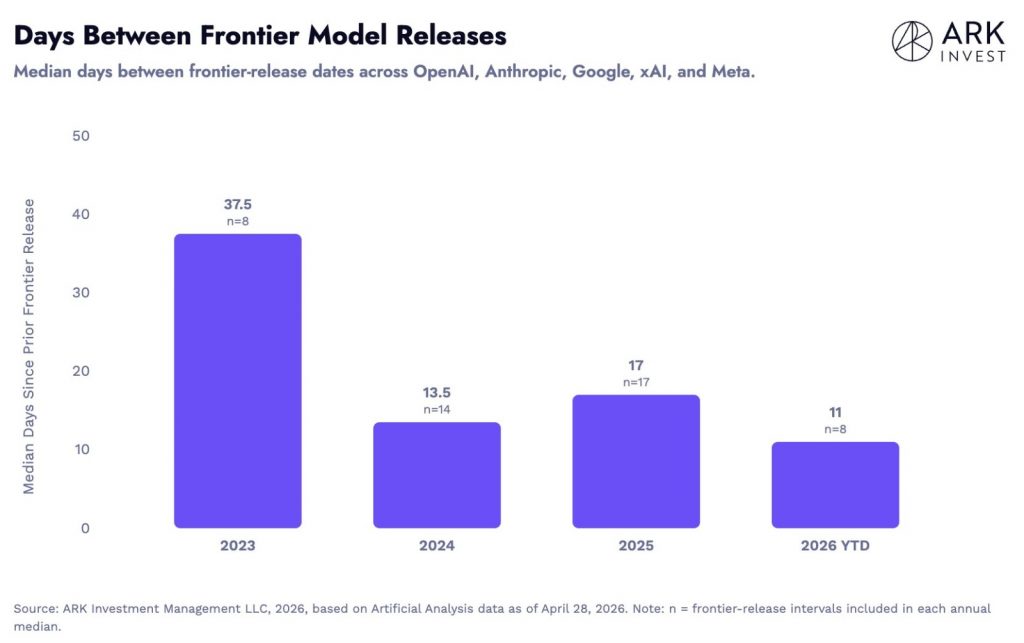
This aligns with what insiders have been saying. Anthropic’s Michael Gerstenhaber noted last year that the timeframe for significant AI leaps is shrinking dramatically, describing the gap between Claude releases compressing from six months to two months — and expecting things to move “faster and faster.” Anthropic has since predicted far more dramatic progress in the next two years, and OpenAI’s VP of Research Aidan Clark has gone further still, hinting that AGI may already have arrived.
Company-by-Company: The Gap Between Leaders and Laggards
The ARK data also breaks down release cadence at the company level, and the divergence is striking.
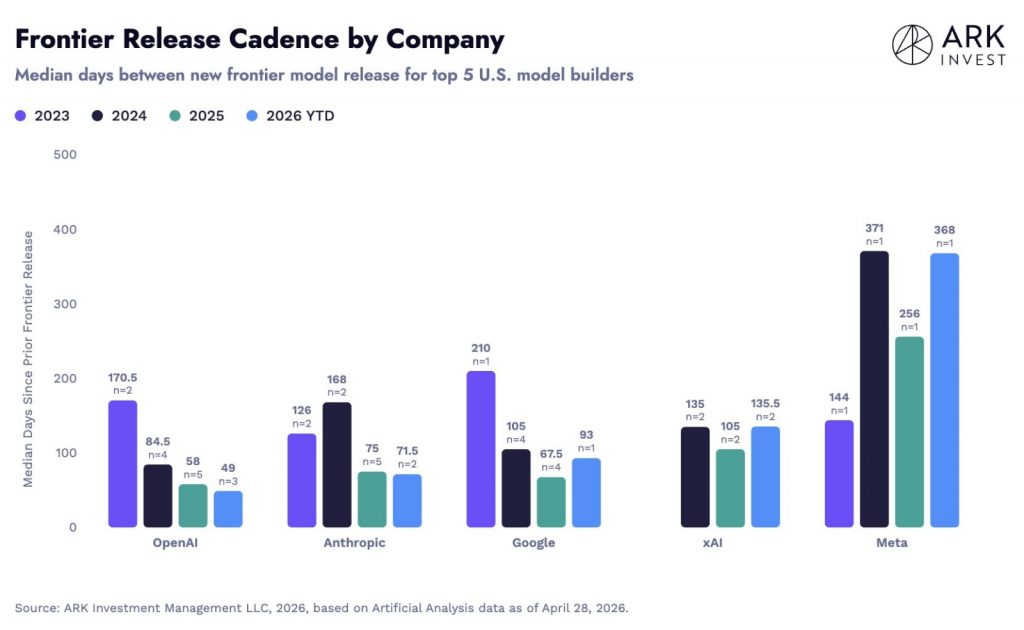
OpenAI has the most compressed release schedule among the five labs. Its median gap between frontier releases has fallen from 170.5 days in 2023 to 84.5 in 2024, 58 in 2025, and 49 days in 2026 YTD. That is the fastest cadence in the peer group and a roughly 70% compression over three years.
Anthropic tells a more uneven story. Its median release gap actually widened from 126 days in 2023 to 168 in 2024 — a period when the company was building out its Claude 3 family — before dropping sharply to 75 days in 2025 and 71.5 in 2026 YTD. The direction of travel is clear, even if the path was not straight. The company’s push into agentic AI capabilities has coincided with a tighter release schedule.
Google has also shown compression. The gap went from 210 days in 2023 to 105 in 2024, 67.5 in 2025, and 93 days so far in 2026. The slight uptick in 2026 may reflect the larger complexity of Google’s Gemini releases rather than any deceleration in ambition.
xAI, Elon Musk’s lab, has maintained a more measured pace but still trended downward — from 135 days in 2023 to 105 in 2024, with 2025 and 2026 both landing at approximately 135.5 days. xAI has fewer releases in its sample (n=2 in most years), which means individual releases have an outsized effect on the median.
Meta is the clear outlier. Its release gaps run in the hundreds of days — 144 in 2023, 371 in 2024, 256 in 2025, and 368 so far in 2026. This reflects Meta’s model strategy, which saw a complete overhaul its team and its leadership, which culminated in the release of its latest Muse Spark model.
What It Means
The aggregate picture from ARK’s data is that the frontier is moving faster — but unevenly, and for different reasons at different companies. OpenAI’s cadence reflects a product-driven strategy, shipping models as capabilities improve and competitive pressure demands. Anthropic’s trajectory shows a lab that initially moved slower as it built foundational infrastructure, but has since shifted into a higher gear. Google is moving fast on the back of substantial compute and research resources. Meta is playing a different game altogether.
The compression in release intervals is not just a product curiosity. It has real consequences for enterprises trying to build on top of these models. As Anthropic CEO Dario Amodei has noted, companies routinely cannibalize their own models before fully extracting their commercial value — and the faster the release cadence, the more acute that dynamic becomes.
For businesses evaluating which AI providers to build on, the ARK data is a useful reminder: the model you evaluate today may not be the model you deploy in six months. The frontier is no longer a distant horizon. It is moving toward you.