AI was thought to be disrupting work, but it also seems to be disrupting entertainment as well.
A new Pew Research report — “Americans and AI 2026” — finds that 50% of Americans now use AI chatbots, up substantially from 2024. And the ways they’re using them tell a story that goes well beyond productivity. Searching for information leads the pack at 42%, followed by work tasks at 38% among employed adults. Third on the list, at 25%, is something that doesn’t usually show up in enterprise AI conversations: fun and entertainment.
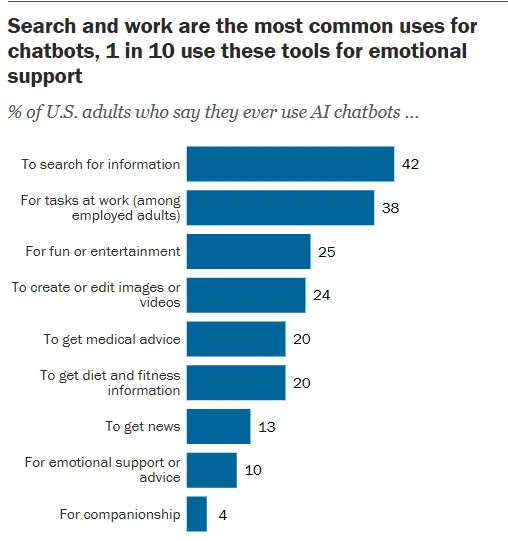
Creating or editing images and videos came in fourth at 24%, with medical advice and diet and fitness information both at 20%. Getting news (13%), emotional support (10%), and companionship (4%) round out the lower end — the last two being what Pew highlighted in its headline finding, that 1 in 10 Americans is turning to a chatbot for emotional support.
The entertainment number deserves more attention than it’s getting. A quarter of all American AI chatbot users are opening these apps for fun — to play with creative tools, have witty exchanges, generate stories, or just explore what the technology can do. That’s not a fringe behavior. At 50% adoption, 25% of that base represents tens of millions of people spending discretionary time with AI rather than with other entertainment products.
That discretionary time is the key phrase. For the last decade, social media platforms like Meta’s Facebook, Instagram, and WhatsApp have competed for idle minutes — the fifteen-minute scroll before bed, the lunchtime distraction, the commute filler. AI chatbots are now competing for exactly that same window, and they’re doing it without needing a social graph, an advertising model, or a content feed.
The implications for platforms built entirely on engagement are real. AI companion apps, per SensorTower data, are already pulling in more than double the engagement hours that dating apps manage. That’s not a prediction about the future — it already happened. Global time spent on generative AI apps is set to more than double year over year, and ChatGPT recently crossed a billion monthly active users faster than any app in history.
What makes this particularly complicated for Meta is that the company has spent years building Meta AI into its platforms precisely to maintain engagement — to make sure users stay inside its ecosystem even as they start using AI. Zuckerberg has talked openly about building toward personal superintelligence that understands individual users’ goals. But there’s a meaningful gap between an embedded AI assistant inside Instagram and a standalone ChatGPT or Claude session that someone opens purely for entertainment. The latter has no ads, no algorithmic feed, no social pressure — just the conversation.
None of this means social media is collapsing. Meta posted $201 billion in revenue in 2025, and its AI-powered ad suite crossed a $60 billion annual run rate. The business is, by any financial measure, thriving. But revenue and time-spent don’t always track together. A platform can be earning more while commanding less of its users’ attention, especially if AI is subsidizing the ad targeting even as the organic engagement softens.
The entertainment slice of the Pew data also raises questions for the broader online content industry. YouTube, Netflix, Spotify, and gaming platforms all compete on the same limited resource — human attention in leisure hours. A user who spends an hour generating an AI-written short story, co-writing a game scenario with a chatbot, or just having a long entertaining conversation with Claude or ChatGPT is an hour not spent watching a YouTube video or scrolling a Reels feed. At 25% of a 50% adoption base, that’s a lot of redirected hours.
The form that AI interactions will ultimately take is still being worked out. Some believe chat itself will fade in favor of background agents that just get things done. But the Pew entertainment numbers suggest that, at least for now, people are actively choosing to engage with these systems for the experience itself — not just to get a task off a list.
That distinction matters for anyone building a business around capturing attention. AI has always been sold as a productivity story. The Pew report is one of the clearer signals yet that it’s also becoming a leisure story — and leisure is where the real competition for the internet’s future is being decided.