Google still hasn’t released a Pro-level model since Gemini 3.1, but it’s gone close to Pro-level performance with Gemini 3.8 Flash.
Google’s newly released Gemini 3.8 Flash has landed a score of 59 on Artificial Analysis’s Intelligence Index, a three-point jump over Gemini 3.7 Flash’s score of 56, continuing a run of near-monthly Flash releases that keep nudging the intelligence number up while barely touching the price tag.
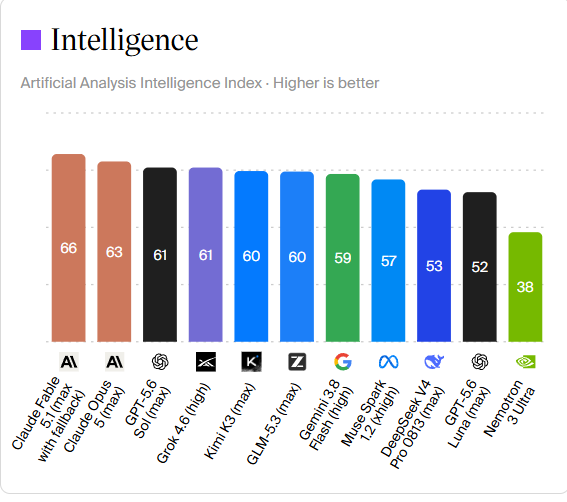
The new score puts Gemini 3.8 Flash just behind Claude Fable 5.1 (66) and Claude Opus 5 (63) at the top of the chart, and ahead of GPT-5.6 Sol (61), Grok 4.6 high (61), Kimi K3 (60), and GLM-5.3 (60). It also clears Google’s own Gemini 3.8 Flash sibling comparisons from a few weeks ago, when 3.7 Flash was sitting just behind GPT-5.6 Terra and Meta’s Muse Spark 1.2, both at 57, on the same index. This time around, Gemini 3.8 Flash is the one doing the leading among the mid-pack models, sitting ahead of Muse Spark 1.2 (57), DeepSeek V4 Pro 0813 (53), GPT-5.6 Luna (52), and Nemotron 3 Ultra (38).
Speed Is Still The Bigger Story
Intelligence gains aside, speed is where Gemini 3.8 Flash separates itself from nearly everything else on the leaderboard. Artificial Analysis clocks the model at 305 output tokens per second, more than double the next fastest model on the chart, Meta’s Muse Spark 1.2, which manages 154 tokens per second. GPT-5.6 Luna trails further back at 126 tokens per second, followed by Nemotron 3 Ultra at 112 and DeepSeek V4 Pro 0813 at 80. Claude’s models, by comparison, sit well down the list — Claude Fable 5.1 with fallback manages 66 tokens per second and Claude Opus 5 sits at 56, less than a fifth of what Gemini 3.8 Flash is putting out.
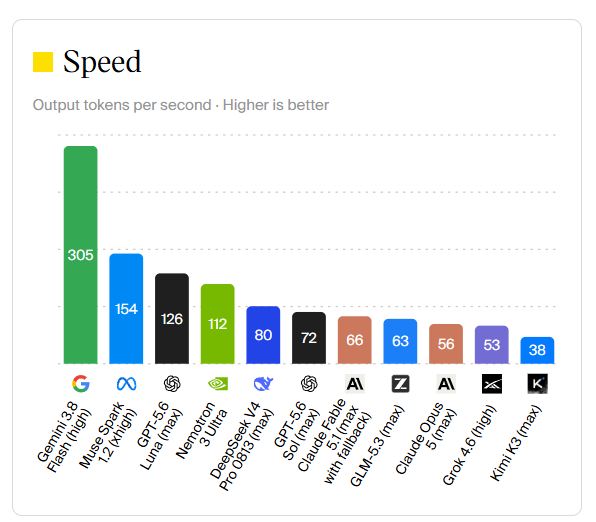
This tracks with what Artificial Analysis has been saying about Google’s Flash line for a while now. Gemini 3.7 Flash was already sitting on the Pareto frontier of intelligence versus speed at the time of its release, meaning no other model offered a better combination of the two. Gemini 3.8 Flash appears to be extending that lead rather than giving any of it back, gaining three points of intelligence while very nearly doubling its predecessor’s throughput.
Cost Per Task Barely Moves
The cost side of the picture is just as lopsided. On Artificial Analysis’s weighted average cost per Intelligence Index task, Gemini 3.8 Flash costs $0.58, cheaper than GLM-5.3 ($0.68), Kimi K3 ($0.84), Grok 4.6 high ($0.94), and GPT-5.6 Sol ($0.95). It’s still not the very cheapest model tested — GPT-5.6 Luna ($0.05), DeepSeek V4 Pro 0813 ($0.27), Nemotron 3 Ultra ($0.39), and Muse Spark 1.2 ($0.40) all undercut it — but those models also all score lower on intelligence, several of them by a wide margin.
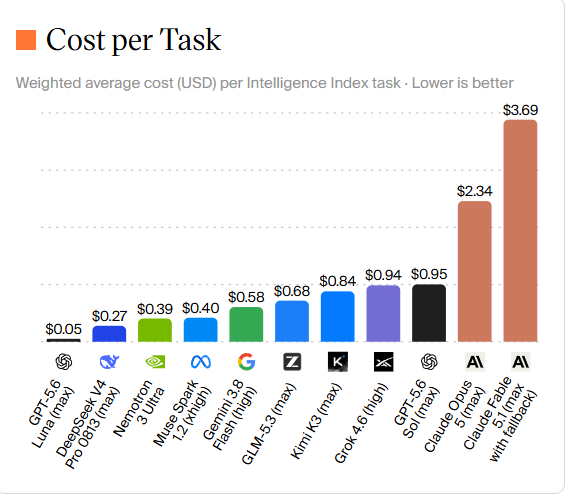
Where the comparison turns lopsided is against the two Claude models on the chart. Claude Opus 5 costs $2.34 per task and Claude Fable 5.1 with fallback costs $3.69 per task, roughly four to six times what Gemini 3.8 Flash costs to complete the same weighted task set, despite Gemini 3.8 Flash trailing Opus 5 by only 4 points and Fable 5.1 by 7 points on raw intelligence. That gap between price and performance is the same story officechai has tracked through the rest of the Flash line this year — Google keeps arriving close enough to frontier intelligence scores at a fraction of what the frontier labs charge to get there.
A Familiar Pattern, Repeating Faster
Gemini 3.8 Flash is the third Flash-tier release from Google in about five weeks, following Gemini 3.6 Flash in July and Gemini 3.7 Flash in mid-August. Each release so far has followed a similar shape: modest but steady intelligence gains, pricing that stays flat or falls, and speed numbers that keep climbing well past what any competing lab is offering at a comparable intelligence level. Gemini 3.6 Flash had been stuck at the same Intelligence Index score as Gemini 3.5 Flash despite the version bump, so the fact that Google has now strung together back-to-back three- and four-point gains across 3.7 and 3.8 suggests whatever changed in the training or tuning process between releases is actually compounding rather than plateauing.
Pricing for Gemini 3.8 Flash remains at the same introductory rate as its immediate predecessors — $0.75 per million input tokens and $3.75 per million output tokens, well under half of what Claude Sonnet 5 or GPT-5.6 Terra charge for comparable workloads. For businesses running high-volume agentic tasks where both cost and latency matter as much as raw intelligence, that combination of rising scores, falling relative cost, and industry-leading speed is likely to keep making Gemini 3.8 Flash a hard model to ignore, even for teams that would otherwise default to a frontier-tier model.