Fable 5.2 became the top model on the Artificial Analysis Intelligence index yesterday and created a 5-point gap with Gemini 4 Carbon, but Carbon’s public release today is letting people pit the two models against each other in head-to-head tests.
Perplexity has rolled out Google’s Gemini 4 Carbon to all Perplexity Pro and Max subscribers, and the company’s own numbers show the model edging out Anthropic’s Claude Fable 5.2 on its WANDR research benchmark while costing a fraction as much per task.
The rollout was announced by Perplexity CEO Aravind Srinivas, who said users can now spin up persistent Teammates powered by Gemini 4 Carbon or call on it for one-off agentic sessions inside Perplexity’s Computer product. Srinivas framed the economics as the headline: Carbon, he said, is 2.5x cheaper than Fable 5.2 while delivering similar capabilities on agentic research tasks.
A chart shared alongside the announcement backs that up. On Perplexity’s WANDR benchmark, Gemini 4 Carbon scores 0.857 at $5.86 per task, placing it narrowly ahead of Claude Fable 5.2’s 0.851 at $14.51 per task. That works out to Carbon beating Fable 5.2 on score while running at roughly 40% of its cost, or in other words, about a third to two-fifths of the price for a slightly better result.
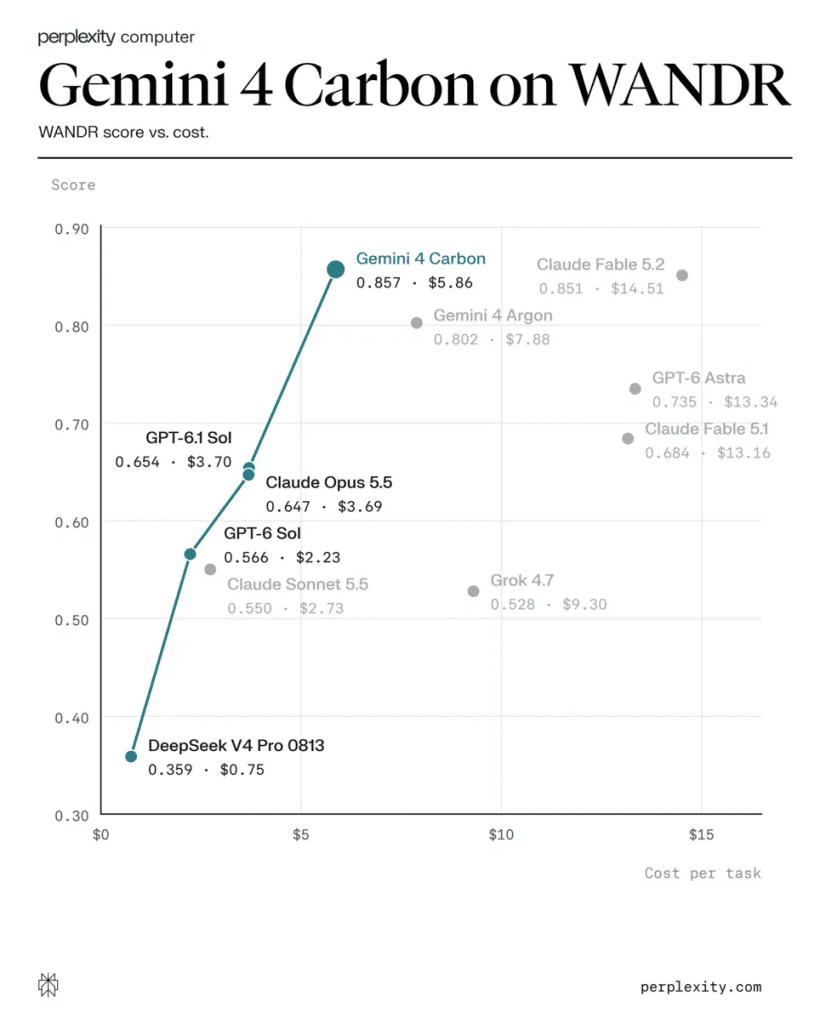
What Is The WANDR Benchmark
WANDR, short for Wide ANd Deep Research, is a benchmark Perplexity built to evaluate how well AI agents handle large-scale research work: pulling together broad, evidence-backed sets of information from across the web rather than just answering a single narrow question. It sits alongside Perplexity’s earlier DRACO benchmark, which instead measures whether a model can produce one accurate, complete long-form report. Where DRACO tests depth on a single task, WANDR tests how an agent performs across a high volume of research-heavy knowledge work, which is closer to what a Teammate inside Perplexity Computer is actually asked to do all day.
Perplexity has positioned WANDR as a yardstick for exactly this kind of agentic research workload, and the benchmark has already set a new state-of-the-art mark once before, when Gemini 4 Carbon’s early evaluation score beat out GPT-6 Astra and Claude Fable 5.1 on both accuracy and cost.
The Rest Of The Field
The chart shared by Perplexity places several other frontier models on the same score-versus-cost plot. Gemini 4 Argon scores 0.802 at $7.88 per task, GPT-6 Astra comes in at 0.735 for $13.34, and Claude Fable 5.1 trails at 0.684 for $13.16. Further down the curve sit GPT-6.1 Sol (0.654, $3.70), Claude Opus 5.5 (0.647, $3.69), GPT-6 Sol (0.566, $2.23), Claude Sonnet 5.5 (0.550, $2.73), Grok 4.7 (0.528, $9.30), and DeepSeek V4 Pro (0.359, $0.75) at the cheap end.
The overall shape of the chart points to a familiar pattern in frontier AI releases: a frontier-pushing model from one lab briefly takes the top spot, only for the next release to leapfrog it days or weeks later. It’s worth noting that Fable 5.2 has also overtaken Carbon elsewhere, outscoring it by five points on the Artificial Analysis Intelligence Index and winning on most of the benchmarks Anthropic published at Fable 5.2’s launch. WANDR, as Perplexity’s own benchmark, is naturally one where Perplexity’s reported numbers favor whichever model it is currently promoting, and the cost-per-task framing in particular depends heavily on how each lab configures effort and token budgets for the test.
Why It Matters For Perplexity
For Perplexity, the pitch is less about chasing the single highest score on any one leaderboard and more about where a model lands on the cost curve. Since WANDR is designed around realistic, high-volume research workloads rather than one-shot answers, a cheaper model that matches or slightly beats a pricier rival at scale changes the economics of running Teammates continuously rather than invoking them occasionally. With Gemini 4 Carbon now live for all Pro and Max subscribers in Perplexity Computer, that cost advantage is available broadly rather than just to the small group that got early access when the model first posted its SoTA result on WANDR.