Anthropic’s release of Fable 5.2 — which dislodged Google’s Gemini 4 Carbon from the top spot on the Artificial Analysis Intelligence Index — seems to have spurred Google into finally putting it into people’s hands.
Google’s Logan Kilpatrick had teased an imminent Google launch by just saying “Gemini” on X.
X users believed it meant the public release of Gemini 4 Carbon. Gemini 4 Carbon has been sitting behind a restricted gate since Google announced it on October 28, available only to vetted cyber defenders through the Fairwind Program.
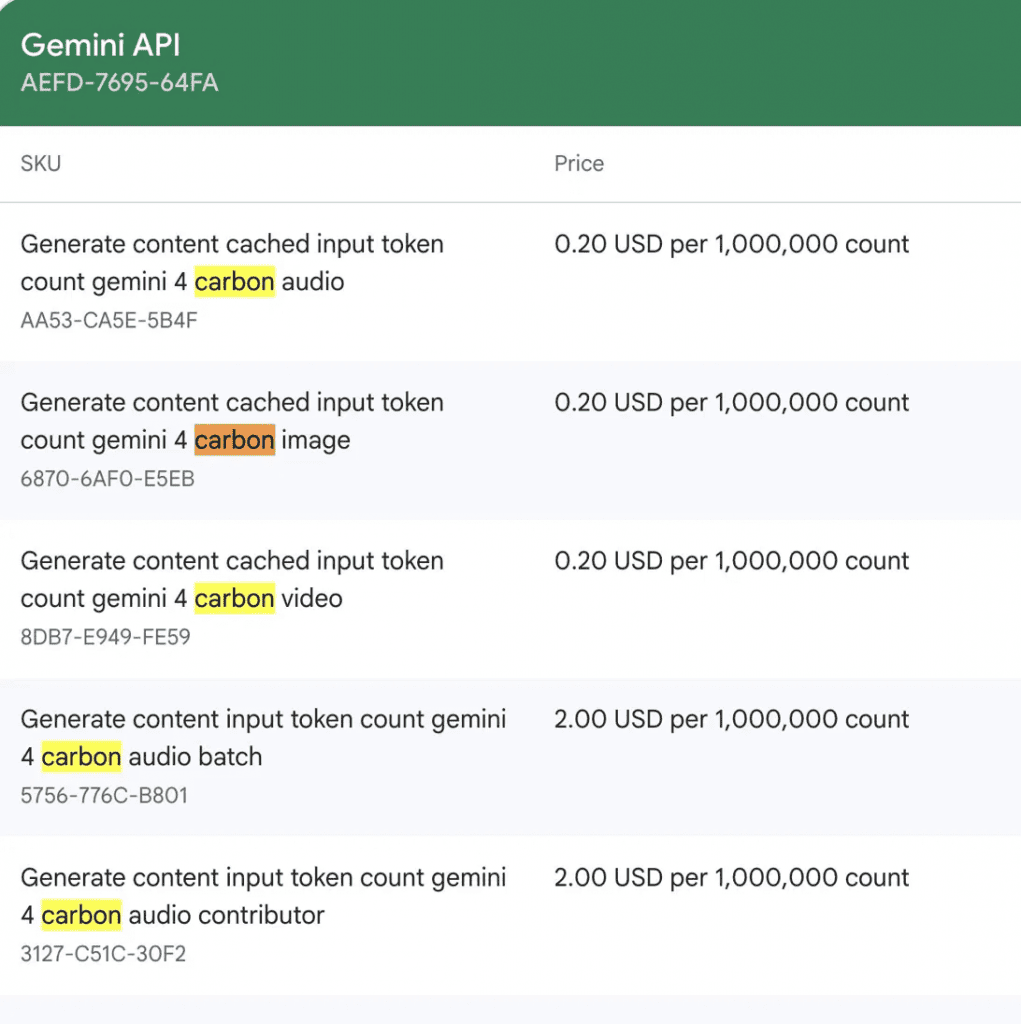
That gate may be about to lift. Billing SKUs for the model have now shown up in Google Cloud’s public catalog, and they’re priced for a general audience, not a closed pilot. X account AiBattle (@AiBattle_) spotted a SKU titled “Generate content input token count gemini 4 carbon text batch,” tagged “global” and priced at $2.00 per million units. Vertex AI tracker StatsWire went further, reporting that it had found 90 published billing SKUs for Carbon under the Vertex AI service, spanning online, batch and flex tiers across text, audio, image and video. The pricing StatsWire listed:
- Online, global: $4 input / $20 output / $0.20 cache reads per million tokens
- Batch & Flex, global: $2 input / $10 output / $0.10 cache reads per million tokens
A separate screenshot of the Gemini API SKU group (AEFD-7695-64FA) shows the same structure in more granular form — cached input tokens for audio, image and video all priced at $0.20 per million, alongside batch- and contributor-specific input token SKUs at $2.00 per million.
Why the pricing is the tell
The $2 input / $10 output numbers aren’t new — that’s the introductory rate Google has already been charging Fairwind’s cyber defenders. What’s notable is the $4 input / $20 output “standard” tier sitting alongside it in the same public catalog. That’s the pricing structure Google reserves for general access, and it mirrors exactly how Gemini 4 Argon rolled out a month earlier: Argon launched restricted on September 30 at an introductory $2/$10, with Google saying at the time that pricing would rise to $4/$20 once the model opened up more broadly. Argon reached general availability roughly two weeks later. If Carbon is following the same script, the standard-tier SKUs appearing now would put a wider release within days to weeks, not months.
A model’s SKUs typically land in Google Cloud’s public billing catalog shortly before — not after — that access actually goes live, since Vertex AI needs the pricing infrastructure in place before it can bill anyone at scale. Billing listings aren’t an official product announcement, and Google hasn’t confirmed a release date or a change in Carbon’s access policy. But a catalog entry with 90 SKUs and a full consumer-grade pricing tier is a harder signal than the usual leaks and screenshots that tend to surface ahead of AI model launches.
Carbon’s run so far
Until yesterday, Gemini 4 Carbon held the top spot on Artificial Analysis’s Intelligence Index, a position it took when it launched barely two weeks after Argon. It also topped Text Arena and placed second on Agent Arena in early community benchmarking. That lead didn’t last: Anthropic’s Claude Fable 5.2 has since overtaken Carbon by 5 points on the same index, and Fable 5.2 along with Claude Mythos 5.2 also beat Carbon and GPT-6 Astra on most other benchmarks at launch. A broader rollout of Carbon, rather than keeping it locked to cybersecurity use cases, would give Google a more direct way to contest that ranking with its strongest model instead of the narrower Argon.
It would also arrive against a backdrop of Google moving fast on several fronts at once. The company has already been testing an apparent successor, internally referred to as Gemini 4 Krypton, alongside a lighter “Flash” variant of Carbon called Gemini 4 Hydrogen, and it recently shipped a new generation of TPUs built for exactly this kind of scaled-up serving. Taken together, a GA release of Carbon in the coming days would fit the pace Google has set since Argon shipped: iterate fast, widen access in stages, and keep successors already warming up behind the model that just launched.
Google has not responded to the billing catalog listing, and until it does, the standard-tier SKUs remain evidence of an imminent release rather than confirmation of one.