Google’s new Gemini 4 Hydrogen has landed on the Artificial Analysis Intelligence Index with a score of 54 at its new xhigh reasoning level, putting it ahead of Gemini 4 Argon (50), Meta’s Muse Wonder Full (50) and OpenAI’s GPT-6.1 Terra (51). It sits just one point behind both Claude Sonnet 5.5 and GPT-6.1 Sol, which score 55 at max effort, and does so at a fraction of Sonnet’s cost.
Hydrogen is Google DeepMind’s third new model in six weeks, following Argon on September 30 and Carbon on October 28. Only Carbon, at 60, scores higher among Google’s models. On the current leaderboard, Hydrogen at xhigh sits seventh overall, behind Claude Fable 5.2 (65), Gemini 4 Carbon (60), Claude Opus 5.5 (59), GPT-6 Astra (57), GPT-6.1 Sol (55) and Claude Sonnet 5.5 (55).
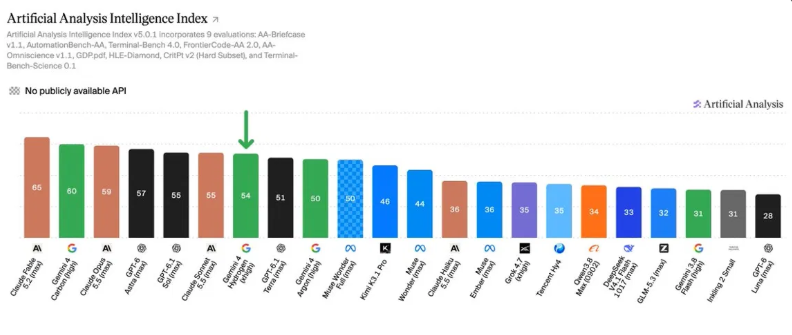
Where Hydrogen lands
Hydrogen introduces a new xhigh reasoning level, the first tier above high on a Gemini model, alongside the existing low, medium and high settings. Here is how the settings score on the index.
| Reasoning level | Intelligence Index | Cost per task |
|---|---|---|
| xhigh | 54 | $3.16 |
| high (default) | 51 | $1.87 |
| medium | 41 | $0.80 |
| low | 27 | $0.29 |
At xhigh, Hydrogen is four points ahead of Argon (high) and clear of Muse Wonder, which had placed third on an earlier version of the index. Muse Wonder Full is also marked on the chart as having no publicly available API, while Hydrogen is generally available. At the default high setting, Hydrogen scores 51, matching Terra and still a point ahead of Argon, though it trails GPT-6.1 Sol (xhigh) and Claude Opus 5.5 (high), which both score 52.
The scores are on version 5.0.1 of the index, which combines nine evaluations: AA-Briefcase, AutomationBench-AA, Terminal-Bench 4.0, FrontierCode-AA 2.0, AA-Omniscience v1.1, GDP.pdf, HLE-Diamond, CritPt v2 (Hard Subset) and Terminal-Bench-Science 0.1. The v5 index leans heavily on private datasets.
Cost: a third of Sonnet, 2.5x Sol
Hydrogen is priced at $1.50 per million input tokens and $7.50 per million output tokens, with cached input tokens discounted 95% to $0.075. At xhigh, Artificial Analysis says it costs about 32% as much per task as Claude Sonnet 5.5 for near-equal intelligence. Sonnet 5.5, which scored 56 on an earlier version of the index, has been a heavy token user. Against GPT-6.1 Sol, though, Hydrogen at xhigh costs roughly 2.5 times as much per task.
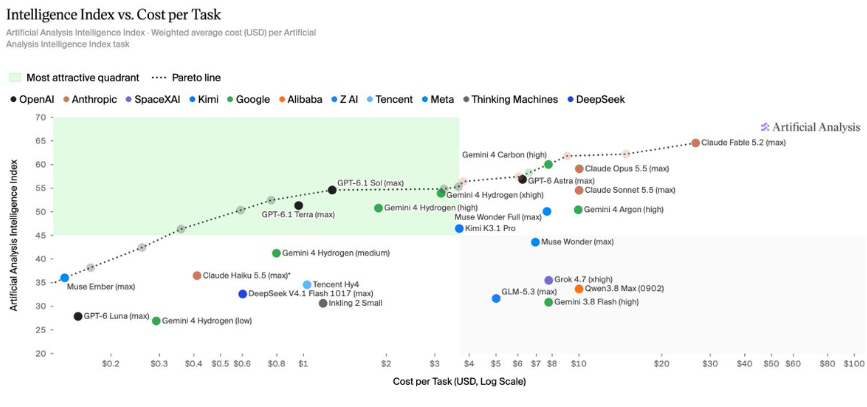
The better value may be at the default setting. xhigh nearly doubles output tokens compared with high for a three-point gain, and cost per task falls from $3.16 to $1.87 when moving down to high. At high, Hydrogen matches Argon’s intelligence at about 19% of Argon’s cost per task, which Artificial Analysis describes as Argon-level intelligence at a fraction of the price for most workloads.
On speed, Hydrogen outputs about 200 tokens per second. At low, medium and high effort it sits on the Pareto frontier of time per task against intelligence, meaning no model is both more intelligent and faster to complete a task.
Strengths: hallucinations, documents and presentation
Hydrogen keeps the Gemini 4 family’s low hallucination rate. On AA-Omniscience, the knowledge reliability benchmark that penalises confident wrong answers, Hydrogen hallucinates just 8% of the time, compared with 43% for Claude Sonnet 5.5 (max) and 52% for GPT-6.1 Sol (max). Only Argon and Carbon (medium) guess less often when they don’t know the answer. Accuracy holds steady across effort settings, though hallucinations rise as reasoning effort is reduced.
On GDP.pdf, a visual reasoning benchmark over long, complex documents, Hydrogen scores 33% all-pass at medium reasoning, the tied top score on the benchmark. On AA-Briefcase, the agentic knowledge work evaluation, graders rated Hydrogen’s presentation above other Gemini models, including Carbon.
Weakness: agentic terminal work
Terminal tasks are where Hydrogen falls short of its rivals, a pattern that has also shown up with Argon. Hydrogen scores 54% on Terminal-Bench 4.0 and 50% on Terminal-Bench-Science 0.1. Claude Sonnet 5.5 (max) scores 64% and 53% on the same two, while GPT-6.1 Sol (max) scores 56% and 58%.
The xhigh setting helps on science tasks, lifting Terminal-Bench-Science from 41% at high to 50%, but makes no difference on Terminal-Bench 4.0, which stays at 54% at both levels. Science scores are fairly even across domains, ranging from 46% in earth sciences to 53% in physical sciences.
Key details
- Context window: 1 million tokens
- Input: Text, image, video and speech, with text output
- Reasoning levels: Low, medium, high and xhigh
- Pricing: $1.50 / $7.50 per million input / output tokens, with cached input at $0.075
Hydrogen’s result adds to a crowded top of the index, where Anthropic’s Fable 5.2 recently took the lead. For Google, the pitch is that its cheapest Gemini 4 model now lands within a point of the mid-tier models from Anthropic and OpenAI, with the lowest hallucination rates of the group, while it still trails on terminal-driven agentic work.