Even as AI startups are working on improving their AI models, Google is also putting in efforts to integrate its AI across its massive ecosystem on mobile and web.
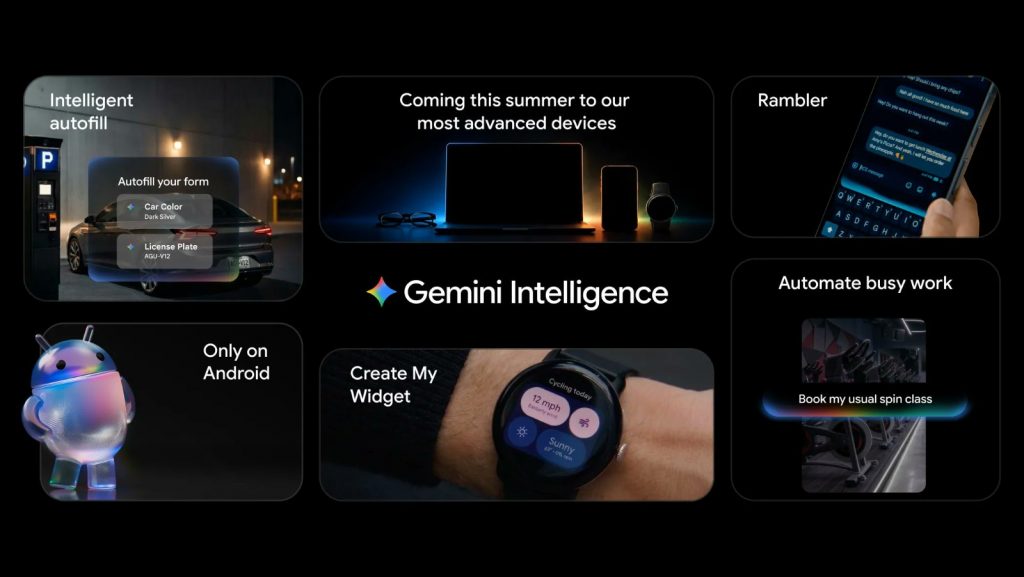
Google has officially introduced Gemini Intelligence on Android, a new platform layer that embeds Gemini directly into the operating system across phones, watches, cars, glasses, and laptops. Rather than being a standalone app, Gemini Intelligence is designed to work proactively in the background — handling tasks, filling forms, and automating workflows without the user having to lift a finger. The rollout begins this summer with the latest Samsung Galaxy and Google Pixel devices, with broader device support coming later in the year.
Multi-Step Automation
One of the headline capabilities is app automation: Gemini can navigate multi-step tasks across third-party apps on behalf of the user. Whether it’s reserving a spot in a spin class, pulling a course syllabus from Gmail and adding textbooks to a shopping cart, or building a grocery delivery order from a photo of a handwritten list — Gemini handles the logistics while the user stays in control. Critically, Gemini only acts on command and halts once a task is complete, with a final confirmation left to the user. Live progress is tracked via notifications.
Smarter Browsing and Autofill
Starting late June, Gemini in Chrome on Android will assist with research, summarization, and content comparison across the web. It can also handle routine browser tasks like booking appointments or reserving parking. Separately, Google is upgrading its Autofill with Google feature by connecting it to Gemini’s Personal Intelligence — allowing the system to pull relevant data from connected apps to fill out complex forms automatically. The integration is strictly opt-in, and users can toggle it on or off at any time.
Rambler: Speak Naturally, Write Polished Text
A new Gboard feature called Rambler addresses one of the persistent awkwardness of voice-to-text: the gap between how we speak and how we want to write. Rambler lets users speak naturally — filler words and all — and converts it into a clean, concise message. Audio is only used for real-time transcription and is not stored. Notably, Rambler is built for multilingual communication, capable of handling mixed-language input — such as English and Hindi blended together — and rendering the output coherently in context.
Custom Widgets with Generative UI
Gemini Intelligence introduces Create My Widget, a feature that lets users build entirely custom home screen widgets using natural language prompts. A meal prepper can ask for weekly high-protein recipe suggestions; a cyclist can request a weather widget showing only wind speed and rain. The feature works both on Android phones and Wear OS watches, and represents Google’s first move into what it describes as generative UI — interfaces built on demand rather than pre-designed.
Googlebook: Gemini Comes to Laptops
Google is also using the Gemini Intelligence platform as the foundation for a new laptop category. The Googlebook, built in partnership with Acer, ASUS, Dell, HP, and Lenovo, merges Android’s app ecosystem with Chrome’s browser into a single device designed from the ground up for AI. The most distinctive feature is Magic Pointer — developed with Google DeepMind — which animates the cursor with Gemini-powered contextual suggestions as the user moves it around the screen. The Googlebook also supports Create My Widget, allowing Gemini to pull from Gmail, Calendar, and the web to build personalized desktop dashboards. A Quick Access feature lets users browse and insert files from their phone directly in the laptop’s file browser without any transfers. Googlebooks are expected to ship this fall.
The Bigger Picture
Google’s push with Gemini Intelligence reflects a broader strategic shift: Android is no longer just an operating system — it’s becoming what Google calls an intelligence system. Rather than competing on model benchmarks alone, Google is betting on deep platform integration as its edge. With Gemini embedded across devices, apps, browsers, and now laptops, the company is positioning itself to make AI a seamless layer of everyday computing rather than a tool users have to consciously invoke.