It turns out that advances in AI can carry over quite neatly to advances in robotics.
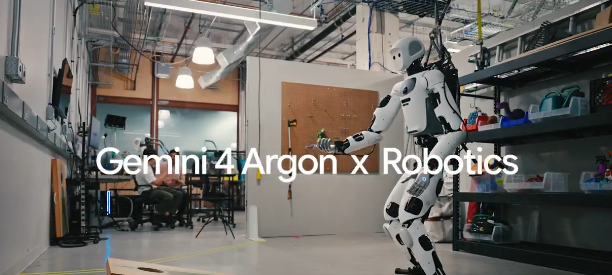
Google has announced that its Gemini 4 Argon model is being extended into the robotics stack, with the company positioning it as a general-purpose physical reasoning system that can control robots, build physics simulations, label robot training data, and improve itself through trial and error.
The company says Argon scores 87% on the Embodied Reasoning (ERQA) benchmark, which tests a model’s ability to solve physical and spatial problems in 3D environments — putting it ahead of every other frontier model on that test.
From chatbot to robot operator
Rather than release a single narrow robotics model, Google is pitching Argon as usable across the entire robotics lifecycle. The blog post lays out four broad categories where developers can apply it:
Robot control: In one demonstration, Argon directs a Boston Dynamics Spot quadruped to pick up soda cans and step on a foot-pedal trash bin to dispose of them, first rehearsing the movements in a MuJoCo physics simulation before attempting them on the real robot. In another, it operates a simple robotic arm using only a wrist camera feed and a coordinate system it reasons about turn by turn, nudging a fallen mug upright and tucking a napkin inside it.
Real2Sim: Argon can take a video of a real robot, a human doing a task on camera, or even a hand-drawn paper sketch, and turn it into a physically accurate simulation. In one example, a sketch of a humanoid throwing a ball at a stack of boxes becomes a fully simulated, physics-verified throwing motion rendered in Blender.
Physical understanding: The model can also watch footage of a robot performing a task and generate detailed, multi-level labels describing what happened — including spotting failures like fumbles, stalled grasps, or wasted motion, which Google says can be used to clean up robot training data.
Self-improvement: Perhaps most notably, Argon is shown autonomously generating thousands of simulated training episodes from a single photo of a tabletop, which Google says boosted a real robot’s task success rate from 56% to 75% while cutting completion time from 35 seconds to 24 seconds. In a separate demo, a robotic arm improves its own pick-and-place speed across several attempts by reviewing its own footage and diagnosing its mistakes.
Rollout
Gemini 4 Argon is available starting now through Google AI Studio and the Gemini API for subscribers on paid tiers, as well as inside Google’s agentic coding environment, Antigravity, where developers can select it as their active model for complex planning and multi-agent tasks.
The robotics push lands against the backdrop of a broader slide in Gemini’s standing: Gemini’s own traffic share has fallen for four straight months as ChatGPT claws back ground, and on pure intelligence benchmarks, Argon has recently found itself overtaken by rivals like Muse Wonder on the Artificial Analysis Intelligence Index. Robotics may be an area where Google is betting it can carve out a clearer lead — especially as the rest of the industry piles into the space, with humanoid robots already setting human-beating records at China’s World Humanoid Robot Games and AI models being benchmarked on tasks as physical as driving a real car through a course.