Microsoft CEO Satya Nadella had once said that they’d make Google dance, and Google sure seems to be dancing.
In February 2023, days after Microsoft unveiled an AI-powered Bing built on OpenAI technology, Nadella gave an interview to The Verge that quickly became one of the most quoted moments in the AI era. He acknowledged Google as the “800-pound gorilla” of search, but declared his ambitions plainly: “I hope that, with our innovation, they will definitely want to come out and show that they can dance. And I want people to know that we made them dance.” The context was a genuine inflection point — ChatGPT had launched just months earlier, Google was reportedly in “code red,” and there was a real, credible belief that conversational AI would gut the search business that Alphabet was built on.
That thesis didn’t age well for the bears.
At the time of Nadella’s comment, GOOG traded at around $94 per share. As of April 29, 2026, the stock closed at $347.31 — a gain of over 188% from that February low. Alphabet’s market cap now sits at roughly $4.28 trillion, making it one of the most valuable companies on Earth. The fear that AI would cannibalize Google’s search business has not only failed to materialize — search queries are at an all-time high, up 19% year-over-year in Q1 2026.
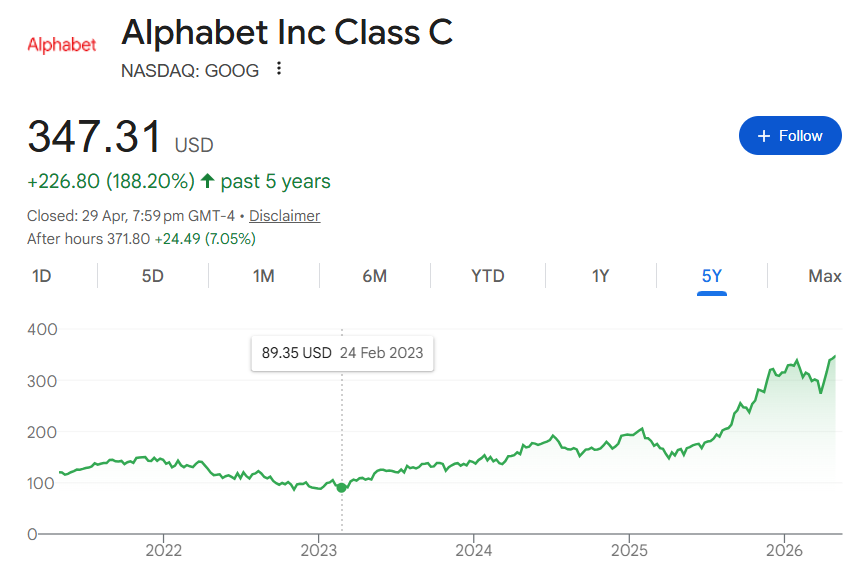
Google Learned to Dance
The irony is that Nadella’s taunt may have been directionally correct, just not in the way he intended. Microsoft’s Bing bet didn’t dethrone Google — it forced Google to move faster than it otherwise might have. The competitive pressure accelerated Google’s AI roadmap dramatically, leading to a series of product releases that have steadily rebuilt its AI credibility.
A symbolic marker of that resurgence: the most searched term on Google in 2025 was “Gemini” — Google’s own AI platform. The technology that was supposed to kill search was instead being discovered through search.
In the generative AI product race, Gemini has gone from a distant afterthought to a genuine competitor. Gemini’s traffic share crossed 20% for the first time in January 2026, a milestone no other platform had reached since ChatGPT’s emergence. In February 2026, Gemini surpassed ChatGPT in app downloads — 101 million to 65 million — driven by deep integration across Android devices, Google Workspace, and the broader Google ecosystem. On the model side, Gemini 3.1 Pro topped 13 of 16 industry benchmarks, outperforming OpenAI’s GPT-5.2 and Anthropic’s Claude Opus 4.6 on most of them.
The Numbers Tell the Story
Alphabet’s Q1 2026 results, reported on April 29, put an exclamation mark on the turnaround. Revenue grew 20% year-over-year — the fastest pace since 2022. Net income came in at $62.57 billion, up 81% from the prior year. Google Cloud, the division housing most of the company’s AI services, grew 63% and beat Wall Street estimates with $20 billion in quarterly revenue. The company now carries a $460 billion cloud backlog. Alphabet also raised its full-year capex guidance to as much as $190 billion, a signal of how aggressively it is betting on AI infrastructure.
The market’s reaction was immediate. After-hours trading on April 29 pushed the stock up another 7%, to $371.80.
Bing Is Still Bing
For all of Microsoft’s early momentum, the Bing story never quite matched the hype. The AI-enhanced Bing generated enormous press coverage in early 2023 but failed to meaningfully shift search market share. Google’s dominance in search — built on distribution advantages across Android, Chrome, and billions of daily users — proved far more durable than critics anticipated. As Nadella himself later admitted in a 2023 antitrust trial, with considerably less swagger: “You get up in the morning, you brush your teeth, and you search on Google.”
Meanwhile, OpenAI — Microsoft’s key AI partner — has increasingly moved to compete with Microsoft directly, including ending its exclusivity arrangement with the company’s cloud infrastructure. The alliance that was supposed to corner the AI market has grown complicated.
What Actually Happened
The AI disruption story of 2023 turned out to be less about Google being displaced and more about the entire category expanding. AI didn’t shrink the search pie — it grew it. Google integrated AI Overviews directly into search results, turning a potential threat into a product enhancement. Gemini, once a laggard, grew traffic 391% year-over-year in November 2025 and is now a genuine second force in the generative AI market.
Satya Nadella wanted to make Google dance. Google is dancing — just on a much bigger stage, with a much higher valuation, and with moves nobody saw coming in February 2023.