One never counts Elon Musk, and Grok 4.5 seems to be yet another example of why.
SpaceXAI’s newest model Grok 4.5 has landed at fourth place on the Artificial Analysis Intelligence Index, scoring 54 and trailing only Claude Fable 5, GPT-5.5, and Claude Opus 4.8. It’s a 16-point jump from Grok 4.3, which had scored a comparatively modest 38 on the same index, and it puts xAI ahead of every open-weights model on the market along with Google’s entire Gemini lineup, including Gemini 3.5 Flash and Gemini 3.1 Pro Preview.
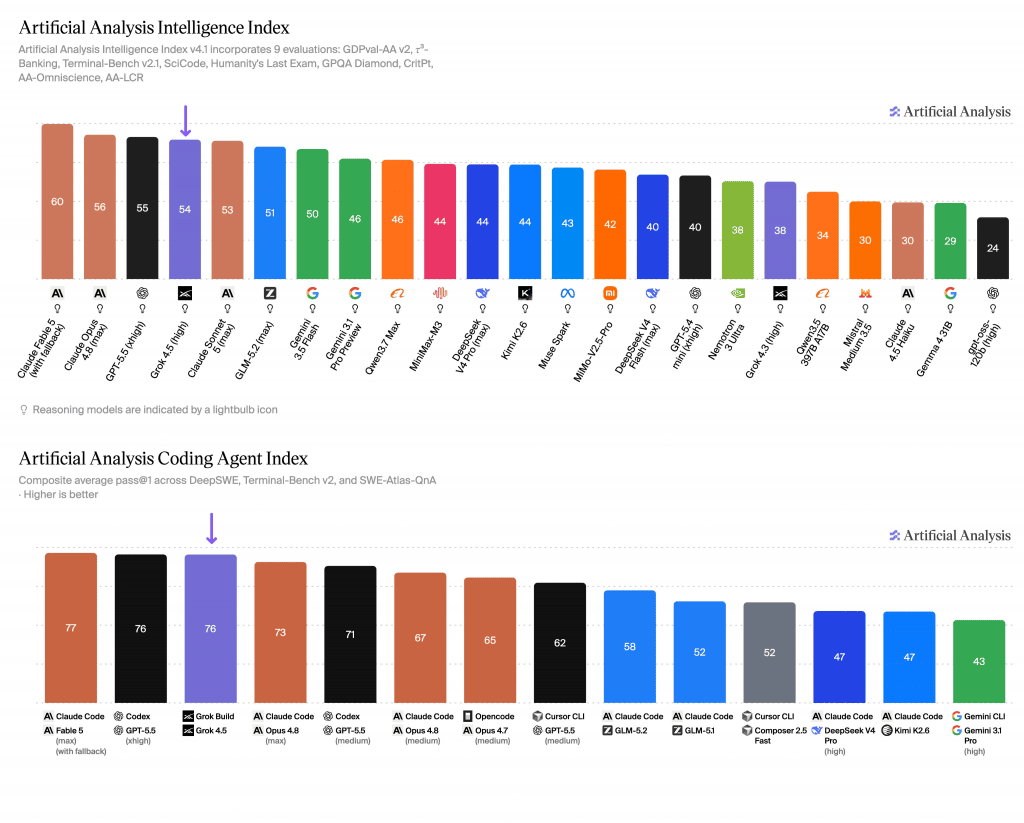
The jump is unusual in scale. Model updates at the frontier tend to move the needle by a handful of points at a time. Grok 4.5 nearly doubled its predecessor’s standing on the index, and did so while xAI was simultaneously working through a wave of co-founder departures and a public restructuring that Musk had described as deliberate. Whatever the internal turbulence, the model pipeline clearly kept moving.
Agentic work is where it separates itself
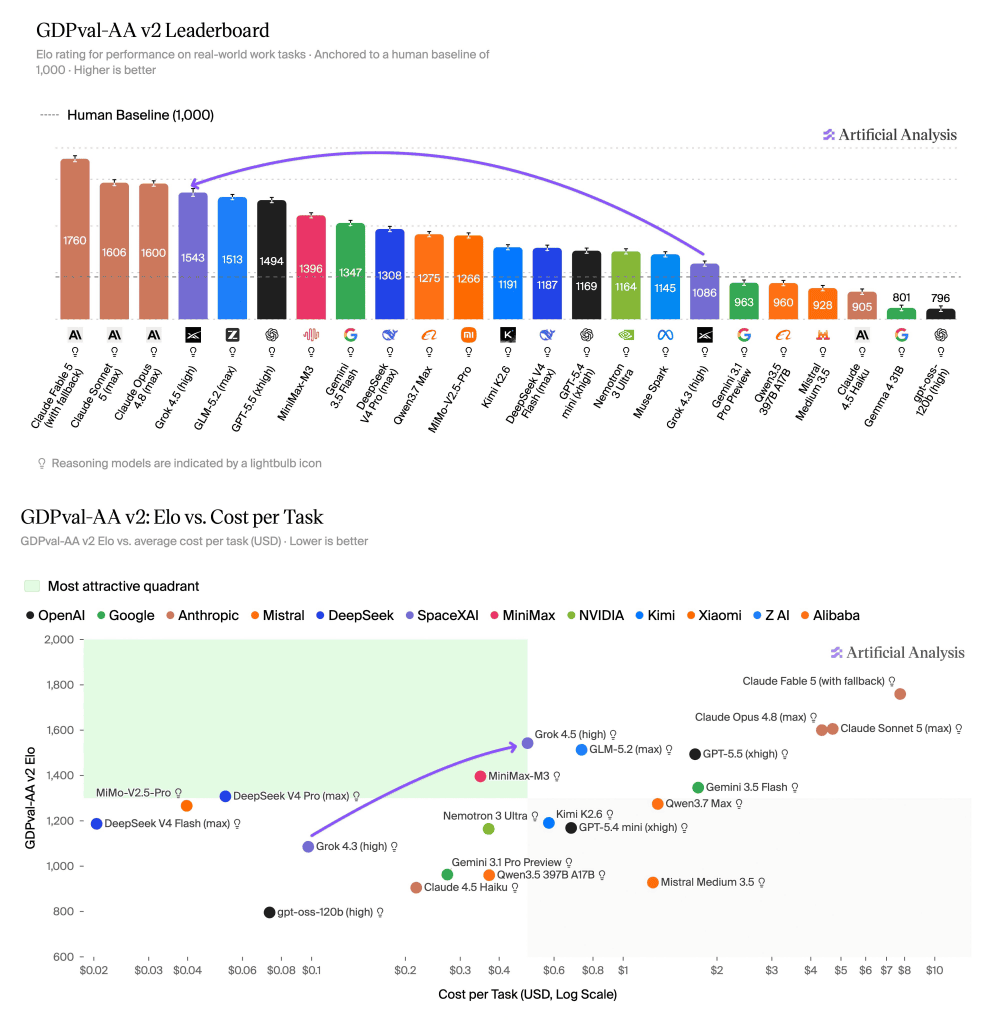
The real story with Grok 4.5 isn’t the headline intelligence number, it’s what happens when the model is asked to actually do things rather than answer questions. On GDPval-AA v2, Artificial Analysis’s benchmark for real-world knowledge work anchored to a human baseline of 1,000, Grok 4.5 scored an Elo of 1543, sitting between Claude Opus 4.8 at 1600 and GLM-5.2 at 1513, and clear of GPT-5.5 at 1494. On τ³-Banking, a test of agentic customer service in banking scenarios, Grok 4.5 posted the single highest score of any model measured, at 33%, edging out GPT-5.5 (xhigh) at 31%.
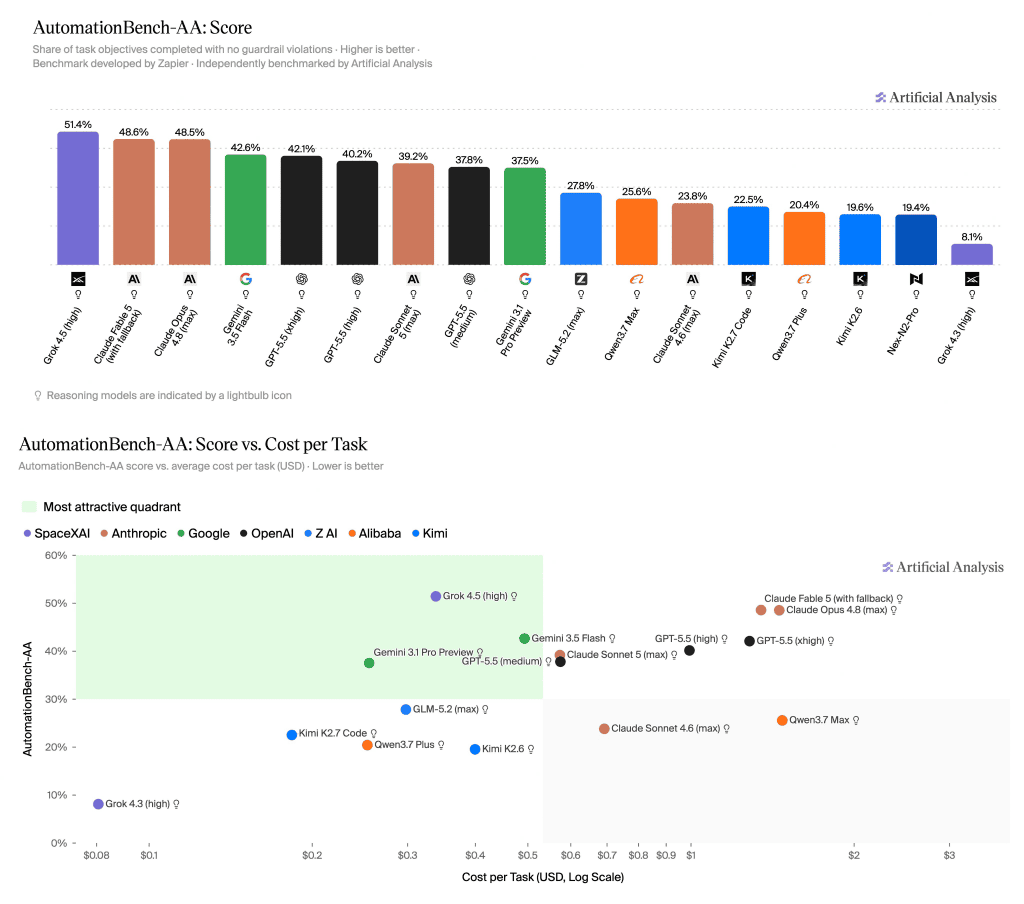
Grok 4.5 also topped AutomationBench-AA, an independent leaderboard built on Zapier’s benchmark for testing whether agents can run real SaaS workflows without breaking business rules. It completed 51.4% of task objectives cleanly, ahead of Claude Fable 5 at 48.6% and Claude Opus 4.8 at 48.5%, making it the first model to clear the halfway mark on that particular test. It got there while using roughly 8,000 output tokens per task, under a quarter of what Opus 4.8 needed, and resolving tasks in about 16 turns by batching more tool calls per turn than any other leading model.
The price tag is doing a lot of the work
None of this would be quite as notable if Grok 4.5 cost what its rivals cost. It doesn’t. The model runs at $0.31 per task on the Intelligence Index, cheaper than GLM-5.2 and Kimi K2.6, and roughly a fifth of what Claude Sonnet 5 (max) costs for a lower score. On GDPval-AA v2, Grok 4.5’s cost per task comes in at $0.49, nearly 90% below the models sitting above it on the leaderboard. On AutomationBench-AA, it costs $0.34 per task against $1.35 for Claude Fable 5 and $1.46 for Claude Opus 4.8.
Some of that gap comes down to sticker pricing. Grok 4.5 is listed at $2 per million input tokens and $6 per million output tokens, with cache hits discounted to $0.50, a headline rate more than 60% below Claude Opus 4.8 and GPT-5.5. But pricing alone doesn’t explain the full spread. xAI’s model also appears to be unusually frugal with tokens, using around 14,000 output tokens per Intelligence Index task, over 60% less than Opus 4.8 burns through for comparable work.
As a coding agent running inside Grok Build, Grok 4.5 scored 76 on the Artificial Analysis Coding Agent Index, tied with GPT-5.5 (xhigh) running in Codex and just a point behind Claude Fable 5 (max) in Claude Code. The efficiency gap widened further here. A task in Grok Build costs $2.49, compared to $11.80 for Fable 5 in Claude Code and $5.07 for GPT-5.5 in Codex, with Grok 4.5 needing just 1.9 million tokens per task against 7.2 million for Fable 5 and 6.2 million for GPT-5.5.
Bigger, but not necessarily more careful
Musk has said Grok 4.5 is roughly three times the size of Grok 4.3, landing at 1.5 trillion parameters, and the scaling shows up unevenly across metrics. On AA-Omniscience, Artificial Analysis’s factuality index, Grok 4.5 scored 26, up from 18 for Grok 4.3, driven by an accuracy jump from 35% to 52%. But its hallucination rate also climbed, from 25% to 54%, a pattern that tends to show up when larger models become more confident without becoming proportionally more careful about what they don’t know. On AutomationBench-AA, Grok 4.5 also triggered more guardrail violations per task than Claude Opus 4.8 or Gemini 3.5 Flash, even as it completed more of the underlying objectives.
The context window shrank too, from Grok 4.3’s 1 million tokens down to 500,000, though the model retains configurable reasoning depth and vision input.
Where this leaves xAI
Grok 4.3, when it launched earlier this year, trailed GPT-5.5 and Claude Opus 4.7 by a wide enough margin that xAI’s position on the frontier looked genuinely uncertain, a far cry from the moment Grok 4 briefly topped multiple leaderboards after its mid-2025 release. Grok 4.5 changes that calculus considerably. It’s now sitting on the Pareto frontier across every major agentic evaluation Artificial Analysis runs, which is a specific way of saying there’s no model that beats it on both performance and cost at the same time in that category.
Anthropic and OpenAI still hold the top three spots on the general intelligence index, and that isn’t nothing. But the distance between fourth place and first has closed considerably, and it closed at a fraction of the price. For a company whose last major release largely maintained the status quo, that’s a fairly significant reversal of direction.