AI continues to disrupt all manner of new industries.
A new chart making the rounds, built on data from a fresh NBER working paper by Cornell’s Imke Reimers and the University of Minnesota’s Joel Waldfogel, lays out just how fast AI has taken over Amazon’s ebook shelves. Monthly ebook releases on Amazon sat around 100,000 a month through 2020, 2021 and most of 2022. Then ChatGPT showed up in November 2022, and the line on the chart simply stopped behaving like it used to. By late 2025, monthly releases had crossed 300,000, roughly tripling in three years, and the bulk of that new volume is coming from books that didn’t exist in any meaningful sense before a large language model wrote them.
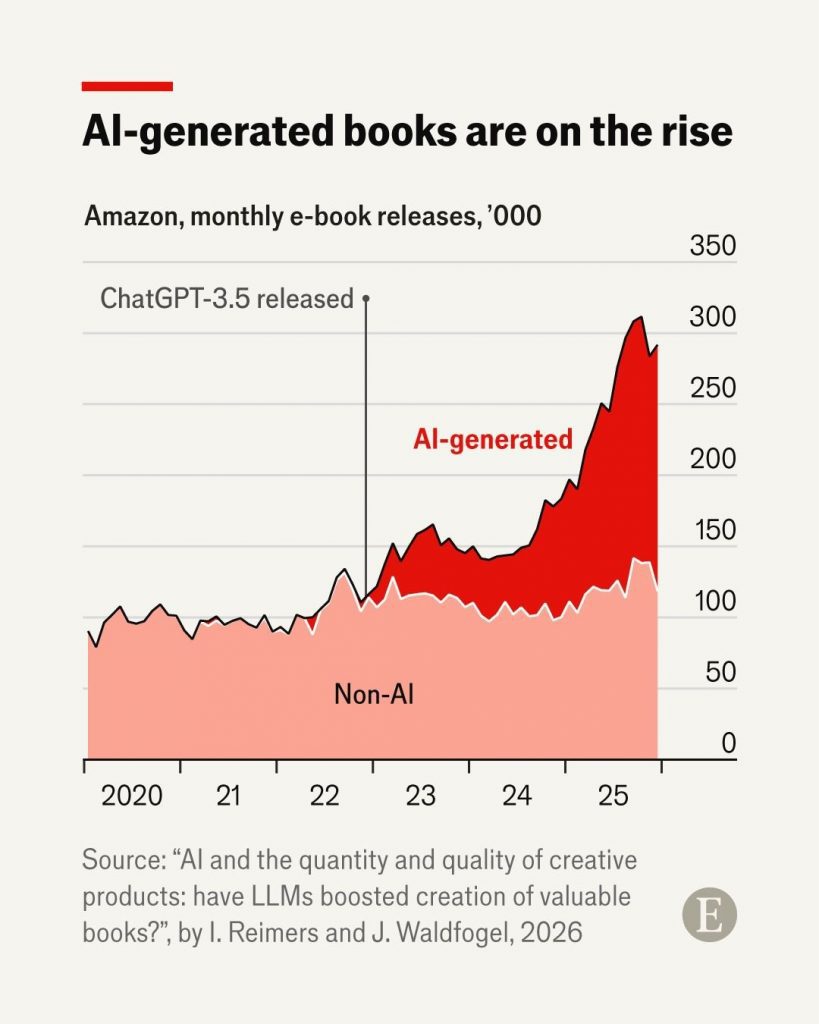
The researchers ran AI detection on more than 50,000 randomly sampled titles to figure out exactly how much of this growth is AI. Detected AI content was close to zero through 2022, climbed to 30 percent of releases in 2023, hit 45 percent in 2024, and crossed the halfway mark in 2025 before continuing on to surpass 60 percent by the end of the end of the year. So we now a market where most new titles are now AI-assisted in some form.
What makes the paper worth reading past the headline number is what it finds about quality. AI-flagged books get a lot less reader engagement than human-written ones — fewer ratings, lower star scores, the works. But that gap has been narrowing steadily since 2023, and the researchers attribute most of the human-AI quality difference to who is using the tool rather than the tool itself. Less experienced and previously lower-performing authors are the ones reaching for AI most often, which means the comparison was never really AI versus skilled writers — it’s AI-assisted beginners versus everyone else.
There’s a sharper twist buried in the welfare math. Running a nested logit demand model, Reimers and Waldfogel calculate that AI-generated books actually raised consumer surplus by less than 1 percent in 2023, by over 3 percent in 2024, and by about 7 percent in 2025. Flooding the market with mediocre books would normally be a net negative for readers. But because the dispersion in quality is wide enough that some AI titles still land in the right tail — genuinely good enough to find an audience — the sheer increase in shots on goal outweighs the drop in average quality. It’s the same logic that has shown up in other corners of AI-generated output, where a surge in volume doesn’t automatically translate into a surge in usable results, but a few winners can still make the overall flood worthwhile.
The most reassuring finding for anyone worried about AI wiping out professional writers is that it hasn’t. Authors who were already publishing before LLMs arrived haven’t been displaced — their output has actually gone up, especially through 2025, and they continue to account for most of the higher-quality releases on the platform. The disruption is concentrated almost entirely among new entrants, a wave of first-time authors who showed up because AI made publishing a book cheap enough to attempt on a whim.
Survey data backs up what the detection numbers show. A BookBub poll of over 1,200 self-published authors from April 2025 found 45 percent already using AI to assist with their writing, 48 percent not using it and with no plans to, and 7 percent on the fence. Among the holdouts, more than three-quarters called AI use in writing unethical. Among adopters, ChatGPT was the dominant tool, used by 85 percent of them. A later Publishers Weekly survey from November 2025 put the number even higher, with 61 percent of writers overall and 42 percent of fiction authors specifically reporting AI tool use. There’s now an entire cottage industry built around this — sites promising a publish-ready, human-sounding book in under half an hour — and some writers have built genuinely profitable careers churning out hundreds of AI-assisted titles a year.
None of this is unique to publishing. The same tension between volume and trust has played out everywhere AI text generation has touched professional output recently, including the string of consulting firms forced to pull AI-assisted reports after their citations turned out to be fabricated. Amazon’s Kindle store just happens to be where the pattern shows up first and most visibly, because self-publishing never had gatekeepers to begin with. What the Reimers-Waldfogel data suggests is that the wave isn’t slowing down, and the books written entirely by humans aren’t going away either — they’re just becoming a shrinking share of an ocean that keeps getting bigger.